Get Full Government Meeting Transcripts, Videos, & Alerts Forever!
Get email alerts on the Traffic Calming topic
No spam. Unsubscribe anytime.
Lancaster County reviews traffic-calming program after studies show mixed results
Summary
County staff updated Lancaster County Council on a traffic-calming program created by ordinance in 2021, reporting study counts, results from installed speed humps and alternatives for neighborhoods where devices are not installed or roads are privately maintained.
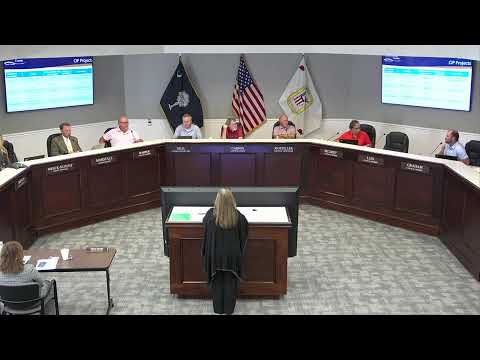
Lancaster County staff on Monday briefed County Council on the county’s traffic-calming policy, the number of neighborhood studies completed and results where devices have been installed.
The county adopted the traffic-calming ordinance on March 9, 2021, and resumed a more active program in late 2022. “In May ’24, we had had 25 studies,” Jeff Cato, county staff presenter, told council, and “a year later, now we have 35 studies completed.”
The policy uses an engineering standard—the 85th percentile speed—to decide whether physical measures such as speed humps or speed tables are warranted, staff said. Phil Leizer of KCI Technologies, the consultant who performs follow-up readings, said the first qualifying installation on Niven Road produced a 26% reduction in speeds among vehicles exceeding the posted limit. “We had 26% decrease in speeds,” Leizer said, and later added that the highest observed speeds after installation were closer to 30–35 mph versus 77 mph recorded before the humps.
Staff told council only a small share of studies qualify for physical devices under the policy. For sites that do not meet the threshold, staff said the county offers alternatives: targeted four-way stops, additional signage, guardrails, digital radar speed-feedback signs paid for and installed by homeowners associations using an encroachment permit, and coordination with the sheriff’s office for enforcement during identified peak periods.
Council members pressed staff on whether the county will consider requests for privately maintained subdivision roads. “Right now, we do not” accept requests for privately maintained roads, Cato said, adding the county is discussing a future policy to review privately maintained, public-right-of-way streets. County staff cautioned that using public funds on private-maintained roads would require a county-attorney review and likely written guidance.
Staff said of the three earlier qualifying locations, Niven Road and Rosemont Drive have had installations: Rosemont’s HOA installed speed humps and staff observed slower speeds near amenity areas, and Niven Road’s measures produced measurable reductions. Lakeview Landing passed the study but residents and the HOA did not reach agreement on device locations or funding, so no measures were installed there.
Leizer described how the county’s study reports show when speeding concentrates—days and hours—so neighborhoods can request focused sheriff’s enforcement rather than immediate physical measures. “What that can do is they can turn that around and give that to sheriff’s office,” he said.
Council members asked staff to continue reporting back on results after installations, and to present options for handling private roads if more residents request traffic-calming on streets that are privately maintained but built to county standards.
The presentation included staff recommendations to keep educating neighborhoods about alternatives, continue the practice of requiring HOAs or residents to fund installations, and prepare additional guidance for private-road inquiries.
Council asked that future updates include counts of pending requests and follow-up speed studies for installed measures.