Get Full Government Meeting Transcripts, Videos, & Alerts Forever!
Get email alerts on the Opioid Settlement Funding topic
No spam. Unsubscribe anytime.
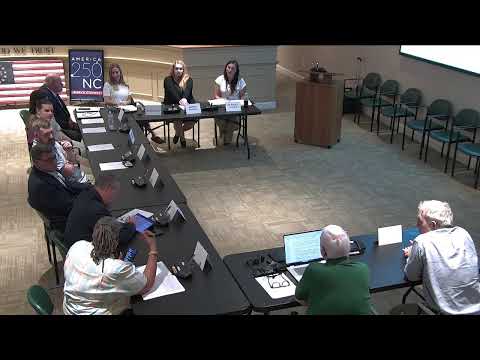
Burke County advisory group seeks $22,000 for peer outreach, approves $8,400 for peer-support training
Summary
At a Burke County opioid settlement meeting, staff reported on settlement funds and program rollouts, the peer network (PPE) requested renewed funding and the group approved $8,400 to cover 24 peer-support training slots.
Burke County opioid settlement staff reported progress on local use of opioid settlement funds and moved to refill a community peer-support grant while approving a separate training payment for peer-support certification.
At a meeting of the county's opioid settlement advisory group, Dr. Katie Samuels, the county opioid settlement program coordinator, updated members on additional settlement agreements, local spending rules and implementation steps. Samuels said North Carolina's original memorandum of agreement (NCMOA) channels 85% of settlement dollars to counties and municipalities and that recent sign-ons — including pending Purdue/Sackler bankruptcy settlement participation and a SAAF 3 sign-on — would add money to Burke County’s allocation. Samuels said the county manager had already completed several sign-on actions to access the funds.
The update outlined program activity paid for with settlement funds: an independent opioid settlement office, naloxone distribution, a community navigator position, hiring steps for a port team (peer support and community paramedic roles), and three provider contracts that have begun hiring and drawing startup funds. "We have distributed over a thousand naloxone kits across the county," Samuels said, noting a new vendor price of $22.22 per naloxone kit versus previous costs near $32–$33.
Brandy Greer, Burke County opioid response deputy director and a longtime peer support worker, described the peers-partnering-for-excellence (PPE) network's outreach and a poster-and-tear-off resource campaign that places crisis and treatment contacts in jails, probation offices, schools, treatment centers and public events. "Naloxone saves lives, but more than that, it gives people a second chance," Greer said, summarizing the program's rationale and the group's role in trainings, outreach and rapid response after the hurricane when state supply chains were delayed.
Cognitive Connection CEO Julie Walker and Burke County Recovery Court (BCRC) staff reviewed the county’s recovery court model and outcomes. Taylor Setzer, BCRC coordinator, outlined the court’s eligibility (nonviolent, substance-involved felony or misdemeanor offenders on active probation), program length (typically one to two years) and a mix of incentives and sanctions used to support recovery and compliance. Peer support staff and graduates presented individual success stories: Lisa Wentworth highlighted participants who regained custody and employment, and Christopher Osworth, a BCRC graduate now working as a peer, said, "Recovery court saved my life," describing years of substance use and his path to recovery and employment through the program.
During final business, advisory members moved to recommend that the Burke County Board of Commissioners reinstate funding for the PPE group equal to the roughly $22,000 that remained from prior allocations; the advisory group approved that motion unanimously by raised hands. Members also approved a separate, immediate funding allocation to pay for up to 24 peer-support training slots (two remaining classes at $350 per seat) — a total of $8,400 — so prospective peer specialists can complete state certification this fall. The group asked staff to return in November with an itemized PPE budget and any additional resolutions needed to place funding on the commissioners' agenda.
The meeting closed after members agreed to follow up on provider interviews and implementation timelines for approved strategies. Samuels said staff expect to return with recommendations in November and to continue recruiting and onboarding providers funded under the approved strategies.