Get Full Government Meeting Transcripts, Videos, & Alerts Forever!
Get email alerts on the Election Data Retention topic
No spam. Unsubscribe anytime.
Witnesses urge JCAR to reject rule they say would remove e-poll book retention and limit local access
Summary
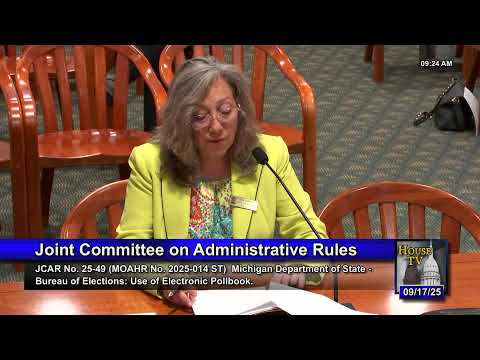
Public testimony at a Joint Committee on Administrative Rules meeting urged rejection of a proposed rule (discussed as 25-49/2025-14) that witnesses said would allow deletion or reclassification of electronic poll-book data, potentially conflicting with federal retention requirements and reducing local clerk and public access to records.
Multiple witnesses told the Joint Committee on Administrative Rules that a proposed election-related rule would eliminate an audit trail and violate federal retention requirements, urging the committee to reject the rule.
Shelly Lake testified that deleting certain election data is a federal felony and warned clerks not to follow any rule that would require deletion of e-poll book records. “Deleting election data is a felony, federally,” Lake said and urged the committee to “protect your clerks, and don't ask them to delete EPB data.”
Steve Fromm, who identified himself as a Salem Township resident, said the proposed change centralizes election data under the secretary of state and removes a form of civilian oversight. “We're going to change rules more to lessen our election integrity by removing yet another piece of the audit trail,” he said.
Representative Johnson read written testimony from Patrice Johnson of Pure Integrity Michigan Elections (PIME), who urged JCAR to reject the rule set she identified as 2025-14. The written testimony asserted that state Rule 168.48 would mandate deletion of electronic poll book data after seven days, while federal law requires retention of election records for 22 months under provisions tied to the Help America Vote Act (HAVA). The testimony argued the rule would expose clerks and taxpayers to criminal penalties under federal statute and risk loss of federal HAVA funding. It also cited Michigan Supreme Court precedent (Klonlara) to argue agencies cannot exceed statutory delegations.
Committee members asked witnesses to clarify technical and legal points. A committee member who identified themselves as an IT professional responded during the hearing that data copied to a central site are backed up, that multiple copies exist, and that the system has been publicly available for years. Senator Bair commented that data are copied to a central site and said they are available for public lookup, while opposing witnesses said transferring records to the secretary of state reduces local clerk custody and impedes civilian oversight.
Witnesses provided several quantitative details in testimony: federal law was cited as requiring 22 months of retention for election records; testimony claimed thumb-drive storage costs of roughly $5–$15; and witnesses said the July 15 public hearing for the rule had zero attendees. Witnesses also asserted the agency omitted required reports and regulatory-impact justification under Michigan administrative procedure requirements.
No formal committee vote on the rule was recorded at the meeting. Committee chair and members said any written testimony would be included in the meeting minutes.