Get Full Government Meeting Transcripts, Videos, & Alerts Forever!
Get email alerts on the Relinquishment topic
No spam. Unsubscribe anytime.
Laguna Beach town hall spotlights Caltrans relinquishment, undergrounding costs and liability
Summary
City Manager David Kiff and residents debated whether Laguna Beach should accept Caltransrelinquishment of Laguna Canyon Road, which includes a $14.4 million state of good repair payment; concerns centered on project costs, long-term liability, wildfire risk and whether transmission or distribution lines can feasibly be undergrounded.
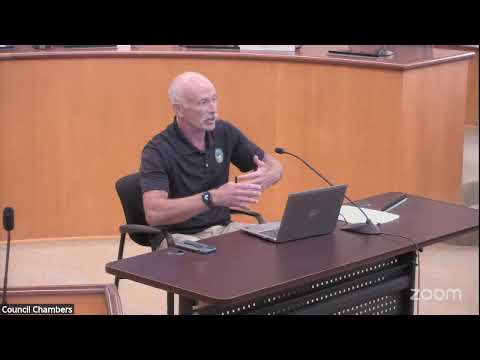
City Manager David Kiff laid out the citystaffposition and options Thursday at a town hall about Laguna Canyon Road, describing an ongoing Caltrans relinquishment process that would transfer ownership of the roadway to the City of Laguna Beach and include an estimated $14.4 million payment Caltrans says would bring the road to a "state of good repair." Kiff said staff is continuing to gather accident and claim data, insurance estimates and answers from utilities before recommending a path to the City Council.
The discussion centered on three linked questions: whether the city should accept Caltransrelinquishment, how (or whether) to underground utility lines along Laguna Canyon Road, and how to measure and pay for the safety and liability risks that could follow city ownership. Kiff told the meeting that the city would likely return to the council in October or November with a recommendation and that staff plans another town hall and more data collection in the meantime.
Kiff described the formal steps already underway: state authorization (completed in 2020), a city request to Caltrans (filed in 2024), and a negotiated calculation of the amount Caltrans says is needed to bring the road to its internal standards. "That amount is the amount you've seen discussed. It's about 14,400,000.0 that would be given to the city in this relinquishment," Kiff said. He emphasized that Caltransdefinition of "state of good repair" does not include the kinds of lane-width changes, traffic-calming measures or extensive undergrounding that many residents want.
Staff and multiple residents focused on cost and risk. Kiff referenced a 2020 HDR consultant estimate that placed the Protect and Connect packagewhich includes undergrounding, bikeways and roadway improvementsat roughly $144 million to $150 million in 2020 dollars, and noted that construction inflation since then would raise the current projected total. Kiff also cited the HDR figure that annual routine roadway maintenance would be on the order of $190,000 to $200,000; he said the city does not yet have reliable estimates for insurance premium increases or self-insured retention impacts if the city were to assume ownership.
Residents raised a range of concerns. Jacob Cherub, a Laguna Beach resident of more than 35 years, said the community has spent "many millions of dollars" already on studies and urged the city to engage higher-level legal and negotiating resources when dealing with Caltrans and utilities. "We need to have a big dog to represent us," Cherub said. George Weiss, another resident, pressed for better factual documentation of the safety and fire incidents cited in consultant work and staff reports, saying he and others had difficulty confirming the consultantlisted incidents in official records.
Others argued the opposite: Penelope Milne, president of CANDU (a canyon neighborhood group), urged residents to focus on verified facts. Milne pointed out that the staff report and HDR material are publicly posted and that some misunderstandings could be resolved by reading the reports. "When the people who own the wires say, 'we think it's best managed by undergrounding,' I think we should take that seriously," Milne said, referring to Southern California Edison (SCE) guidance discussed at the meeting.
Participants also debated what utility undergrounding would mean in practice. Kiff explained utility line types and costs: transmission lines (the highest-voltage circuits) are the most expensive and require large trenches and vaults; distribution lines are less costly to bury; cable and phone lines are easiest to combine in trenches. He said some transmission lines along the route may not have room for conventional trenching without affecting private property or open space, and that Caltrans has told staff it will not permit placing major utility trenches under the traveled roadway unless no feasible alternative exists.
The city manager described options staff is evaluating, including: (1) leaving the road under Caltrans control; (2) seeking Caltrans to pursue improvements while the state retains ownership; (3) accepting relinquishment and pursuing targeted safety improvements while seeking SCE targeted undergrounding (TUG) funds for utility work; or (4) accepting the road and funding undergrounding and other work from local funds. Kiff said staff sees off-ramps at several points in the process and that signing the state-of-good-repair letter is not an irreversible commitment.
Several residents urged that the city put the question to a vote. Drake Smith, an 18-year-old resident, said many residents feel decisions about large capital commitments should be resolved by a ballot measure, not only council action. Other residents echoed requests for broader notification and transparency: Gail Wade, president of the Laguna Canyon Conservancy, asked the city to mail or otherwise publicize materials so more residents know the issue is active; several speakers said they had not received notice of the town-hall event.
Kiff also addressed wildfire and safety questions. He showed consultant data indicating hundreds of injury or property-damage collisions in earlier study periods and cited a consultant calculation (using Caltrans statewide cost-per-accident averages) that produced an estimated annual liability exposure figure (HDR's published number of roughly $11 million per year). Kiff warned that the HDR approach uses statewide average valuation and that the city needs Caltrans claim-level data (20142024) to produce an accurate city-specific insurance and legal exposure estimate.
No formal votes or action were taken at the town hall. Kiff closed by restating next steps: the city will keep gathering Caltrans claim records and accident detail, consult insurance brokers, pursue conversations with SCE on TUG funding and covered conductors, prepare limited design options to show what Caltrans would approve, and return to the council in the fall with a recommendation. He invited public feedback in writing and said the city will hold at least one more public meeting and post the presentation and a Q&A on the city website.
Ending: The meeting made clear there is no consensus among residents about relinquishment or undergrounding and that the staff and council still lack key data on costs and insurer exposure. City staff described a deliberate, multi-step process and emphasized additional work before any council decision. Residents asked for fuller documentation, broader public notice and, in several cases, a public vote if the council moves toward a large capital commitment.