Get Full Government Meeting Transcripts, Videos, & Alerts Forever!
Get email alerts on the Public Safety Drones topic
No spam. Unsubscribe anytime.
Syracuse committee asks police to add privacy safeguards to drone-as-first-responder pilot
Summary
The Syracuse City Council Public Safety Committee asked the police chief to revise the department's Drone-as-First-Responder pilot policy to add supervisor approval, clearer privacy language, restrictions on protest monitoring, retention details and public reporting; the committee will reconsider the policy in two weeks.
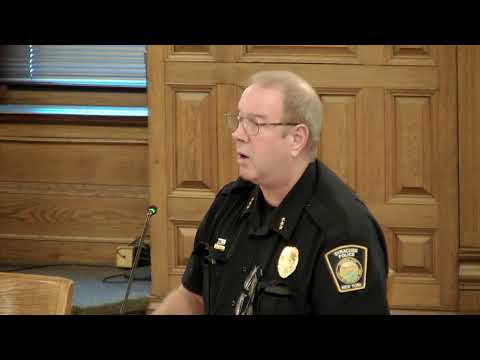
On Oct. 25, 2025, the Syracuse City Council Public Safety Committee asked Syracuse Police leadership to revise its Drone-as-First-Responder (DFR) pilot policy to include additional privacy and oversight safeguards and return the updated policy to the committee within two weeks.
Committee members said they support the department’s goal of faster situational awareness but want clearer limits on when drones will record, who can authorize flights, how long recordings are retained and how the public can review or contest footage. The police chief and department staff agreed to add changes to the existing policy and to publish a public dashboard showing flight frequency, patterns and call types before the pilot launches.
Police officials told the committee the department has already used drones in prior non-DFR operations — including tracking a man with a rifle to a mall, monitoring a brush fire in the Skunk City area and helping firefighters direct water at the Maria Regina fire — and said those uses saved time and reduced risk. The chief said the DFR pilot’s stated purposes are to improve response to calls for service, enhance efficient use of resources, provide real-time situational awareness and help de-escalate incidents.
Officials proposed several written changes to the department’s UAS policy (referred to in the discussion by section numbers 606.6 and 606.7). Among the promised revisions: require supervisor approval (at the level of lieutenant or captain, or a sergeant who holds an FAA Part 107 remote pilot certificate) before launching a drone as a first responder; add explicit language prohibiting DFR use for random patrols; and add a specific prohibition on using the DFR classification to monitor protests “absent an articulable danger to safety.” “Drones will not be used to monitor protest activities, absent an articulable danger to safety,” the chief said during the meeting.
Committee members pressed for stronger, explicit privacy language after noting that an older policy draft included a stronger prohibition on recording locations where people reasonably expect privacy (for example, residents’ yards) but the newer draft uses a more general phrasing. The chief said the department did not intend to “water down” privacy protections and agreed staff would consider restoring or strengthening language consistent with national best practices and CALEA guidance.
The committee also discussed data storage and access. Technology staff said drone footage will be uploaded to Axon’s evidence.com platform and follow the department’s existing body-worn camera-retention rules. Department witnesses gave different examples in the meeting: one said non-evidentiary footage is “generally” retained for 30 days unless turned into evidence, while another noted some routine recordings (for example, a parking-ticket capture) are retained for a minimum of three years per the department’s retention settings. The chief said footage that becomes evidence in a criminal matter would be retained according to legal requirements. Committee members asked the department to provide a written retention schedule.
On access and oversight, staff said the civilian review board (CRB) and the state attorney general’s office have been granted access to evidence.com in the past and that specific external access requires explicit department permission or a court order or FOIL request. The chief and staff agreed to add a clear description of who may access footage, under what circumstances, and what redaction tools the city will use to protect uninvolved bystanders. “We can redact — blur faces and license plates — before release when required,” the chief said.
Committee members asked for proactive internal review mechanisms similar to the department’s body-worn-camera auditing practice. Staff said periodic and random reviews of drone flights are already done and that the department will add language to require a formal random-audit program in writing.
On authorization and deployment, the department recommended starting the pilot with one drone station (covering the city) and expanding to a goal of five stations if the pilot proves successful. Possible launch sites discussed included the Woodlawn reservoir area or the new public safety building; no final siting decision was made. Staff said drones would typically reach scenes faster than patrol units and could be dispatched simultaneously with officers when appropriate.
The committee also sought limits on surveillance in transit. Police said they are open to negotiating whether the footage recorded during a drone’s flight from point A to point B must be automatically retained or whether the retention window can be shortened; staff said keeping transit footage can be useful if citizens later complain that a flight looked at their property. The department said recording can be turned on and off and that operators generally position cameras forward while en route to avoid looking down unnecessarily.
Public concern was a consistent theme. Staff noted the department received about 141 public comments via a surveillance-technology working-group process and that a majority of those commenters opposed the DFR plan; the chief characterized that input as “unscientific” but acknowledged community reservations and described the pilot as an opportunity to build trust if the department adopts robust safeguards. The department also offered demonstrations (including a regional site visit and an on-line presentation recorded by Neighborhood Watch leader Tony Borrelli) and said it will expand public education and outreach.
The committee did not vote on the pilot. Instead it directed the chief to incorporate the discussed changes — including clearer privacy protections, written retention rules, named authorization levels for launches, a random review/audit mechanism and public reporting — and to return the revised policy to the committee for reconsideration in two weeks. The committee recorded that the matter will be revisited, giving the department time to supply the requested written clarifications.
Ending: The department and the committee agreed the pilot will be treated as a one-year program subject to review, and the committee instructed staff to provide the revised policy and the retention schedule before the next meeting. The committee emphasized that formal limits, published standards and accessible reporting will be required before the DFR pilot proceeds.