Get Full Government Meeting Transcripts, Videos, & Alerts Forever!
Get email alerts on the Zoning Text Amendments topic
No spam. Unsubscribe anytime.
Reno County planning staff presents broad zoning text amendments on cell towers, ADUs, manufactured homes and shipping containers
Summary
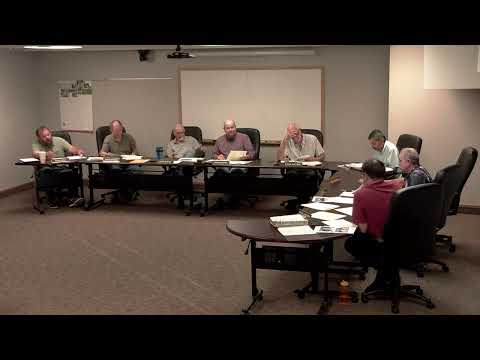
Reno County planning staff on Thursday presented a first-reading draft of zoning text amendments that would change how the county regulates telecommunication towers, accessory dwelling units, manufactured homes and shipping containers.
Reno County planning staff on Thursday presented a first-reading draft of zoning text amendments that would change how the county regulates telecommunication towers, accessory dwelling units (ADUs), manufactured homes and shipping containers.
The presentation, given to the Reno County Planning Commission by planning staffer Mark, focused on four topics that staff has grouped for revision. "Last month we had a discussion about future text amendments, and the board directed staff really to bring forth some further text amendments on cell towers, accessory dwelling units, manufactured homes," Mark said, and added that he included shipping-container language after finding inconsistent rules in the code.
Why it matters: the changes would alter how rural property owners and developers obtain permits for towers and related equipment, how and where a second dwelling can be located on a parcel, and how freight containers are treated in residential and agricultural districts. Several proposed changes are driven by state statute and federal rules that, according to staff, constrain local review of telecommunications projects.
Cell towers: staff summarized limits in state law on what counties may require for private telecommunication towers on private property, saying that many common review criteria have been precluded. "Reading this led me to the conclusion to perimeter our rights. I come up with essentially about 13 things that now we cannot review with cell towers," Mark told the commission. He said the county can still require certain technical, site-plan items including a 1:1 setback (the tower base must be at least the tower height from property lines), survey verification of distances, limited lighting (not exceeding FAA minimums), fencing around the lease area or tower base, driveway/safety location, and restrictions triggered by wetlands or floodplains.
Staff proposed permitting most communication towers by right (a zoning permit rather than a conditional-use public hearing) with clear, limited performance standards because state statute removes many topics from local discretion (for example, the county cannot require coverage maps, demand/need analyses, or force removal of an existing tower in most cases). Mark summarized expected local review items as "setbacks, lighting that's not required by the FAA, fencing, driveway location, and maybe location on the property if it's in a wetland or floodplain." He also proposed requiring a lease or similar evidence that the property owner and applicant have an arrangement covering removal and site restoration if a tower is abandoned.
Temporary towers (cell-on-wheels): staff proposed that temporary towers be allowed on a zoning lot for six months from permit issuance, with up to one six-month renewal. After 12 months, staff said the structure should be treated as permanent and must comply with the permanent-installation setback and fencing requirements, or the operator should reapply for a permit that treats the structure as permanent.
Equipment buildings and accessory structures: staff noted that towers are being proposed as a principal use permitted by right, which raised questions about accessory equipment buildings. Under existing county permitting, any building or structure above a small threshold (a 120-square-foot building or larger) requires a permit. Commissioners asked how large an equipment shelter could be by right; staff and members discussed using a conservative threshold (board participants suggested 400 square feet) beyond which an accessory building would require conditional-use review to prevent operators from building large commercial shops under the guise of tower-related equipment. Mark said he would research prior applications and propose a specific size threshold.
Manufactured homes: staff proposed simplifying language by treating single-wide and double-wide units uniformly as "manufactured homes" where allowed, and confirming the county's existing restriction that homes built before 1994 (pre-HUD standard) are treated differently. The draft would allow replacement of a previously permitted manufactured home without a conditional-use case if the applicant can show prior lawful use (for example, documentation of an older conditional-use permit or proof of removal within a set time). The commission discussed whether to keep design standards for "residential-design" manufactured homes; staff argued some standards duplicate building-code requirements.
Accessory dwelling units/additional dwellings: the draft text would permit a subsidiary dwelling on the same zoning lot as the principal house, subject to size limits and shared-utility requirements. Staff proposed either a percentage cap (50% of the primary residence) or a flat maximum (1,200 square feet); commissioners favored a straightforward maximum of 1,200 square feet and shared utilities/single address to reduce risks of de facto lot splits. Sanitation and public-works rules remain controlling: if an additional dwelling would exceed the capacity of an existing septic or well situation, applicants must comply with sanitation code and public-works requirements. Mark summarized that county sanitation now allows two homes on a single septic in some circumstances but emphasized that any new dwelling must meet sanitation standards before a permit is issued.
Shipping containers/freight containers: staff noted inconsistent language in the code that at times prohibited containers and at other times allowed them. The draft would allow freestanding intermodal shipping containers in agricultural districts for bona fide farm operations without a numeric limit; in residential zoning the draft proposed to limit freestanding containers for nonagricultural residential lots (staff suggested two as a starting point). Commissioners discussed whether containers incorporated into a larger, roofed building should be treated as conventional accessory buildings and therefore counted against accessory-building square footage caps; staff recommended revising definitions to distinguish freestanding shipping containers from structures that are built and roofed so they are treated as buildings for accessory-building calculations.
Next steps and board direction: commissioners and staff treated the draft as a first reading. Commissioners asked staff to clarify definitions (for example, distinguishing intermodal freight containers from semi-trailers), to specify which items would be subject to survey verification, to propose a concrete accessory-building size threshold for tower equipment (staff will research prior tower permit files), and to return with a revised yellow-line draft at the next meeting. Mark said he would clarify language about independent towers versus antennas mounted on existing structures and would refine the ADU, manufactured-home, and container provisions before the next review.
Meeting-level action: the commission approved the minutes from the Aug. 21 meeting at the start of the session. The planning staff said the proposed text changes would next go to the Board of County Commissioners for consideration after the Planning Commission completes its review.
The commission did not adopt any final ordinance or regulation at Thursday's session; staff described the package as a first-reading draft and the board asked for clarifications and additional drafting before a subsequent reading and formal action.
Staff and commissioners said they will continue to refine the draft and bring a cleaned-up version back to the commission in October for further reading and possible formal recommendation to the County Commission.