Lifetime Citizen Portal Access — AI Briefings, Alerts & Unlimited Follows
Douglas County updates pilot Land Protection Program; Kansas Land Trust advancing three projects
Loading...
Summary
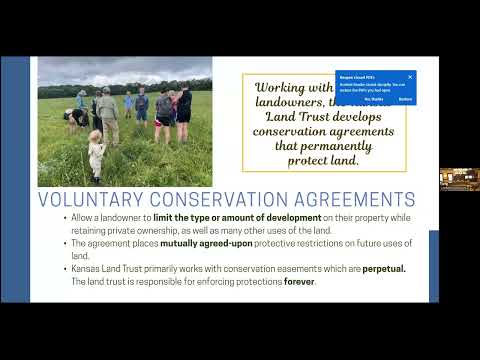
Douglas County commissioners on Sept. 10 heard an update on a pilot Land Protection Program and a partnership with the Kansas Land Trust to pursue voluntary conservation agreements on private property.
Douglas County commissioners on Sept. 10 heard an update on a pilot Land Protection Program and a partnership with the Kansas Land Trust to pursue voluntary conservation agreements on private property.
The program, which the county developed from its Open Space Plan, was seeded in July 2022 with a $2,780,000 allocation for open-space implementation from American Rescue Plan Act (ARPA) funds; the county subsequently formalized a $250,000 agreement with the Kansas Land Trust to launch the pilot. Caitlin Amerlin, the county’s heritage conservation coordinator, and Caitlin Stanley, executive director of the Kansas Land Trust, described outreach, applications and next steps.
Program details and why it matters
The Open Space Plan, adopted by Douglas County in April 2024 after a multi-year planning process, set criteria and priorities for conservation. Amerlin told commissioners the pilot was intended to help private landowners access conservation pathways and to implement parts of that plan. "The Land Protection Program is a pilot program ... designed to support voluntary conservation agreements and pathways for Douglas County landowners," Amerlin said.
Kansas Land Trust reported 16 inquiries in response to the pilot’s outreach and 8 eligible applications; staff identified 3 projects that "rose to the top," Stanley said. The projects were selected primarily for their "significant public benefits," as measured against the county’s open-space criteria.
The three projects under further review
- Watershed and recreation forest (southwest Douglas County): Stanley said the property involves five landowners and about 400 acres, of which roughly 270 acres are oak-hickory forest, and includes about 1.34 miles of stream bank proposed for protection. The selected landowners envision hiking trails and low-impact tent sites; Stanley said the public access component will be written into the conservation agreement. The Kansas Land Trust is exploring a Forest Legacy Program application with the Kansas Forest Service that could allow an eligible public entity to hold ownership while recreational features are managed by a partner.
- Conservation area near Clinton Lake: A landowner who previously lacked resources is pursuing protection of a high-quality remnant prairie adjacent to other protected lands. Stanley said the landowner plans to transfer ownership upon death to a conservation-aligned entity to allow research, education and low-impact public recreation; the site would serve as a habitat connector and may support future trails.
- Urban agriculture feasibility project (within the county's urban growth area): One application proposes protecting productive urban agricultural land to support beginning farmers. The Kansas Land Trust is evaluating whether a perpetual conservation easement is the appropriate legal tool or whether an alternative protective mechanism would better serve the land and surrounding uses. "We're pursuing the appropriate pathway for that, because the conservation easement may not be the appropriate pathway," Stanley said, noting environmental criteria and adjacent land uses shape the choice.
Due diligence and next steps
Stanley described standard due diligence steps under way: appraisals, title work, environmental site assessments and baseline documentation. She said the larger southwest corridor project will need additional funding. Amerlin said the easement or protection pathway is intended as the first step; subsequent partners and funding would be needed to realize public-access and programming goals.
Commissioner questions and county role
Commissioners pressed on what, if any, obligations the county assumes for long-term management and how protection interacts with zoning. Commissioner Kelly asked whether the county would change zoning or assume responsibilities for recreational features; Amerlin and Stanley said the county is not being asked to operate campgrounds or manage day-to-day public access and that, for this pilot, Kansas Land Trust-held easements are the likely structure. Commissioner Willie suggested involving Tanya Boyd, the county's zoning and codes director, earlier in project review so potential land-use conflicts and neighborhood context can be flagged sooner. Commissioner Reed and other commissioners emphasized the complexity of projects, the time required for relationship-building and the need for resources for restoration when land is not yet in a condition that meets conservation criteria.
Stanley said many applicants need restoration work before protection is feasible and that landowners were connected to state and federal programs when possible. Amerlin said the county is developing a local landowner resource guide to help people identify available technical and funding resources.
Public benefits, partners and funding
Speakers told commissioners the pilot has leveraged outside interest: the Kansas Forest Service and federal Forest Legacy Program could be partners on the southwest corridor; other potential funding includes federal conservation programs such as EQIP and state habitat programs. Commissioners noted the pilot is an early-stage effort and recommended the county retain a role in shaping selection or co-holding instruments if the program continues beyond the one-time pilot funding.
Votes at a glance
At the meeting's start the commission approved the consent agenda, items 1.1 and 1.2, by voice vote, "Aye," and the chair declared the motion passed 5-0. The Land Protection Program update was presented as information only and did not require a vote.
Where this stands
The Kansas Land Trust will continue appraisals, title reviews and environmental assessments on the three prioritized projects; Stanley said the trust would seek additional partners and funding for larger projects. County staff said they will continue to refine the pilot, produce a landowner resource guide and consider where county review or involvement is advisable as projects proceed.