Get Full Government Meeting Transcripts, Videos, & Alerts Forever!
Get email alerts on the Homelessness topic
No spam. Unsubscribe anytime.
East County engagement favors distributed shelter services; Multnomah County reviews Cook Plaza options
Summary
At a Multnomah County Board of Commissioners briefing, Commissioner Vince Jones Dixon on behalf of District 4 presented findings from a 90-day pause and community engagement about the planned East County Homeless Resource Center at Cook Plaza, saying the process showed East County residents want homeless services distributed across the district rather than concentrated in Rockwood and Gresham.
At a Multnomah County Board of Commissioners briefing, Commissioner Vince Jones Dixon on behalf of District 4 presented findings from a 90-day pause and community engagement about the planned East County Homeless Resource Center at Cook Plaza, saying the process showed East County residents want homeless services distributed across the district rather than concentrated in Rockwood and Gresham.
The engagement, led by Jones Dixon’s office with Homeless Services Department staff, involved listening sessions, a map exercise and a follow-up survey of 44 participants representing neighbors, city and county staff, service providers, faith-based organizations and people with lived experience. Ashley Graff, strategy and policy director for Commissioner Jones Dixon, summarized three main findings: priority location criteria (accessibility and safety, avoidance of concentrated siting in Gresham/Rockwood, caution about siting near schools, and siting where need exists); priority community impacts to mitigate (safety and livability concerns, credible and accountable operators); and priority service needs (family shelter, upstream prevention, navigation services and a visible day center).
Jones Dixon framed the engagement with a personal story about a neighbor he had met while serving on the Gresham City Council, saying, “This work must always be about people, not just programs or buildings, about dignity and about lasting change.” He said East County residents “recognize the urgent need for services, but there is a broad consensus: services must not be concentrated in one neighborhood.”
Homeless Services Department interim director Anna Plumb and management analyst Zach Kurl described the county’s prior investments and remaining budgeted funds associated with Cook Plaza. Plumb said the county purchased the property in 2022 for $3,000,000 and that “we have spent other funding as well,” including design, resilience-hub study work and seasonal severe-weather shelter improvements; she said spending to date is “over $4,000,000.” Plumb also told the board that Gresham, as the city, has not approved code or permits that would allow the “pod” or village-style shelter design envisioned for Cook Plaza, a potential permitting contingency if the project proceeds in place.
Zach Kurl said Multnomah County’s federal delegation secured an earmark of $1,670,000 for the project and that a HUD application was submitted in December 2024 with letters of support from East County jurisdictions and local nonprofits. Kurl said awardees must use earmark funds consistent with the appropriations language and that declining the earmark could affect future grant competitiveness; he added reporting requirements tied to the earmark extend through December 2025.
Staff described the Cook Plaza design intent as a village-style site with 28 “pods,” a day center for services and case management, and the potential to convert the upstairs into about 90 severe-weather shelter units in winter. Annual operating-cost estimates presented to the board were described in the meeting as about $1.63 million.
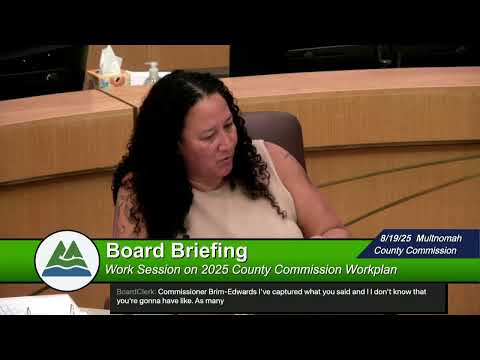
Board members pressed staff on the engagement findings, the data behind recommendations, and next steps. Commissioner Br[e]hm Edwards asked how the figure that “20% of families on the shelter wait list prefer Gresham” should be read; staff said not all callers on wait lists identified a preferred location and that 20% was the share that named Gresham specifically. Several commissioners cautioned that siting decisions require coordination with East County cities and that the county should avoid re-creating concentrated service burdens in one neighborhood.
Commissioners and staff discussed alternatives: if the board directs pursuing a similar facility at a different site, staff estimated a real-estate search could take about nine months and design/permitting/renovation could add 2–24 months, placing a comparable opening no earlier than FY 2028, as presented. If the board directs proceeding at Cook Plaza, staff said a program could reasonably launch in 2026, but that timeline is contingent on redesign and permitting, including any city code changes.
District 4’s recommendations to the board included: (1) take the engagement findings into account when siting services and explain to constituents when findings cannot be reflected; (2) avoid further concentrating services in Rockwood and Gresham and instead distribute services across East County; (3) prioritize family shelter, upstream prevention and navigation services; and (4) preserve budgetary resources allocated for East County if a decision is made to change the planned use of Cook Plaza. Graff said her team will reconvene a monthly East County leaders meeting to maintain direct community partnership going forward.
No formal board vote or binding decision was taken during the briefing. The board directed continued discussion and follow-up: clarifying data behind wait-list geography, reconciling city permitting constraints, reviewing how earmarked federal funds must be used, and returning with options and timelines that capture community priorities and budget implications.
Looking ahead, staff flagged three contingencies for the board’s consideration: city permitting for the village/pod shelter design; the HUD earmark’s reporting deadlines and restrictions; and whether the county will retain allocated capital and operating funds for East County services if siting changes. The board requested further briefings that include clearer timelines, identification of required approvals, and explicit recommendations if the county should pursue Cook Plaza, an alternate site, or a hybrid of distributed services across East County.