Get email alerts on the Transportation Safety topic
No spam. Unsubscribe anytime.
Tualatin updates Neighborhood Transportation Safety Program; map-based submissions open
Summary
City staff briefed the City Council on completed and ongoing NTSP projects, explained the project submission process and criteria, and confirmed a $150,000-per-fiscal-year funding ceiling for the 2025–26 cycle.
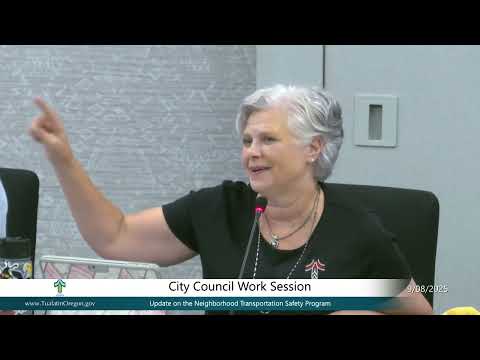
Tualatin city staff on Monday updated the City Council on the Neighborhood Transportation Safety Program (NTSP), reviewed recently completed projects and one current procurement, and opened the 2025–26 project submission process.
The presentation, given by Abby McPhetcher, engineering associate, and Mike McCarthy, city engineer, described completed installations including a rectangular rapid flashing beacon (RRFB) at Eibach and Columbia and signal upgrades on Boones Ferry intended to reduce conflict between drivers and pedestrians. McPhetcher said Hazelbrook is in an RFP stage to connect an under-highway trail to existing sidewalks and to reduce unsafe crossings near the middle school. "So tonight, we're gonna be giving you an update on the neighborhood transportation safety program, otherwise known as the NTSP," McPhetcher told the council.
The NTSP is funded at $150,000 per fiscal year, McPhetcher said. Staff outlined the program’s selection criteria — safety, equity, feasibility and impact — and explained how residents can submit suggestions through a map-based survey on the city website. The advertising phase for the 2025–26 cycle is September 2025; staff said suggestions received by Oct. 1 will be considered for the current cycle, while later submissions will be held for the next year.
Why it matters: the program is the city’s primary mechanism for small-scale pedestrian, ADA and traffic-safety improvements. McPhetcher told councilors the map-based survey allows residents to pin specific sidewalk panels or locations, which helps staff cluster requests and avoid unnecessary follow-up calls.
Councilors asked how projects are prioritized when submissions outnumber available funds, whether the program will accept requests for treatments such as speed bumps, and how staff measure safety and equity. McPhetcher said staff score projects using the four stated criteria and rely on data where possible — for example, speed data collection to verify speeding concerns and an equity map to weight equity-related requests. "We do evaluate all the projects on safety, equity, feasibility, and impact," she said. She added that top-ranked suggestions are presented to a steering committee for final consideration.
McCarthy explained coordination with the police department on crash data: the city receives a monthly summary of crash reports and flags locations that show repeat incidents. He said the department deploys traffic counters and speed measurements where complaints indicate a pattern.
Staff estimates the NTSP typically funds roughly one to two projects per year because some projects, including RFP-led signal work, can consume the full budget. McPhetcher noted some project types (signal upgrades, striping) stretch the budget farther than full construction items.
The council asked about outreach to residents without internet access. McPhetcher said she is listed as the program manager on the NTSP web page and that residents can call the city and have staff submit on their behalf; staff also said they have used yard signs with QR codes in past outreach.
Ending: Staff closed by asking councilors to promote the survey and said they will return with project recommendations after the submission and scoring process is complete.
AI generated
The text on this page is AI generated. Summaries, highlights, analysis, and video transcripts are all produced from the original source material.
AI can make mistakes, so if you spot one, and we will fix it for everyone.
Note: the source content is unaltered by us. Any content source we link to, be it a video, an audio recording, or a document, is presented exactly as its publisher released it. That publisher is usually a government body, sometimes an individual official or another organisation.