Get Full Government Meeting Transcripts, Videos, & Alerts Forever!
Get email alerts on the School Finance topic
No spam. Unsubscribe anytime.
Darien finance committee forecasts $490,512 surplus, recommends seven transfers to cover repairs, software and staffing
Summary
At a Sept. 12 special meeting, the Darien School District finance committee reviewed the July 2025 financial report projecting a $490,512 positive balance and recommended seven budget transfers to cover HVAC repairs, a board-management software purchase, staffing adjustments and other early-year shortfalls.
The Darien School District Board of Education finance committee reviewed the July 2025 financial report at a special meeting Sept. 12 and was told the district is forecasting a $490,512 positive balance for fiscal year 2026.
The projection reflects a mix of new savings from revised salary schedules and one-time or early-year deficits, the committee heard. The presenter identified specific line items: a 0.2 full-time-equivalent French teacher at the middle school (a $23,005.48 deficit), an additional elementary section at Henley (a $88,006.31 deficit), and $112,002.16 in savings tied to a revised paraprofessional schedule. Savings from new salary schedules were also reported for secretaries ($9,653), custodians ($15,007.87) and maintenance staff ($43,005.89).
Two vacant HVAC positions have led the district to contract out repairs; the presenter said that contracting costs created an $85,005.34 deficit in that line. "If anybody knows of any HVAC people, we'd love to see a resume," the presenter said when asked about recruitment.
Other items affecting the early-year picture included a $14,400 anticipated deficit in the food service subsidy tied to calendar changes for early-release professional development days, a $6,000 software charge for board-management software (one discussed higher package would be $10,200), and turnover that exceeded expectations by $189,005.29. Contract support produced a favorable variance of $44,009.89, attributed to favorable settlements with custodial and maintenance bargaining units and unused unaffiliated support-service salaries. Special-education contracted consult services showed a deficit linked to five students who returned to the district, offset in part by $377,007.90 in tuition savings for nonpublic placement reductions.
Committee members asked for clarification on salary-savings mechanics and timing. The presenter explained that "salary savings" is a budgeted line that captures the effect of delayed hiring; it typically accrues over the first half of the school year as positions remain unfilled or start dates are delayed and is often realized by midyear. The committee also discussed the effect of recent negotiated deductible changes and salary-schedule adjustments; the presenter said those changes have produced roughly $240,000 in health-insurance-related savings this year and more than $1 million in cumulative savings across four bargaining units since the schedules were instituted.
The presenter also noted a state budget development that affects special-education reimbursements: on June 30 the State of Connecticut approved a budget that added $40 million in both fiscal 2026 and fiscal 2027, and the district is forecasting a 70% reimbursement rate under the state program. The committee was told that the reimbursement outcome still depends on statewide submissions and that the first submission is due Dec. 1.
Electric costs were flagged as a pressure item, with a projected $44,000 deficit tied to the state energy public benefit charge, which the district and town had expected to be reduced but which remained in effect. The presenter said both the town and the Board of Education had budgeted on an anticipated reduction that did not materialize.
The committee reviewed seven recommended transfers to cover early-year needs. The presenter said the transfers would pull from turnover savings, certain insurance and settlement savings, and other salary-savings lines. Specific recommended transfers included: $81,874 to cover HVAC repairs and contracted services while two HVAC positions remain vacant; funding for the board-management software line (the packet listed $6,000 but the committee discussed presenting $10,200 if the board prefers that package); transfers to cover the electric public benefit charge from insurance and settlement savings; use of turnover savings to fund the Henley first-grade section and the 0.2 French teacher at the middle school; turnover savings to offset the food-service subsidy for early-release days; and an internal shift within special-education lines to move funds from out-of-district tuition to contracted special-education services for the five returning students.
Committee members also discussed the board-management software procurement. One member described the tool as likely bringing productivity gains to central office staff and advocated for the larger package; staff reported that a demonstration of the full suite is scheduled for district personnel and that staff will present a recommendation to the full board. The presenter said the full transfer for the selected package would be taken from the workers' compensation savings line if the higher-cost package is chosen.
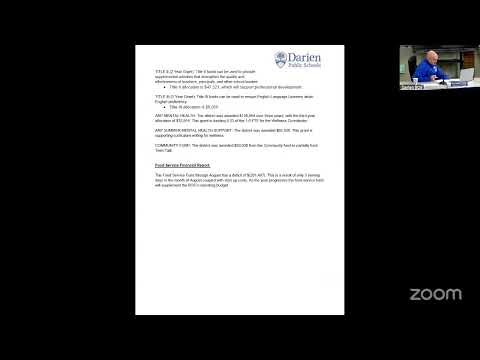
On grants, staff reported modest changes: an "IDA" grant award increase to $1,029,000 (about $50,000 higher than the prior year) that largely funds paraprofessionals and some special-education staff and psychologists; Title II allocation of $47,003.21, restored after a temporary federal freeze and intended for professional development; Title III at just over $8,000 to support English-language learners; and remaining American Rescue Plan (ARP) mental-health funds covering roughly one-third of a wellness coordinator position. Staff also noted that Title I funds are still not available to the district, consistent with prior-year census and income data.
On food service, staff said the food-service fund began the year with a $201,004.87 deficit — a common cash-flow pattern because August generates few meal-service days — and historically runs positive by late fall and into the second half of the school year; last year the cafeteria fund ended about $280,000 positive and subsidized the district's budget.
Staff recommended that the finance committee forward the financial report and the recommended transfers to the full Board of Education for approval. There were no members of the public in attendance for comment, and the committee adjourned by motion.