
County board approves 14‑story mixed‑use tower and public plaza at 2500 Wilson Boulevard
Get AI-powered insights, summaries, and transcripts
Subscribe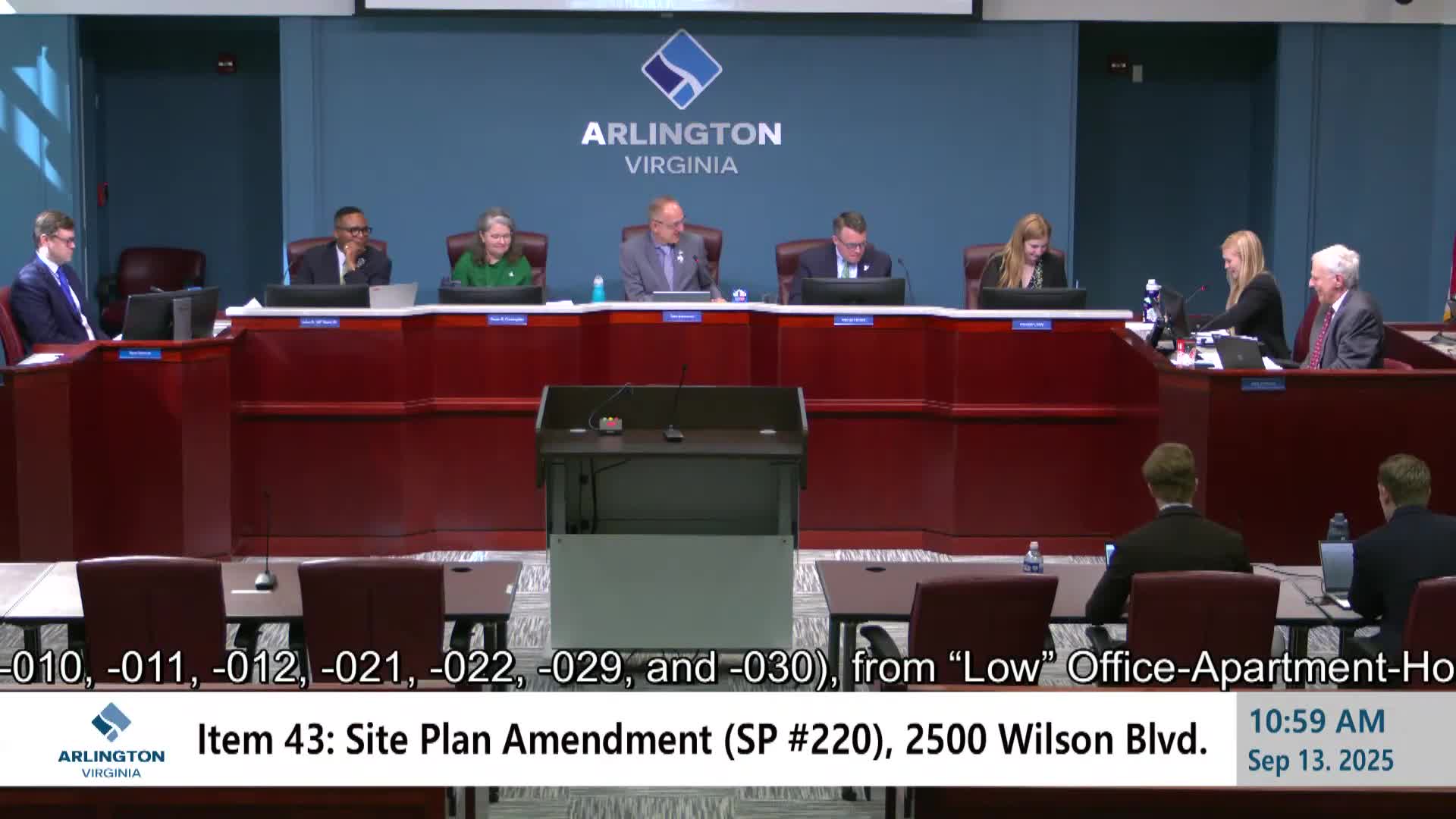
Summary
Arlington County Board voted unanimously to rezone and approve a 14‑story mixed‑use redevelopment at 2500 Wilson Boulevard that will add 316 apartments (including 20 committed affordable units), about 14,000 square feet of retail and a new publicly accessible open space along Clarendon Boulevard.
The Arlington County Board on Sept. 13 unanimously adopted a general land use plan amendment, rezoning and site plan amendment permitting a 14‑story mixed‑use building at 2500 Wilson Boulevard in the Clarendon/Courthouse area.
The project by TMG (the Meridian Group) calls for 316 residential units — including 20 committed affordable units at 60% of area median income (9 one‑bedrooms and 11 two‑bedrooms) — roughly 14,032 square feet of ground‑floor retail, and about 6,500 square feet of on‑site public open space flush with the Clarendon Boulevard sidewalk. The applicant told the board the building will pursue LEED Gold certification and include energy‑efficiency measures, a portion of EV charging spaces and other green‑building features.
Staff said the proposal conforms to the county’s recently adopted special GLUP (General Land Use Plan) guidance for the Courthouse/Clarendon area and implements many of the study’s recommendations on height, setbacks, streetscape improvements and public space. Emma Martin, a planner in the Department of Community Planning, Housing and Development, told the board: “staff finds the project is generally consistent with the applicable and relevant adopted or accepted county board plans and policies.”
Developer Dan Glavin said the existing site — a five‑story office building and elevated, underused open area — will be replaced with a pedestrian‑oriented plaza and retail adjacency intended to activate the street. “The public space and retail adjacency here is very purposeful,” he told the board, noting the project’s proximity to Courthouse and Clarendon Metro stations and its goal of knitting the two neighborhoods together.
The proposal includes transportation and pedestrian upgrades around the block: curb extensions, a protected northbound bike lane on North Barton Street, new street trees, an upgraded bus stop with a curb extension, and below‑grade parking with a 0.42 parking ratio. The applicant said the design provides more bicycle parking than car parking.
Planning, housing and transportation advisory bodies reviewed the project. The Planning Commission, Housing Commission and Transportation Commission all recommended approval. Commissioners and community speakers raised several issues during public testimony and the board’s discussion: the final scope of public art on the site, the future location and continuity of an on‑site childcare provider, building massing and materiality (particularly long, unbroken facades on some frontages), and whether the project should include larger family (three‑bedroom) affordable units.
Staff and the applicant told the board they had discussed relocation and relocation‑planning requirements for the Ground‑floor childcare tenant and that the county’s standard site‑plan conditions require tenant relocation planning and coordination with the county’s AED (Arlington Economic Development) office before demolition permits are issued.
Board members expressed support for the project’s added housing and streetscape improvements while also urging the developer and staff to continue to refine the design, protect the childcare tenant where feasible, and ensure the site’s public art follows the county’s public‑art process. The board also requested continued attention to pedestrian safety around the site, notably at the Clarendon/Cleveland and Wilson/Barton intersections.
Votes at a glance: The board approved the GLUP amendment, rezoning to C‑2.5 (from C‑1.5), the major site plan amendment (SP#220) and an encroachment ordinance authorizing an underground electrical transformer vault to encroach into a street easement. The motion (moved by Maureen Coffey, seconded by JD Spain) passed unanimously: Tackis Carantonis — yes; Matt Ferrante — yes; Maureen Coffey — yes; Susan Cunningham — yes; JD Spain — yes.
Why it matters: The block had been identified in a special GLUP study as a “missing tooth” between Clarendon and Courthouse. County staff and the applicant said the redevelopment is intended to increase transit‑oriented housing supply, add public open space at street level and improve pedestrian and bicycle connections in the RB (Rosslyn‑Ballston) corridor.
What’s next: The ordinance conditions require the developer to finalize design details, satisfy relocation requirements for any affected tenants before demolition permits are issued, and complete specified public‑realm improvements as part of site‑plan permitting. The developer and staff will continue to coordinate with the county board’s public‑art and transportation programs during the building‑permit phase.