Get Full Government Meeting Transcripts, Videos, & Alerts Forever!
Get email alerts on the Broadband topic
No spam. Unsubscribe anytime.
Albemarle County broadband authority hears project closeout, BEAD award changes; Brightspeed work resumed under VDOT probation
Summary
Authority members received updates on Valley/Value 21 closeout, countywide build timelines and BEAD awards, and were told Brightspeed construction was suspended after resident complaints but has been allowed to resume for 90 days under VDOT-imposed limits.
At a meeting of the Albemarle County Broadband Authority, members received progress and compliance updates on local broadband construction programs, state BEAD award changes and a recent VDOT inspection that suspended and then allowed Brightspeed to resume work under probation.
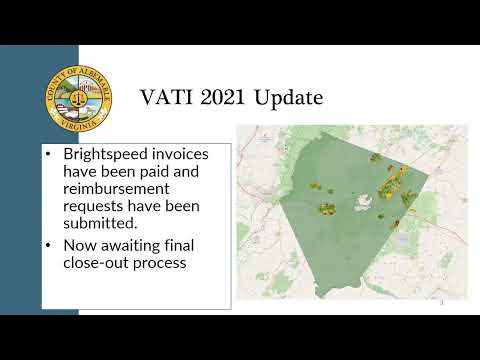
Authority staff said payments to Brightspeed have been made and reimbursements submitted to the state as part of the closeout process for the Valley/Value 21 project; the Department of Housing and Community Development (DHCD) will perform a final document review before the project is officially closed. Staff reported the project had settled approximately 1,420 locations for roughly $2.5 million in payments, and that remaining state and authority funds are expected to be reconciled as the closeout proceeds.
The authority also received a countywide construction update. Staff said Firefly’s backbone construction is largely complete in many areas but that the overall target for backbone completion has been pushed to December 2025, with some service areas now projected into late 2025 or winter 2026. The report named Beaver Dam and Saint John Road as newly in service and said Dominion Energy’s portion of the work showed design complete and about 171 miles recorded as completed as of the last quarterly call.
Members discussed state BEAD (Broadband Equity, Access, and Deployment) award developments. Staff explained that the state made application changes in a later award round that treated low-earth-orbit and fixed wireless proposals more comparably with fiber, producing roughly $200 million in program cost reductions. According to the staff presentation, the state’s initial connectivity target of about 133,000 locations was later revised to closer to 90,000 after an NTIA-led reassessment; locally, an initial list of about 1,290 unserved locations was reduced to about 525 in the state’s analysis and is believed by staff to be closer to 330 truly remaining passings in Albemarle County.
Staff said Comcast won the award for the remaining passings in the county and told the authority Comcast has proposed fiber-to-the-home (FTTH) in the awarded areas rather than hybrid fiber-coax. Comcast’s statewide proposal was described as covering roughly 24,000 locations with an estimated project cost near $300 million and a roughly 51% provider match; the application will be submitted to the National Telecommunications and Information Administration (NTIA) for approval and could be modified by NTIA. The timeline noted in the applications for buildout across Virginia runs from Jan. 1, 2026, through 2030; authority staff said they will press Comcast to prioritize Albemarle County locations earlier than the applicant timelines indicate.
Several authority members expressed skepticism about satellite-based service as a primary solution for the county. One member cited academic analyses and speed-test data suggesting that, at low population densities, Starlink’s service can fall below common broadband thresholds; the member said that, for Albemarle, low-earth-orbit service may cover only a few edge cases rather than serve as a countywide solution.
Separately, staff briefed the authority on resident complaints about Brightspeed construction activity in multiple neighborhoods, including Redfields, Willoughby and Mill Creek. Complaints alleged lack of advance notification, damage to property including a damaged sewage line that caused a backup, insufficient traffic and worker safety measures, and digging outside the public right-of-way. The authority said it referred the complaints to the Virginia Department of Transportation (VDOT), which inspected the work and found permit and safety deficiencies and that directional boring called for in permits had not always been used.
Following the inspection, Brightspeed’s work was suspended for 30 days; staff reported that Brightspeed and its contractor (identified in briefing materials as Mastech) met with the relevant agencies and that Brightspeed committed to increased on-site supervision and to comply with permit notification and safety requirements. VDOT allowed Brightspeed to resume work under a 90-day probationary status with a limit of 12 open permits at a time and required that a hotline number appear on resident door tags for reporting problems.
Authority members directed staff to continue monitoring construction quality and resident complaints, to follow up with VDOT and state reviewers as needed, and to push providers to prioritize remaining local passings. No substantive policy changes were adopted at the meeting beyond adoption of routine administrative rules and the board calendar (see “Votes at a glance”).
The authority also adopted an amended meeting calendar that removes the March meeting and sets the December meeting for Dec. 2; members approved an updated set of procedural rules with corrected effective dates. Staff said they will return with any additional schedule adjustments after several months of observing meeting needs.