Get Full Government Meeting Transcripts, Videos, & Alerts Forever!
Get email alerts on the Ems Service topic
No spam. Unsubscribe anytime.
County staff present two ambulance proposals; staff leans toward Marion Health for 911 coverage
Summary
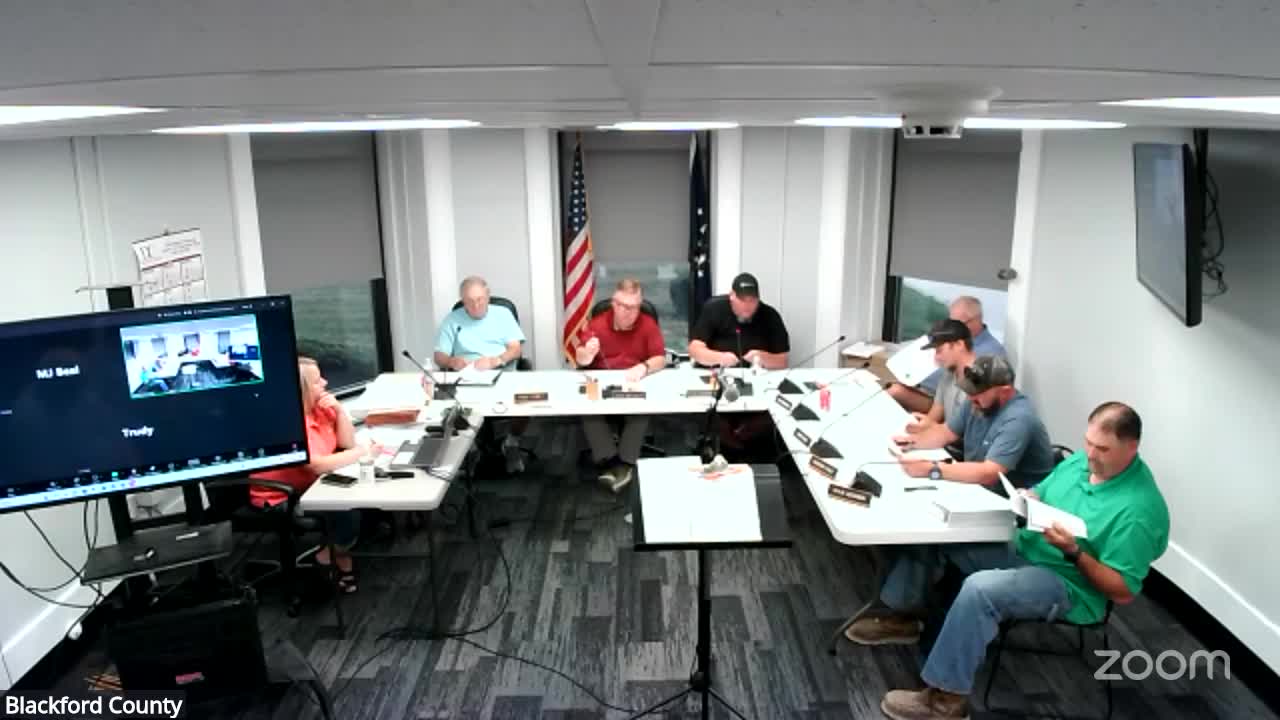
County staff briefed commissioners and councilors Sept. 17 on two competing ambulance service proposals — one from IU Health Lifeline and one from Marion Health — and recommended pursuing Marion Health’s proposal that emphasizes county 9‑1‑1 coverage; no contract was awarded.
Blackford County officials reviewed two proposals Sept. 17 to provide ambulance services after the county's current agreement approaches expiration. County staff summarized an IU Health Lifeline option and an alternative offered by Marion Health, discussed funding and facility needs, and recommended further negotiation. No formal decision or contract award was made.
County staff presented key differences between the proposals. The IU Health Lifeline option as described would leave the county with one regularly based ambulance in Hartford City and a second ambulance that Marion Health staff described would be used for longer hospital transfers when available; staff said the IU option included an annual subsidy in the county’s current range (roughly $500,000) but could include a 4% annual increase and would allow the provider discretion to use the secondary unit for non‑local transfers.
In contrast, the Marion Health proposal described a model that prioritizes 9‑1‑1 emergency coverage inside Blackford County. Under the Marion scenario staff outlined, the county would host a full‑time advanced life support (ALS) ambulance in Blackford County and Marion Health would base a second ambulance at Marion East that could be routed into Blackford County when needed. Marion’s model as presented would still require county investment in housing or a facility for on‑site crew quarters, but staff said Marion’s approach would more consistently dedicate ambulances to local 9‑1‑1 response rather than relying on a provider’s transfer workload.
Why this matters: ambulance coverage affects response times for life‑threatening events and carries substantial recurring costs. Staff and elected officials framed the choice as a trade‑off between retaining the existing IU Lifeline arrangement (which includes a large component of interfacility transfers and potential variability in local ambulance availability) and contracting with Marion Health for service that would focus primarily on emergency response within the county.
Funding and costs discussed
- Current subsidy: staff said the county currently pays a subsidy in the roughly $500,000 range to maintain ambulance service. Proposals reviewed were priced within that general envelope but included projected annual increases (examples in the presentations used 4% as an illustration).
- Staffing cost estimate: presenters referenced an industry rule of thumb that operating one staffed ambulance can cost on the order of $750,000 to $1,000,000 annually when salaries, benefits, equipment, insurance and overhead are included; counties with larger populations running multiple ambulances reported multi‑million dollar budgets.
- Capital needs: county staff discussed the need for a housing facility if Marion Health’s model were chosen. Potential sites discussed included county property or school grounds nearer the county center; staff noted the county could also acquire or lease a small facility with living quarters, a restroom, a kitchen and vehicle storage.
Operational considerations
- Transfers versus 9‑1‑1 work: staff emphasized that hospital‑to‑hospital transfers (which can produce higher reimbursement) are a significant revenue source for private ambulance operators; depending on a provider’s business model, that can reduce local ambulance availability for 9‑1‑1 calls. Marion Health’s proposal was presented as focusing its ambulance resources on emergency response rather than transfers.
- Mutual aid and coverage risk: several officials cautioned that any single‑unit model would increase reliance on mutual aid from neighboring counties. County staff said frequent reliance on mutual aid risks pushing partner services into negotiating fees or declining availability if the burden is large.
What happened and next steps
County staff recommended pursuing the Marion Health proposal for a local ALS ambulance with Marion East as a supporting resource and returning negotiated terms for council review. The council did not vote; staff were directed to continue negotiations, clarify costs and facility options, and return a formal contract or recommendation for action at an upcoming meeting (staff suggested the Oct. 8 agenda would be used to continue fleet and funding discussions).
Community context and concerns
Sheriff and other local officials participated in the discussion about dispatch logistics, historical run volumes and hospital turnaround times. Presenters noted Blackford County averages a low number of transports per day (examples cited were about 2–3 transports on typical days), which affects revenue potential for private operators and increases the county subsidy required to guarantee coverage.
Ending
County staff asked for direction to continue negotiations and to seek final contract details and an implementation timetable before the county’s current provider agreement expires. The county council and commissioners will receive a report back with firm pricing, facility options and proposed contractual terms before any binding vote.