Get Full Government Meeting Transcripts, Videos, & Alerts Forever!
Get email alerts on the Sewer District topic
No spam. Unsubscribe anytime.
Blackford County officials hear objections and details as engineers explain proposed county sewer district
Summary
Blackford County commissioners and the county council met Sept. 17 to get an overview and take public comment on a proposed county sewer district; engineers said forming a district would open grant funding and allow phased projects, while residents and some officials raised cost and hookup concerns.
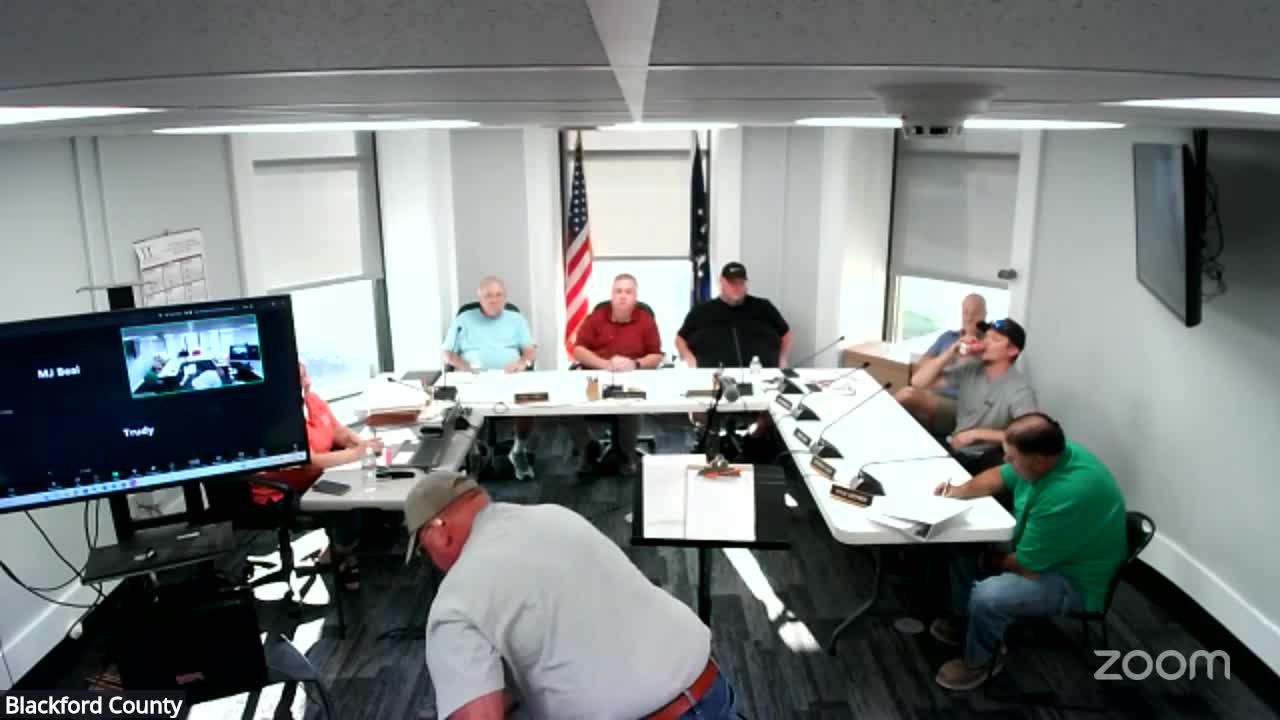
Blackford County commissioners and the county council met Sept. 17 for a public information session about a proposed Blackford County sewer district. Engineers and attorneys from Commonwealth Engineers answered questions about how a district would be formed, how projects would be phased and how funding and user rates could be set, while residents voiced opposition and urged councilors to reject the petition to form a district.
The meeting brought public comment, technical explanation and follow‑up questions into one session. Resident Dennis Layman, speaking on behalf of property owners opposed to the district, said he had “over 850 signed petitions against this,” and urged elected officials to vote no on forming a sewer district.
Commonwealth Engineers representatives described the formation process, how the Indiana Department of Environmental Management (IDEM) is involved and how projects would be prioritized. Thomas Barclay of Commonwealth Engineers said creation of a district is not a state mandate: “This is not mandated by the state. It is highly encouraged,” and he described state waivers that can delay mandatory connection for some homeowners. Project engineer Rob Baluchi emphasized that creating a district does not commit the county to immediately build every identified project: “Creation of a district doesn't commit any project to happen.”
Why this matters: a regional sewer district would open state and federal funding sources that are hard to access without an authorized district entity, but it also raises questions about which properties would be served, who would pay and how quickly costs could be imposed on homeowners. Residents said prior public meetings left them with incomplete information; engineers and county staff said the information session was intended to answer those questions.
Key points and details
- Public opposition: Dennis Layman, speaking for property owners, said he delivered more than 850 signed petitions opposing formation of the district and said county residents were told inaccurate information at earlier meetings. Layman said the project would be “a $30,000,000 project with around 300 sites,” and argued the county should pursue cheaper fixes for localized problems rather than a broad district.
- Scope and phasing: Commonwealth Engineers described the planning document as a “breathing” planning tool that lists multiple possible project areas so funding agencies can evaluate them. Company representatives said earlier drafts identified roughly eight areas countywide; building every area at once is not the plan. The firm said the first area under consideration was a corridor along State Road 18, from Montpelier toward Hartford City, and cluster areas such as Shamrock Lake and Lake Mohi (identified in the consultant plan) were among initial candidates.
- Hook‑up rules and waivers: Engineers said IDEM has guidance on connection waivers. In areas where a sewer line is installed, IDEM may grant homeowners an initial 10‑year waiver and up to two subsequent five‑year waivers, or other combinations depending on the life expectancy of the homeowner’s septic system. Commonwealth representatives said waivers and the county’s permitting authority affect when an individual homeowner must hook up.
- Cost and funding: Engineers and county staff said large projects typically require significant grant support; multiple speakers said many of the conceptual projects would be feasible only with “90% plus” grant funding. Staff and consultants discussed how capital cost is converted into a monthly user rate: project cost divided by expected users, minus grant support, yields a projected monthly fee. Presentations referenced typical user‑rate targets that funding agencies look for (state averages cited in discussion were roughly $65–$80 per month in many planning documents), and speakers noted that smaller systems or earlier projects in other counties had higher or lower results depending on scale (Delaware County was cited as an example of a larger, financially stable district that serves more than 3,000 customers).
- Technical considerations and treatment capacity: Commonwealth said it had consulted likely receiving municipalities (Montpelier, Hartford City and other “certified treatment areas”) about whether treatment capacity exists and whether upgrades would be required; if upgrades are necessary that cost must be included in project estimates.
- Property, permitting and septic regulation: County speakers and consultants discussed local permitting rules and how failing septic systems, baffle conditions and lot sizes affect the feasibility and cost of on‑site repairs versus central systems. Multiple people urged updating county ordinances and stronger inspection/maintenance practices to reduce raw sewage discharges.
What the county did (and did not) decide
No votes were taken at the Sept. 17 session. Commonwealth Engineers said the petition to IDEM had previously been submitted and that IDEM requested updated council approval after membership changes on the council. County staff said the matter will be returned to the county council agenda on Oct. 8 for further consideration and possible formal action; until then, the meeting functioned as an informational briefing and public comment session.
Voices from the meeting
- Dennis Layman, resident and representative of property owners opposed to the sewer district: “I have over 850 signed petitions against this.” - Thomas Barclay, Commonwealth Engineers (presenting): “This is not mandated by the state. It is highly encouraged.” - Rob Baluchi, Commonwealth Engineers (project engineer): “Creation of a district doesn't commit any project to happen.” - Danielle Struble, Commonwealth (attorney for districts): referenced Delaware County as a stable example and said that Delaware County “does make money” and has healthy reserves for projects.
Community context and next steps
Speakers said that forming a regional sewer district is primarily a mechanism to pursue grants or pursue a project if a cluster of residents or a potential industry asks for service. Several residents told the panel they worry about compulsory hook‑ups, immediate assessment or large monthly bills. Consultants and county staff reiterated that forming the district would not obligate the county or individual property owners to immediate construction or billing; any specific project would go through engineering, public meetings and financing steps before construction.
The council indicated staff should return the matter on Oct. 8 for next steps. Commonwealth Engineers said it will be available to answer further questions and that IDEM will host formal public meetings once the petition process advances.
Ending
County officials kept the Sept. 17 session to information, asking consultants to clarify technical, permitting and funding questions and giving residents another opportunity to record objections on the public record. The council scheduled further consideration for Oct. 8; if the council and commissioners approve an updated petition, IDEM would hold formal hearings as the next stage in the statutory process.