Get Full Government Meeting Transcripts, Videos, & Alerts Forever!
Get email alerts on the Housing Services topic
No spam. Unsubscribe anytime.
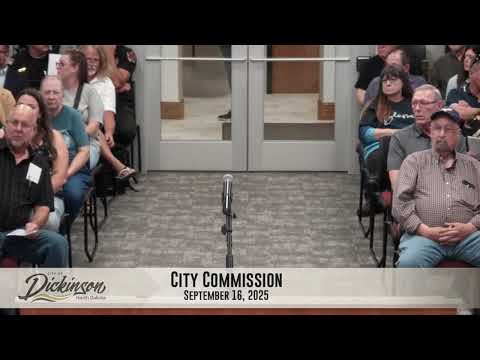
Dickinson denies United Way special use permit for Evergreen building after hours of testimony
Summary
After extensive public testimony and technical questioning, the Dickinson City Commission voted 3-2 on Sept. 16 to deny a request from United Way Dickinson for a special use permit to operate a low-barrier shelter with embedded treatment and supportive/transitional housing at the former Evergreen building (Resolution 41-2025).
Dickinson, N.D. — The Dickinson City Commission on Sept. 16 denied a special use permit requested by United Way Dickinson to operate a three-part supportive-care facility at the former Evergreen building, concluding a multi-hour public hearing with divided testimony from service providers, neighbors, public-safety officials and people with lived experience.
The applicant, Dakota Gant, Executive Director of United Way Dickinson, described a three-floor program: a 13-room low-barrier emergency shelter on the first floor, an onsite treatment center operated by Southwest Multicounty Corrections Center (SWMCCC) on the second floor, and 30 supportive/transitional housing units on the third floor. "This project is not simply a homeless shelter," Gant told the commission. He said the facility would combine short-term shelter, embedded treatment and transitional housing with case management, security and an advisory board to provide oversight.
United Way presented anticipated startup funding sources including a $1,000,000 HOME-ARP award, a Home Loan Bank grant cited as up to $3.5 million (applicant said the exact amount and timing were being finalized) and CHS and other implementation grants. Gant said ongoing operations would be supported by Medicaid reimbursements, other state programs and rent contributions; he added the project was not seeking city or county tax funding and said projected revenues at capacity could exceed $3.2 million annually.
City staff described the SUP application and recommended approval subject to the conditions in the staff report (including reporting and compliance audits). Planning and Zoning, which previously heard the application, recommended denial. The Planning and Zoning denial was noted by city staff and the commission as part of the record.
Public hearing, testimony and concerns
More than a dozen speakers addressed the commission. Supporters included service providers and people with lived experience who described benefits of a full continuum of care and the need for local capacity. Allison Wanner, clinical director at SWMCCC—2—9s Community Treatment Program, told the commission that "transitional facilities, thoughtfully designed centers that combine safe housing with job training, counseling, addiction recovery and reentry services are not magnets for crime" and cited evidence that supportive housing reduces recidivism and emergency-system costs.
Several people who have experienced homelessness described how transitional housing helped stabilize their families. Melissa Banks, who said she and her children had been homeless, said transitional programs require participation and that such programs had helped her rebuild.
Opponents included many neighbors and nearby property owners who raised safety, staffing, funding sustainability, and location concerns. Speakers cited experience in other communities and referenced a shooting outside a homeless shelter in Bismarck as evidence they feared for neighborhood safety. Phyllis Sackman and Bruce Coppinger, neighbors within blocks of the Evergreen building, said proximity to schools and residential areas made the site inappropriate. Other speakers, including a retired firefighter and the director of a local counseling agency, highlighted potential increases in public-safety calls, operating costs for first responders, and the challenges of sustaining a large residential treatment operation.
Technical and funding questions
Several commissioners pressed the applicant on licensing and funding details. City commissioners asked whether inpatient licensing and Medicaid billing rules would permit the combined program as proposed; clinical and state representatives on the record said they had discussed Medicaid and inpatient (IMD) rules with state staff and that inpatient treatment capacity typically must meet Medicaid rules (discussed in public testimony). United Way and treatment partners said they had engaged state agencies and would separate inpatient and outpatient spaces per Medicaid guidance and that medical staff would be onsite. SWMCCC and other service representatives said they could provide medical and treatment staffing and described grant sources for startup.
Commission action and vote
After closing the public hearing, Commissioner Riddle moved to approve the United Way SUP; Commissioner Murphy seconded. The recorded vote was: Commissioner Riddle —28094 Aye; Commissioner Murphy —28094 Aye; Commissioner Frederick —28094 No; Dr. Bair —28094 No; Chair Scott Decker —28094 No. The motion failed and the special use permit was denied (Resolution 41-2025).
Why it matters: The proposed project would have added local capacity for low-barrier sheltering, onsite treatment and transitional housing. Commissioners and the public were sharply divided on whether the Evergreen site and the project's scale were appropriate; the denial means the proposed operator and location will not proceed under the requested SUP, although the underlying service need (homelessness, addiction and reentry services) was widely acknowledged.
What to watch next: The applicant and community providers may consider alternative sites, scaled changes to the proposal, or additional conditions to address neighbors' concerns. Separately, the city will continue discussions about broader homelessness, treatment and reentry services and funding coordination with state partners.
Speakers (selected and attributed): Dakota Gant, Executive Director, United Way Dickinson; Allison Wanner, Clinical Director, SWMCCC Community Treatment Program (treatment operator); Melissa Banks, resident and shelter program participant; Phyllis Sackman, neighborhood resident; Bruce Coppinger, neighborhood resident; Jackie Miller, nearby resident and packet submitter; Brenda Owen, Director, Summit Counseling Services; Amber Wanner, former Evergreen staff and community supporter; Jonathan Holt, Commissioner of Recovery and Reentry, State of North Dakota; many other residents and service providers.