Get Full Government Meeting Transcripts, Videos, & Alerts Forever!
Get email alerts on the Municipal Court Fees topic
No spam. Unsubscribe anytime.
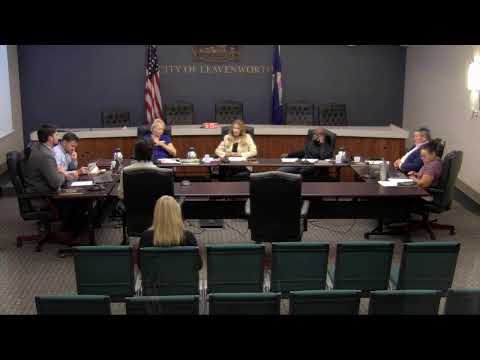
Leavenworth City officials review $1.5 million in outstanding municipal court warrants, consider collections and amnesty
Summary
Leavenworth City presented an overview of municipal court fees and unpaid fines at a City Commission meeting, highlighting a long-term revenue decline and seeking direction on possible recovery options.
Leavenworth City presented an overview of municipal court fees and unpaid fines at a City Commission meeting, highlighting a long-term revenue decline and seeking direction on possible recovery options.
Penny, the department head overseeing municipal court staff, told the commission that “since 2019, to last year, there was about a $200,000 reduction in fees and fines,” and that unpaid cases in warrant status total about $1,500,000 with another roughly $400,000 estimated in outstanding fines.
The presentation said several factors appear to be driving the decline: fewer traffic citations because the police department has fewer officers available for traffic enforcement, state-mandated fees the city passes through to Kansas, and collection shortfalls that leave municipal-court revenues about $50,000 short of covering court expenses each year.
Why it matters: municipal-court revenue in Leavenworth is deposited to the city’s general fund, which pays for police, fire and public works. Staff framed the issue as both a budget question (recovering lost revenue or reducing subsidies) and an operational one (clearing old cases that remain in the court tracking system).
City staff reviewed how fines and fees are established. Penny said the city commission set administrative fees after a 2011 charter ordinance; current administrative fees cited in the presentation include a $25 administrative fee for many traffic violations and a $50 administrative fee for offenses requiring court. The presenter also explained that certain fees are state-mandated and are collected by the city and passed through to the state.
The municipal judge, Judge Gary Fuller, and court staff described how fines are imposed and collected. Penny explained that the judge sets fines within ranges in the city’s code and the UPOC (Uniform Public Offense Code). Penny described court processes for nonpayment, including notices to appear, additional $50 letters for “must appear” or “failure to appear,” and the potential for bench warrants if defendants repeatedly fail to respond. Speaking for the bench, Penny summarized the judge’s approach: “We do not arrest people for nonpayment ... They are arrested if they don't pay and they don't show up to court to provide some sort of explanation.”
The commission discussed potential remedies. Staff listed options: (1) pursue a collections contract (the presenter noted many jurisdictions hire contractors to pursue old debts and that state law allows a collection fee, which the presentation cited as a statutory maximum of about 33 percent), (2) re-run an amnesty program like one the city offered in 2019 that removed late fees if a defendant paid the base amount owed, (3) revive a community-service program so defendants could perform supervised work as partial satisfaction, and (4) examine whether older cases could be administratively closed in limited circumstances.
Commissioners asked staff for more detailed data before any policy change: a breakdown of outstanding amounts by offense category, how much of the outstanding balances are state pass-through fees, the number of active bench warrants, and the results of the 2019 amnesty program. Several commissioners also asked for options that balance collections against the cost and equity concerns of incarcerating indigent residents; Judge Fuller and staff noted the city already bears costs when people are jailed for failure to appear or for related underlying sentences.
No formal action was taken. The commission requested that staff return with further analysis on three items: (1) a collections contract option and the contractor fee structure, (2) records and outcomes from the 2019 amnesty program, and (3) feasibility and cost of a supervised community-service alternative.
Ending: Staff said they will compile additional data and return to the commission with more detailed options and cost estimates so the commission can weigh budget and equity implications before deciding whether to pursue collections, another amnesty program, or community-service alternatives.