
Elkhart County planners propose budget increases for legal services, GIS and TIF commitments
Get AI-powered insights, summaries, and transcripts
Sign Up Free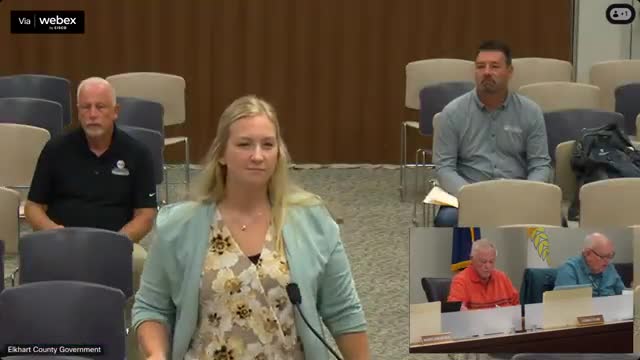
Summary
May Crancer, planning and development, walked Elkhart County Council through proposed 2026 increases for code enforcement, legal services, GIS and two redevelopment TIFs; councilors pressed for spreadsheets and clarity on recurring costs.
May Crancer, planning and development, walked Elkhart County Council through a series of proposed increases affecting planning, code enforcement and redevelopment funds during a council budget work session.
Crancer said the planning division’s personnel lines reflect HR’s recommended pay adjustments and that an “other professional services” line that was previously zero now shows $20,000 to cover weed-and-nuisance work rather than asking separately for appropriations. She also noted an increase in legal services tied to a change in the county’s board attorney vendor, saying the new firm is more expensive and the shift adds roughly $45,000 annually.
The nut graf: these changes are framed as cost‑recovery and continuity moves, but council members pressed staff on where recurring costs could be absorbed, and on whether centralized IT purchasing should pick up small departmental software charges.
Crancer explained smaller items in the planning budget: a $400 telephone increase to cover phones added in 2024 and a $500 subscription increase to cover Adobe licenses. That Adobe request prompted debate about centralizing software purchasing under IT to avoid duplication and to preserve departments’ line‑of‑sight over which staff need which tools. Crancer said central negotiation by IT “makes a lot more sense” but argued for departments to retain budget lines so they know what they’re using. Another councilor suggested shifting the $500 to IT’s budget so IT can negotiate volume pricing.
Stormwater and GIS: Crancer described a $3,000 increase in the stormwater account to cover GIS staff hours and Esri software costs used to calculate impervious surfaces. She said GIS work has become more complex and the county is moving to pay consultants rather than rely on a single coordinator, adding consultants will reduce the need for a single in‑house specialist but increase contract costs. Council members asked whether consultant costs were one‑time or ongoing; Crancer said the change is expected to continue into 2026.
Unsafe buildings and liens: Crancer reported growth in the unsafe‑building account because of higher demo activity and lien collections; she told council the account is an early source of funds for cleanup so the general fund need not be tapped, but cautioned lien revenue is unstable and may not be fully collectible if properties go to tax sale.
Permitting and subdivisions: Planning staff said the department averages about 2,500 permits a year and has seen steady volume since pandemic spikes; two new major subdivisions were submitted this year (one in Jefferson Township and one in Cleveland Township) and staff noted there are no single large high‑dollar permits currently on the books.
TIF allocations and highway uses: Crancer drew attention to two significant increases in Tax Increment Financing (TIF) budgets. Middlebury East TIF shows a $250,000 increase for a multi‑year commitment to help Middlebury with a wastewater treatment plant; the State Route 13 interchange TIF shows a $500,000 increase for the same set of projected seven‑year design and construction costs. Crancer said the county expects to carry 40% of those costs and the town 60% over time and is placing the funds in the budget rather than seeking a separate appropriation.
Councilors asked for more detailed TIF spreadsheets; Crancer said she could email supporting schedules and noted redevelopment has for years projected TIF dollars toward highway projects. She also said the county coordinates monthly with Highway on potential right‑of‑way and construction requests and that TIF funds have in the past been used for highway needs when projects were prioritized.
Ending: Crancer closed by offering to provide TIF spreadsheets and further line‑item detail for Friday’s meeting. Councilors flagged several follow‑ups—particularly a spreadsheet of TIF balances, clearer breakdowns of consultant vs. staff GIS costs and confirmation of whether nuisance/weed appropriation is recurring.