Get Full Government Meeting Transcripts, Videos, & Alerts Forever!
Get email alerts on the K 12 Curriculum Math topic
No spam. Unsubscribe anytime.
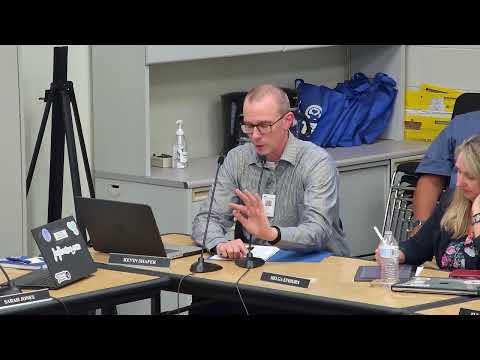
Board hears plan for new state math standards, move to integrated high school courses
Summary
District staff briefed the board on state-adopted math standards and an upcoming shift from standalone Algebra/Geometry courses to integrated high school mathematics; board members asked about acceleration and options for advanced or struggling students.
Talbot County Public Schools officials told the Board of Education that Maryland’s newly adopted mathematics standards will change how math is taught and assessed, and the district is preparing for an integrated high-school pathway.
Doctor Pepekaei (district math lead, as described in the presentation) explained the state will move away from discrete Algebra 1, Algebra 2 and Geometry courses toward an integrated model. “We will be moving away from Singleton classes of Algebra 1, Algebra 2 and Geometry. Instead, going to an integrated approach for teaching mathematics,” Pepekaei said, adding that geometry will be “infused throughout Integrated 1 and Integrated 2” and that a new assessment will accompany the change.
Why it matters: Board members raised questions about accelerated students who currently take Algebra 1 in eighth grade and then double up in high school to reach calculus. Pepekaei said the integrated sequence can preserve that trajectory for accelerated students but acknowledged the change will require district-level planning and probably a separate work session for details.
Details and district response: - Accelerated placement: District staff said they will continue to accelerate students in middle school so they can access higher-level coursework earlier; students currently taking Algebra 1 in eighth grade are counted in Algebra 1 assessment results rather than eighth-grade math results. - Assessments and timing: When the integrated model is implemented, the high-school assessment timing will shift; students will be tested mid-year through the second integrated course in the new sequence. - Planning: District staff asked the board to treat the shift as a separate work-session topic to allow deeper discussion of pathways, equity and student scheduling.
Board members asked about options for students who struggle in math and about the district’s ability to preserve accelerated pathways for students aiming for advanced courses. District staff recommended a follow-up work session and said they will continue to analyze impacts as curriculum and assessment expectations change.
Ending: The board requested a separate session to review how the integrated sequence will affect acceleration, remediation and course access for diverse learners.