Get Full Government Meeting Transcripts, Videos, & Alerts Forever!
Get email alerts on the Court Interpreters Training topic
No spam. Unsubscribe anytime.
Texas court staff propose 40-hour online training to boost court interpreter pass rates
Summary
Office of Court Administration staff proposed a 40-hour, self‑paced online training for candidates preparing for the National Center for State Courts licensing exam, and committee members discussed expanding orientation, prescreening applicants and other measures to raise oral exam pass rates.
Court staff proposed a 40-hour, self-paced online training course to better prepare prospective court interpreters for the licensing exam and to raise pass rates for Texas courts.
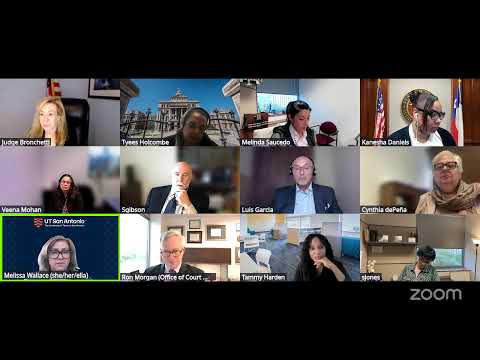
Sandra DeJo, of the Office of Court Administration (OCA) court services division, presented the plan during a meeting of the Judicial Language Access Committee. DeJo said the course would be available for 60 days and would include 20 modules focused on Texas court proceedings, ethics and the three modes of interpreting. “We do not believe 6 hours is enough for somebody that is an aspiring court interpreter to have a grasp of what is needing to become a licensed court interpreter,” DeJo said.
The proposal, which OCA staff described as a pilotable, optional program, is intended to raise passing scores on the oral proficiency portions of the National Center for State Courts (NCSC) licensing exam used statewide. Ron Morgan (staff member) told the committee the largest shortfall is oral exam performance: “The biggest need that we're seeing is that people are having a hard time passing the oral proficiency exam, in order to serve as an interpreter.”
The course DeJo described would be self‑paced over 60 days, include 20 modules (40 instructional hours), quizzes for each module, written and audio practice exercises for sight translation, consecutive and simultaneous interpretation, and Texas‑specific terminology. DeJo said modules 1–6 would prepare candidates for the written exam; modules 15–20 would focus on oral exam skills. She proposed recording the modules, hosting them online, and providing an email help line for students. DeJo outlined a four‑week development timeline for preparing modules, plus additional weeks for recording, uploading and testing materials.
OCA staff said the program could be hosted on OCA or JBCC/JVCC learning platforms and could be provided to candidates at little or no fee because initial development would be funded through staff time. Leo Perales (OCA) added that such a hands‑on, practice‑oriented course would offer more concrete preparation than the limited materials currently on agency websites and could be especially helpful for “languages of lesser diffusion” for which Texas lacks a testing infrastructure.
Committee members discussed several complementary or alternative steps: expanding the current statutory/rule orientation (currently described as at least six hours), adding prescreening or intake questions to better profile candidates, offering practice tests, and piloting a skills course for candidates who pass the written exam. Cheryl Jones, deputy director who oversees licensing, urged a change away from relying on short six‑hour orientations because, she said, “a lot of those who are taking the exam and not passing are the ones that are taking the 6 hour courses.” Jones said expanding orientation hours would likely require staff and vendor alignment.
Members debated bifurcated testing (administering one mode, typically simultaneous interpretation, as an initial screener) and keeping partial scores valid for a limited period to allow candidates who narrowly fail one section to retake only that section. Some committee members said bifurcation could reduce rater and candidate burden but would increase travel and scheduling burdens for candidates in a large state. Tammy Harden (JBCC) and others said voluntary practice and an enforced skills course could reduce repeat unsuccessful testers and improve outcomes.
Legal and administrative constraints were discussed. Scott Gibson, general counsel, advised that the current rule language requires an orientation of at least six hours but does not forbid a longer orientation. Committee members noted that any requirement to make longer training mandatory could require a formal rule change through the commission and the Texas Supreme Court and a public comment period.
Next steps agreed by members included circulating DeJo’s syllabus and slide deck to committee members, having staff (Morgan and Tammy Harden, among others) draft a memo with options and recommended next steps, and scheduling a follow‑up meeting (committee members discussed possible dates in mid‑October). Morgan said staff would prepare a memo and circulate backup materials to members the following week.
Votes at the meeting were procedural: the committee approved the minutes from its July 10 meeting by voice vote and later voted to adjourn. The committee recorded no public comments during the meeting and moved to adjourn after the training discussion.