THECB advisory panel reviews formula funding, forms working groups on inflation and infrastructure
Loading...
Summary
A coordinating-board advisory committee reviewed the structure and purpose of Texas’ higher-education formula funding and voted to form two working groups to develop recommendations on funding levels (including a possible inflation adjustment) and on infrastructure and deferred-maintenance reporting.
A coordinating-board advisory committee reviewed the structure and purpose of Texas’ higher-education formula funding and voted to form two working groups to develop recommendations on funding levels (including a possible inflation adjustment) and on infrastructure and deferred-maintenance reporting.
The briefing was presented by Andy McLaren, Assistant Commissioner for Funding at the Texas Higher Education Coordinating Board (THECB). McLaren described formula funding as the mechanism the state uses “to objectively and equitably distribute state funding among institutions of higher education,” explained core formula components, and outlined the board’s timeline for preparing biennial funding recommendations to the Legislative Budget Board and the governor’s office.
Why it matters: Formula funding and any inflation adjustment feed into THECB’s recommendations for the next biennium and shape the lump-sum appropriations that general academic institutions use for salaries, instruction, facilities, research and related operations.
McLaren said formula funding can be applied two ways — to set a rate or to fund additional enrollment growth — and that institutions receive money as a lump-sum appropriation and then decide how to allocate it locally. He reviewed the formulas the board uses most often: an Instructions and Operations (I&O) component driven by semester credit hours (weighted by level and field); a teaching-experience supplement (for undergraduate credit hours taught by tenured/tenure-track faculty); an infrastructure formula based on predicted square feet (PSF) for operations, maintenance and utilities; a small-institution supplement for institutions with headcounts under 10,000 (with a flat amount under 5,000 that phases down to a cap at 10,000); the Comprehensive Regional University (CRU) component (degrees to at‑risk students); and special formulas for Lamar State Colleges (INA, contact hours) and for Texas State Technical College (TSTC) that use a returned-value approach.
McLaren reviewed recent funding and legislative changes the board tracks, including research funding mechanisms such as the Texas University Fund (TUF) and the National Research Support Fund (NRSF). He said the TSTC returned-value calculation led to a roughly $40 million biannual increase in formula funds for TSTC in the most recent run.
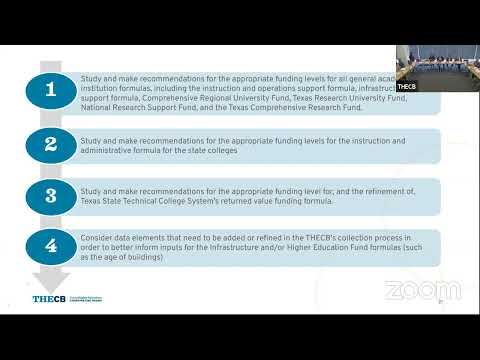
Committee members discussed priorities and voted to create two working groups. The first will develop recommendations on appropriate funding levels for general academic institutions — including how an inflation adjustment might be structured and tied to state affordability goals. Several members cited inflation indices: one committee member referenced cumulative Consumer Price Index growth since 2021 of about 24% and an HEPI figure near 17% as context for any adjustment. Emily Dierdorf volunteered to chair the funding-level working group; additional volunteers included Sherry, Judy and Jason (committee members who identified themselves during the meeting).
The second working group will examine infrastructure reporting, deferred‑maintenance data and whether THECB should resume or change campus-condition reporting. Members noted the current infrastructure metric (predicted square feet) is intended as an “equitable assessment of space need” and not a measure of actual square footage. The committee discussed sources of condition data and consultants used by institutions; several members referenced that some systems use Gordian for deferred-maintenance estimates. Committee members also asked staff to consider how to aggregate deferred-maintenance metrics across institution types (GAIs and HRIs) and whether the board’s data collection methods should change to improve comparability.
Administrative items and votes: the committee held elections and confirmed a vice chair by voice vote (Jason Baldwin consented to the nomination and was confirmed). The committee also elected a chair by voice vote (the meeting record shows a chair election by voice vote; the transcript does not clearly identify the nominator). The committee set a next full committee meeting for Thursday, Sept. 25 (virtual) and discussed an in-person meeting on Dec. 4. Members agreed working groups should meet virtually at first; each working group is limited to five members to avoid constituting a quorum for the full advisory committee.
Quotes
"Formula funding is intended to objectively and equitably distribute state funding among institutions of higher education," Andy McLaren said during his presentation.
Daniel Harper, convening as former chair, thanked members for their service and emphasized the committee’s role in advising the coordinating board: "We are here working on behalf of the entire state and all of the GAIs," he said.
Emily Dierdorf, volunteering to chair the funding-level group, said she would include an inflation-adjustment review: "I'll cover the inflation adjustment in there," she said.
Ending
Staff told the committee they will send preliminary funding runs to the Legislative Budget Board and the governor’s office next year as part of the standard biennial process and invited members to identify additional data they want before the working groups meet. The panel adjourned and will reconvene virtually on Sept. 25; members expect to report back on working-group deliberations at future advisory meetings.