Get Full Government Meeting Transcripts, Videos, & Alerts Forever!
Get email alerts on the Land Use Zoning topic
No spam. Unsubscribe anytime.
Westminster planning commission continues public hearing on Wakefield Valley amendment
Summary
The Westminster Planning and Zoning Commission on Thursday continued the public hearing on a proposed amendment to the Wakefield Valley general development plan (DP2401) that would add up to 35 single-family lots on Parcel W and dedicate Parcel X as open space, citing the need for more review of traffic, water allocations and final plans.
The Westminster Planning and Zoning Commission on Thursday, Sept. 18 continued the public hearing on Wakefield Valley development plan amendment DP2401, an applicant proposal to add up to 35 single-family detached dwelling units on Parcel W and to dedicate Parcel X as open space to Carroll Lutheran Village or the City of Westminster.
The public hearing was opened by Chairman Thomas Fair and the hearing record was led by city planning staff member Mark Dieter, who summarized the application and the staff recommendation. Dieter said the application before the commission is "the proposed fifth amendment to the Wakefield Valley general development plan" and described prior iterations that proposed 25 and then 32 density rights before the current proposal for 35 lots on Parcel W and dedication of Parcel X for open space.
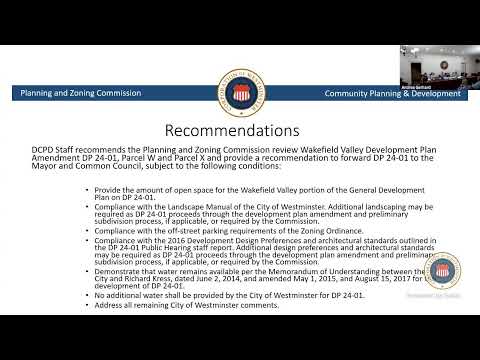
The proposal matters, staff and applicants said, because Wakefield Valley is controlled primarily by a 1978 development plan that predates the city's zoning map; any amendment must show it does not increase gross allowable density beyond the original plan and that it meets several code subsections. Planning staff recommended the commission forward DP2401 with a favorable recommendation to the Mayor and Common Council subject to seven conditions, including compliance with the City of Westminster landscape manual, off-street parking requirements, architectural standards and development timing preferences; additional landscaping and architectural standards as required during subsequent subdivision and site-review steps; demonstration that water remains available under a memorandum of understanding (MOU) between the city and owner Richard Kress (later amended); a statement that "no additional water shall be provided by the City of Westminster for DP2401"; and resolution of all remaining City of Westminster comments.
Applicant representatives walked the commission through density, open-space and water calculations. Land-use consultant Marty Hackett said the Wakefield Valley plan originally allowed roughly 768 units in 1978; about 549 units are built today and "the total plan is coming out at 643 units" under current accounting. Hackett and other applicants presented calculations showing the proposal would lower the average density across the Wakefield plan from the 1978 figure of about 1.6 units per acre to about 1.24 units per acre for the amended plan. They also showed open-space figures that, they said, increase the Wakefield plan's open-space share from about 41% in the 1978 plan to about 43.2% with the amendment.
On water, the applicant said the development would rely on water allocations governed by a memorandum of understanding tied to earlier property transactions. The applicants told the commission the MOU provided roughly 70 single-family water allocations originally and that about 10 have been used for other projects, leaving roughly 60 allocations available for Wakefield-related development. Mark Dieter noted staff would require the applicant to "demonstrate that water remains available per the memorandum of understanding between the city and Richard Kress" as a condition of any favorable recommendation.
Traffic and circulation were reviewed by the applicant's traffic expert, who said a July 8, 2025 traffic study modeled the 35-lot subdivision and concluded the project would generate a small number of new peak-hour trips (approximately seven evening peak trips) and would not change the existing level-of-service categories at study intersections beyond minor impacts. The traffic witness said most intersections would remain within acceptable planning thresholds but that two approaches show level-of-service D under some analyses; commissioners asked for the final, signed traffic study and for staff to confirm which analysis method (Critical Lane Volume or Highway Capacity Manual) will govern county review.
Commissioners pressed applicants on grading, tree preservation, sight lines and stormwater. Applicants said most existing tree screening along the former golf course entrance would remain, that grading would be limited to the development footprint, and that stormwater management facilities would be designed to city standards; they noted the stormwater facility might be sited either on Parcel W or within the dedicated open-space area depending on final design and the city's acceptance of parkland dedications. Applicants described a small "pocket" park that would remain under homeowners-association maintenance and larger open-space parcels intended for dedication to the city or Carroll Lutheran Village.
Property owner Richard Kress addressed the commission and described the site's history, including his family's earlier donation of the Wakefield clubhouse and surrounding open space to the city. Kress said the parcel purchase and subsequent work were intended to secure water and to allow limited future development: "We're just hoping to get these lots approved so that I can get some of my money back that it took to get Stonegate going," he said, and added the development would use single-family houses in roughly the 2,800–3,800 square-foot range.
After several hours of questions and testimony, the commission voted to go into a brief closed session to consult counsel about "the implications of a prior lawsuit regarding the property," citing Maryland statutory authority for a closed legal-advice session. When the public meeting resumed, commissioners also voted to continue the public hearing to a later October meeting and left the record open for additional material; the transcript records multiple references to possible dates (Oct. 21 and Oct. 25) while staff and the commission confirmed an October continuation and requested that the applicant supply an electronic and paper copy of the complete submission, including the final traffic study, for review before the next meeting.
What remains: the commission asked staff to circulate the full application materials and the final traffic study, and it directed the record remain open until the continued hearing. The Mayor and Common Council will make the final decision on any amendment to the Wakefield Valley general development plan after the commission's recommendation and any required public notices and hearings.
Votes at a glance: approval of the Nov. 21, 2024 meeting summary was moved, seconded and passed by voice vote; the motion to go into closed session to consult counsel under Maryland law was moved and seconded and carried by voice vote; the motion to continue the public hearing was moved and seconded and carried by voice vote (transcript shows conflicting date references while the commission agreed to continue the hearing in October and to reopen the public record).