Get Full Government Meeting Transcripts, Videos, & Alerts Forever!
Get email alerts on the School Safety topic
No spam. Unsubscribe anytime.
Port Jervis board hears extensive districtwide safety upgrades; approves new security attendants
Summary
At a Port Jervis City School District Board of Education meeting, Buildings & Grounds Director Justin Bosch outlined districtwide safety upgrades — including door‑swipe access with a 20‑second lockdown delay, protective window film and lockdown shades, expanded camera monitoring, a Knox‑style responder box and new PA/visual alert systems — and the board approved personnel changes that add security attendants.
At a Port Jervis City School District Board of Education meeting, Buildings & Grounds Director Justin Bosch described a series of districtwide safety measures the district has installed or is rolling out and noted the board approved personnel changes that add security attendants.
Bosch told the board that nearly all campus exterior and classroom doors now use electronic card swipes and that the district programs a 20‑second delay before swipes lock during a lockdown so students and staff in hallways have time to enter classrooms. He said IT can remotely change access for particular staff and that law enforcement badges continue to work during a lockdown.
Bosch also described protective window film installed on first‑floor classroom windows and a rolling “lockdown” shade installed in classrooms to block sight lines into rooms during an event. “If there’s an intruder in the building, they’re going to look in the window. They’re going to wiggle the door. Door’s locked, they can’t see, they’re going to move on,” Bosch said, describing the goal to “buy seconds” for responders to arrive.
The district has about 270 cameras across campuses, Bosch said; they can be monitored in a command center during incidents but do not record audio. He described plans to provide camera access to law enforcement during an incident, and noted the district runs off‑hour drills with law enforcement to familiarize officers with campus layouts.
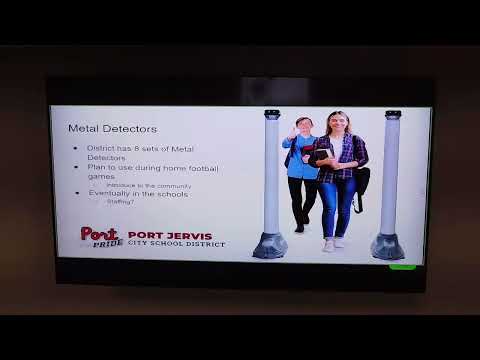
Other safety items Bosch described: installing a Knox‑style box outside buildings to store maps, keys and access badges for emergency responders; upgraded public address and large visual display speakers (shown as text and lights during a lockdown) in cafeterias, gyms and some hallways; strobe lights to signal a school is in lockdown to people approaching campus; deployment of Naloxone (Narcan) nasal kits at high schools with planned staff training; and acquiring eight sets of metal detectors to introduce first at community events before broader school use due to staffing limits.
Bosch said the district has moved to a staffing model that includes five SROs (one assigned to each building plus one roaming SRO) and 10 security attendants (approved by the board in the personnel agenda earlier in the meeting). He said security attendants come from retired law enforcement and corrections backgrounds and are intended to provide a consistent, trained presence in hallways and common areas, working with SROs and school administrators rather than replacing law enforcement.
Board members asked about drill frequency and implementation details. Bosch said the district runs four lockdown drills per year and nine evacuation drills, and that classrooms and exterior windows are numbered so law enforcement can rapidly identify a room from the exterior. He said cameras cannot capture audio and that card deactivation for staff who leave the district is handled but the exact timing is “being determined.”
The board also approved the personnel employment agenda during the meeting, which the district staff said includes security attendant appointments; the personnel agenda passed by voice vote without a roll‑call tally reported in the transcript.
Why it matters: Bosch emphasized that many of the changes are intended to “buy seconds” in an active event and that most purchases were budgeted through capital reserve, general budget or technology funds or offset by grants. Several board members noted they appreciated the improvements and asked the administration to continue training and formalize de‑escalation and integration training for new security staff.
Bosch asked whether there were additional questions; none were raised that altered the description of the district’s current measures.
Ending: The safety presentation concluded before the buildings and grounds capital projects report; several board members thanked Bosch and district administrators for the work underway.