Get Full Government Meeting Transcripts, Videos, & Alerts Forever!
Get email alerts on the Enrollment And Capacity topic
No spam. Unsubscribe anytime.
Olentangy officials press need for two new schools as enrollment surges; bond would not raise tax rate
Summary
Board leaders and the superintendent said a November bond issue would fund two new schools without increasing the local tax rate; the board cited rapid enrollment growth, housing permits and student-yield calculations as drivers of the request.
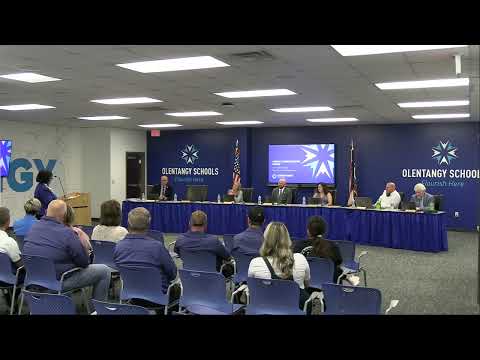
Board leaders and the superintendent outlined enrollment projections and a proposed November bond that would fund one new high school and one new elementary school at no new millage, telling the Olentangy Local Board of Education on Sept. 11 the district’s growth already requires additional capacity.
Board President Mr. Lester and Superintendent Mr. Meyer said the district has added about 5,000 students in the last decade and projects roughly another 5,000 students in the next 10 years. The bond proposal as described to the board would pay for the two immediate-need buildings without increasing the tax rate; administrators said operating funds for the new schools are accounted for in the district’s five-year forecast.
Why it matters Administrators and trustees said the district is growing by roughly 500 students per year and that growth is concentrated in younger grades: Meyer said enrollment in grades 5–8 currently exceeds grades 9–12 by about 150 students, which feeds into future high-school needs. Meyer told the board that an elementary school typically enrolls roughly 625 students, so current growth is equivalent to nearly three-quarters of an elementary school each year.
Numbers, housing and student yield The administration presented several figures to demonstrate the scale of growth and the fiscal context: - The district’s funded enrollment (used for state funding) for the prior year was 22,582; head count at the start of the current year was reported near 24,000. - The district reported roughly 500 new students arrive each year. - From the first eight months of 2025, building permits recorded included 520 single-family and 266 multifamily permits (786 total) in district territory. - The district uses a planning yield of 0.8 students per single-family home and 0.2 students per multifamily unit. - The district estimates that the state provides about $1,574 per pupil under current funding lines while the district’s per-pupil cost was presented as about $17,264; the difference, as described by the treasurer, represents the local funding responsibility.
Board and superintendent remarks “It is a straightforward issue for us. It’s about enrollment,” Meyer said, summarizing the board’s rationale. Mr. Lester clarified that passing the bond to build schools would not increase the tax rate; he also warned that additional operating requests will likely follow as growth continues because “in the three years it would take to build a high school, we have gotten enough students to fill a high school.”
What the bond would and would not do Administrators stressed the bond is intended to add facility capacity without increasing the district’s current tax rate. They said the district has reduced its tax rate by 1.5 mills in recent tax years and has used refinancing (refunding) to lower future debt-service costs; the district reported recent refundings that reduced future payments and cumulative savings since 2012.
Why the board cares Trustees said continued growth strains classroom space, specialized program availability and extracurricular opportunities, and that crowding can reduce the district’s ability to maintain current instructional practices that staff and board leaders underscored as central to student outcomes.
Ending Administrators said community information sessions will continue across the district and urged residents to attend to ask questions about enrollment forecasts, taxes and timelines before the November bond vote.