Get Full Government Meeting Transcripts, Videos, & Alerts Forever!
Get email alerts on the District Budget Review topic
No spam. Unsubscribe anytime.
Timberlane budget committee reviews SAU, school board, technology, curriculum and professional learning budgets; unanimously accepts them for review
Summary
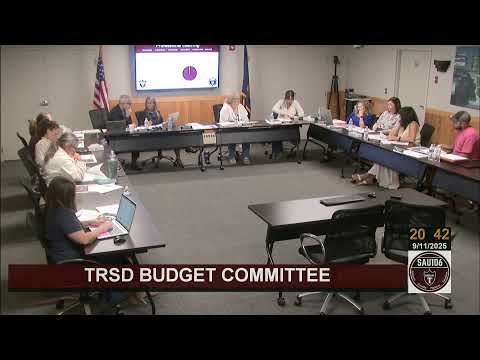
The Timberlane Regional School District budget committee on Sept. 11 reviewed proposed SAU, school board, technology, curriculum and professional learning budgets and voted unanimously to accept each for further review.
TIMBERLANE REGIONAL SCHOOL DISTRICT — The Timberlane Regional School District budget committee on Sept. 11 reviewed proposed budgets for the SAU, the school board, technology, curriculum and professional learning and voted unanimously to accept each for further review. Committee members recorded seven votes in favor, none opposed and no abstentions on each motion.
The district’s current fiscal-year budget voted on the warrant totaled about $82 million, presenters said. Salaries account for the largest single share — roughly 47.7% (about $40 million) — with benefits at about $21 million (roughly 26%) and operating costs making up the remaining quarter of the budget. Maria, district finance staff, told the committee that operating expenditures rose by about $5 million between fiscal 2023 and fiscal 2025, and that roughly $3 million of that increase reflected a lease prepayment while $1.8 million covered contracted services used where the district could not hire staff.
"In 2025, we have 274 budget entries," Maria said during her financial overview, explaining the number of transfers used to keep accounts accurate over the fiscal year. She described the transfers as a routine accounting practice to ensure expenses are charged to the proper account and noted the district reports those transfers to the state.
Why it matters: committee members and staff framed the presentations as the first step in a multiweek review process that will culminate in formal votes on cost items and articles later in the season. The committee also discussed a recent state law change — House Bill 394 — that removed the school board member’s vote on the budget committee and requires the budget committee to take votes on all cost items, including the operating budget.
SAU and school board budgets Slightly more than 1% of the district’s total budget is dedicated to the SAU (shared administrative unit), the presenters said. Dean, a district staff presenter, said the SAU budget covers roughly 15 staff, districtwide mailings and memberships in multiple professional organizations; the proposed SAU appropriation for fiscal 2027 was presented at about $102,836.
At the school board level, presenters described a budget that covers legal fees (the largest single driver), auditing costs, stipends for clerks and treasurers, and the costs of running the district’s annual and deliberative meetings. The proposed school board budget was presented as roughly $313,870, with legal fees representing about 59% of that amount. Presenters noted the district is exploring options to shift certain legal costs to the district’s insurance provider when appropriate.
Technology Technology director Ken told the committee the technology budget proposal — about $1.1 million for fiscal 2027 — supports the district’s one-to-one device program for students and staff, enterprise software (PowerSchool and related systems), and increasingly networked physical-security systems such as video surveillance, access control and intercoms. Ken said a major capital item in the proposal is a campuswide intercom replacement to serve three campus buildings (the middle school, PACK and the high school) and roughly 1,800 students in those buildings. He described growing recurring subscription and cloud-storage costs for video and security services and said some previously capitalized warranties are now moving to annual subscription lines.
Curriculum and professional learning Assistant Superintendent Sandy Allaire described the curriculum budget (about 0.32% of the operating budget) as districtwide instructional resources for preschool through grade 12. She said the district has shifted away from hard-copy textbooks toward online resources and that the i-Ready platform now provides both diagnostics and embedded instructional materials used across math and reading. Sandy said the district is expanding i-Ready usage to grade 9 to obtain additional diagnostic data at the secondary level.
Sandy also noted upcoming state requirements that will affect curriculum costs. She cited House Bill 1015 (effective July 1, 2027), which requires districts that serve elementary grades through 5 to provide research- and evidence‑based literacy and math instruction. "We will have to vet resources to make sure they meet the minimum requirements," she said, and added that the law was written without a statewide cost estimate, leaving local districts to absorb implementation costs.
Professional learning funds are primarily driven by contractual benefits that include tuition reimbursement and stipends for staff. Presenters said about 70% of the professional learning line is contractual benefits; the district also uses Title II and other grant funding to reduce operating costs for professional development and mentoring.
Committee process and next steps Presenters described the budget review format: each departmental presentation will include a “part of the whole” slide, drivers, future-oriented "seeds" and a closing slide showing the department’s share of the budget. Committee members discussed whether to vote on budgets as presented or to review all materials and vote later; the group agreed to review materials and gather questions before voting on final recommendations.
Votes at a glance - Motion to accept the SAU budget for review — Approved, 7-0-0 (mover: not specified; second: not specified). - Motion to accept the school board budget for review — Approved, 7-0-0 (mover: not specified; second: not specified). - Motion to accept the technology budget for review — Approved, 7-0-0 (mover: not specified; second: not specified). - Motion to accept the curriculum budget for review — Approved, 7-0-0 (mover: not specified; second: not specified). - Motion to accept the professional learning budget for review — Approved, 7-0-0 (mover: not specified; second: not specified).
The committee asked staff to circulate detailed materials and to add specific follow-up items to future agendas; presenters said they would provide additional line‑level documentation, quotes and clarifications at upcoming meetings. The committee scheduled building tours and future presentations to coincide with school events in October and November.