Rockdale board to consider CTAE local application; district reports growth in career and technical programs
Summary
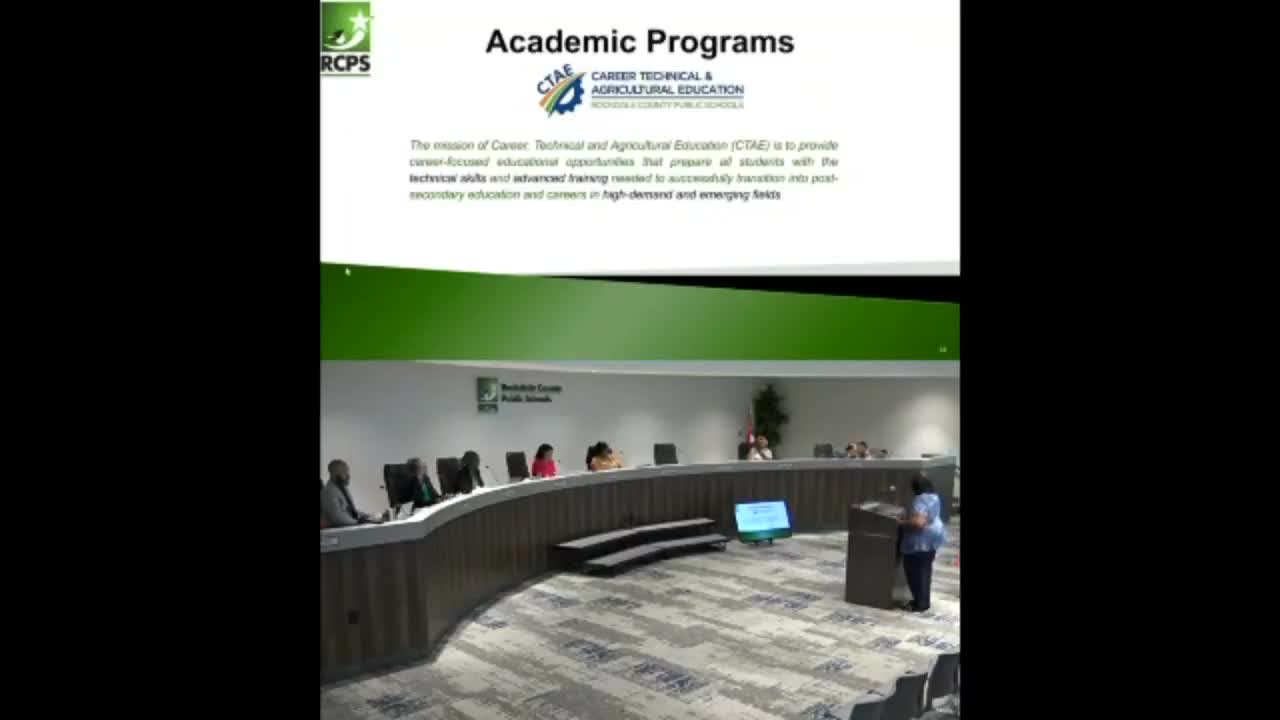
The superintendent will recommend approval of the FY26 CTAE local application ($361,160). Career, technical and agricultural education (CTAE) officials reported pathway expansions, increased pathway completers and growth in work-based learning placements.
Rockdale County Public Schools staff asked the board to approve the district’s Career, Technical, and Agricultural Education (CTAE) local application for fiscal year 2026 and reported growth across CTAE pathways and work-based learning placements.
Dionne Jonagan, the district’s career-technical director, presented the application and said its total financial impact is $361,160. She provided a breakdown: $196,541 in federal funds, $153,651 in state funds and $10,968 for Ag Ed extended day and extended year support for FFA activities. The superintendent will recommend board approval of the application at the regular session.
Jonagan outlined pathway additions and program expansion. At Heritage High School, the district added a marketing, communications and promotions pathway; Salem High School added financial technology. The district also added new career academy pathways — including nail care services and phlebotomy — and a legal-services offering in the public-safety pathway. Jonagan reported that 1,262 students completed pathways and that 80% of pathway completers earned an industry-related certification. She said the district’s graduation rate stood at 99.5%.
Work-based learning coordinator Dr. Brandy Johnson presented detailed program metrics and the application process. She said the program had 134 students (spring baseline) in the prior year and reported 22,257 hours worked across placements with paid wages exceeding $55,000 for students who held paid positions. Johnson told the board the program conducted about 182 job visits and that 75 students earned Georgia BEST employability certificates; 77 work-based learning students were also enrolled in dual enrollment. She said four youth-apprenticeship completers met the program’s credentialing requirements and that program graduation among tracked apprentices was 100%.
Johnson described application and selection timing: the work-based learning application goes out in October and closes in November in order to provide counselors and staff time for placement by December and scheduling during academic advisement. She described the program’s vetting — attendance, discipline, academic record and counselor recommendation — and said students must be at least 15 for many off-campus placements because of transportation constraints. Johnson said the program will place a cohort of 25 students at Piedmont Rockdale Hospital this year and that those placements require additional modules and documentation.
Board members asked about second-year student placements and whether returning students take slots that could go to first-time participants. Johnson said returning students provide networking benefits and that some employer partnerships persist only because of returning students; she said she had 22 returning students and that second-year placements often reinforce partnerships and student success. Jonagan and Johnson also described school-based enterprises as one way to address transportation barriers because those placements allow students to ride school buses.
The board will consider the CTAE local application and related grant funds during the regular session; the work session presentation did not record a formal vote on the application.