Get Full Government Meeting Transcripts, Videos, & Alerts Forever!
Get email alerts on the Capital Budget topic
No spam. Unsubscribe anytime.
Norwood committee approves FY2026 capital plan, sends warrant articles to selectmen
Summary
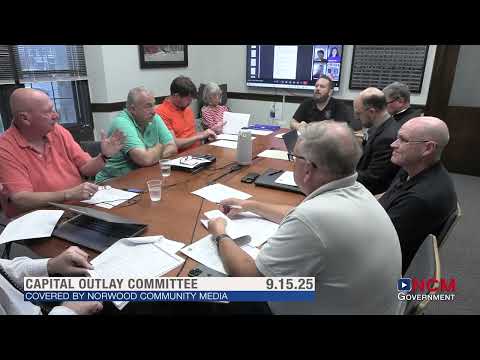
The Capital Outlay Committee voted unanimously Sept. 15 to approve the town's FY2026 capital projects plan and to accept the FY2026—60 capital improvement plan report, moving borrowing authorizations and project presentations toward the November town meeting warrant.
The Norwood Capital Outlay Committee voted unanimously on Sept. 15 to approve the town's fiscal year 2026 capital projects plan and to accept the FY2026—60 capital improvement plan report, sending both items to the finance commission and the Board of Selectmen for placement on the Nov. town meeting warrant.
The vote clears a FY2026 spending package that includes a $3,000,000 appropriation for a fully equipped fire ladder truck, a $2,000,000 exterior-focused project for the public library, and funding for an HVAC study for the town's elementary schools. The committee also reviewed a multi-year outlook that lists potential future projects such as Meadowbrook Town Hall work, stormwater projects, and road repairs including Washington Street.
Why it matters: Approval at the committee level allows staff to present formal warrant articles in October and November. If voters authorize borrowing at Town Meeting, the town will be able to seek purchase orders and, later, issue debt for large projects. The committee and staff emphasized that the plan prioritizes repair and maintenance of existing assets rather than major expansions.
Town staff and committee members described the plan as conservative and focused on preserving current infrastructure. Tony, the town's general manager, summarized the approach as a 'pretty vanilla capital plan' that aims to 'fix what we have and repair and maintain what we have' rather than expand municipal facilities. He also invoked a long-standing budgeting principle he attributed to a former official, saying the effort is to do 'nothing more, nothing less.
On the fire ladder truck, town staff explained the $3,000,000 figure covers the truck and complete equipment outfitting so the department will not need to return the following year to fund missing components. Tony said the town typically seeks full purchase authorization at Town Meeting so procurement and bid work can proceed; if an approved project later requires more money, the town would return to Town Meeting for a supplemental appropriation.
The library project was described as phase 1 work focused on exterior sealing and water infiltration fixes, not a full interior renovation. Tony said the building's chiller is less than 10 years old and the plan is to address the envelope and sources of water infiltration first; subsequent phases could address mechanical, electrical and plumbing (MEP) systems and interior refreshes.
Committee members pressed for clarity on the large items in the out years, including a multi-million-dollar Town Hall project. Staff and members discussed the trade-offs between staging work in smaller chunks and pursuing a single, comprehensive renovation. Staff warned that major work on Town Hall likely would trigger full-code upgrades that could significantly increase cost; design and engineering work is expected to better define what can be phased and what must be completed together.
On school facilities, committee discussion noted an HVAC study that produced a broad estimate in the hundreds of millions for comprehensive upgrades to elementary schools. Staff and school representatives said each school will have different needs and that solutions could range from targeted electrical upgrades and portable cooling units to larger system replacements, depending on the findings.
Financial context: committee members were told approximately $3,000,000 of the recommended projects could be funded from free cash, and staff reported an estimated free cash balance near $10,000,000 pending November recertification. The committee heard that some stormwater projects will likely require a dedicated fee or other mechanism because the general fund cannot absorb all stormwater capital costs.
Votes at a glance - Approval of Aug. 26, 2025 meeting minutes: outcome approved, roll-call result 6 yes, 1 abstain (see actions for full vote record). - Approval of FY2026 capital projects plan (warrant articles for Nov. town meeting): outcome approved, roll-call result 8'00. - Acceptance of FY2026—60 capital improvement plan report (out-year acknowledgement): outcome approved, roll-call result 8'00.
What happens next: The committee's approvals send the FY2026 warrant articles to the finance commission and the Board of Selectmen; the committee plans to finalize warrant article language at its October meeting. If Town Meeting authorizes borrowing, the town will proceed with procurement and phased borrowing as projects are ready. Staff said some projects could require returning to Town Meeting for supplemental appropriations if final bids exceed authorizations.
The committee also reviewed a draft town meeting presentation and asked staff to add a simple financial breakdown showing how much of the total would be covered by free cash, by borrowing and by enterprise funds. Several members asked staff to explore whether the timing of large projects could be tied to the town's schedule for retiring other debt to reduce taxpayer impact.