Get Full Government Meeting Transcripts, Videos, & Alerts Forever!
Get email alerts on the Infrastructure Spillway topic
No spam. Unsubscribe anytime.
Consultants propose short-term inspection and sketches for Dial Pond spillway; commission agrees to move forward with study
Summary
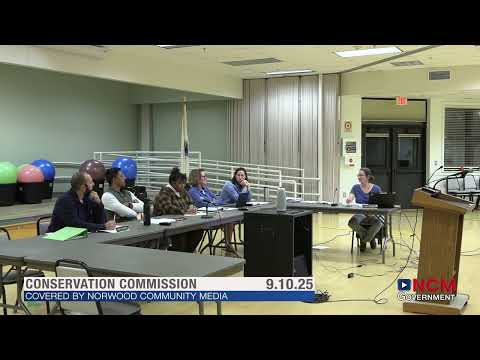
An engineering consultant told the Town of Norwood Conservation Commission Sept. 10 it can perform a limited, visual inspection of the Dial (Geil) Pond spillway and provide conceptual sketches for short‑term repairs if feasible.
An engineering firm presented a revised proposal Sept. 10 to assess interim fixes for the Dial Pond (Geil Pond) spillway, offering a two‑task scope: a limited, visual field inspection by a registered professional engineer and, if short‑term repairs appear feasible, conceptual sketches and notes describing a possible short‑term solution.
Heather, a representative of the consultant team, said the first task would be a document review and a field inspection limited to visual assessment of the spillway and associated channel substrate. The inspection would identify whether short‑term measures could be implemented, outline a timeline for repair, and summarize risks of using the structure “as is” while long‑term repairs are planned. If short‑term solutions are viable, the firm would add a second task of conceptual drawings using field data, limited LIDAR or aerial data if available, and sketches to show the general scope.
The firm said the prior fee for the study had been $5,000; with the revised two‑task scope they proposed an additional $2,500, for a new total of $7,500 (task 1: $2,500; task 2: remaining amount). Commissioners asked whether the firm would provide price estimates for implementation options; the consultant confirmed they would include contractor pricing references and adjust them for inflation as a reference.
Commission members discussed likely short‑term measures based on comparable local work: bulk/fiber bags, riprap and wall packs. The consultant said some previously installed interim solutions at other sites have lasted more than a year and that the appropriate short‑term measure will depend on the channel substrate and site conditions discovered during inspection. Commissioners also clarified that the firm is an engineering consultant and that the town would contract construction work separately if a repair option is chosen.
The commission agreed to authorize the consultant to proceed with the limited study and conceptual sketches under the revised scope; that authorization was recorded in the meeting discussion but not as a formal, roll‑call vote in the provided excerpt.
The firm said it would schedule the field inspection, deliver a summary report with feasibility conclusions, and include cost references for potential repair options. The commission requested staff follow up on schedule and contracting steps for any subsequent construction work.