Get Full Government Meeting Transcripts, Videos, & Alerts Forever!
Get email alerts on the Property List Cpa topic
No spam. Unsubscribe anytime.
Norwood commission to compile list of town-owned properties, historic sites and housing opportunities
Summary
The Town of Norwood Community Preservation Commission agreed to assemble a draft list of potential preservation, historic and housing sites — starting with town‑owned properties and assessor records — to help prompt CPA applications and outreach.
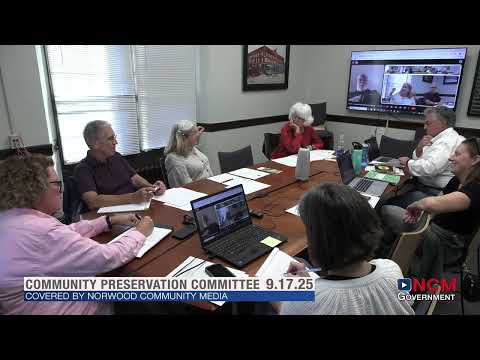
The Town of Norwood Community Preservation Commission agreed Wednesday to assemble a draft list of town‑owned properties, historic sites and potential housing sites to help community members identify locations that could be targeted for future Community Preservation Act (CPA) funding applications. The commission asked staff to start with assessor records and to consult commission members on open space, historic and housing priorities.
Commissioners said the list is intended as a prompt to help new project proponents and community groups prepare CPA applications, not as a definitive inventory. Kristen (staff) and a small working group will pull assessor data and existing cultural inventories, then return a draft to the full commission for review. Commissioners set a nonbinding target to prepare an initial draft during the coming months and to refine it over the winter, aiming to circulate a draft by year‑end or soon after town meeting.
Members discussed where data should come from and how broad the list should be. The assessor’s office was identified as the primary source for town‑owned property records; the commission also discussed using the town’s cultural inventory (referred to in the meeting as “MACRA/cultural inventory”) and existing lists held by the Historical Commission. Commissioners stressed that eligibility for CPA funding depends on project type and that not every address on a list would automatically be approved for funding.
Commissioners debated whether the list should include privately owned properties and where to draw the line on what qualifies as “historic.” Some members urged starting with town‑owned properties to avoid encouraging applications that would primarily fund private home repairs; others favored a broader brainstorming list that could include historic private properties for which owners might seek grants. The group agreed to include a clear disclaimer on any public list noting that inclusion is not a guarantee of CPA funding and that eligibility would be assessed on a case‑by‑case basis.
The commission named roles for assembling the first draft: staff will start with the assessor’s records; committee members will consult specific subject‑matter colleagues — open space, housing and historic preservation — and return recommendations to the full commission. The plan is to prepare a draft for the next meeting cycle and to use the winter months for additional outreach and refinement.
The discussion arose during the commission’s “CPA information session” agenda item, when members summarized a recent community meeting on historic priorities and public suggestions, including a recommendation from a representative of the Norwood Record to prepare a list of potential sites to help solicit proposals.
The commission did not adopt formal policy changes at the meeting; members directed staff and volunteers to assemble and circulate draft lists for review.