Get Full Government Meeting Transcripts, Videos, & Alerts Forever!
Get email alerts on the Well Water Septic topic
No spam. Unsubscribe anytime.
Board permits septic installation at 137 Main Street conditionally while requiring arsenic and coliform clearance
Summary
The Board allowed the owner of 137 Main Street to begin septic work at his own risk, conditioned on subsequent laboratory results showing no arsenic and acceptable coliform levels and on final compliance testing for VOCs.
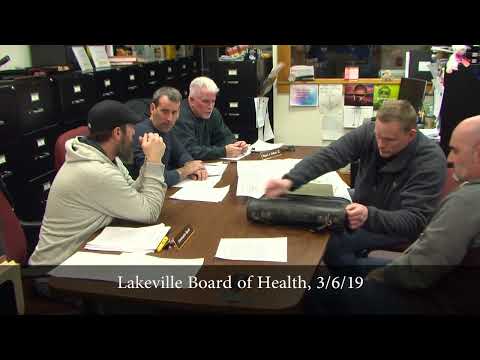
At its March 6, 2019 meeting the Town of Lakeville Board of Health voted to allow installation of a septic system at 137 Main Street to proceed immediately, provided the owner completes required water testing and obtains a certificate of compliance showing the well is free of arsenic and coliform.
Matt Thompson, identified as owner of 137 Main Street, told the board he had renovated the house and wanted to proceed with septic installation before a scheduled March closing for a buyer. He said an earlier water test showed a small arsenic exceedance (0.016 mg/L) and that he had hired a contractor to install treatment. "I just paid, you know, Tom 5,200 to go install the arsenic unit," Thompson said, noting he would also run required volatile organic compound (VOC) testing and repeat coliform and arsenic sampling after treatment.
Board members reviewed the property's history: the well had prior coliform failures in 2015 and again in late 2018. The board reiterated the requirement that, before the Health Department issues a certificate of compliance, the owner must provide lab results showing acceptable arsenic and coliform levels and that VOC results are passing. A board member made a motion to allow the septic work to start now "subject to your compliance" and conditioned on submission of new coliform and arsenic tests; the motion passed on a voice vote.
The board discussed options if the well continued to fail, including installing a new deep well or relocating a well to the front of the property to avoid a previously approved 70‑foot variance. The board also noted that backwash water from any treatment system must not discharge to the septic; it must be routed to a separate leaching area or otherwise handled outside the septic system.
The board said the owner may proceed at his own risk and must obtain passing laboratory results and a certificate of compliance before final signoff. The board did not record a roll‑call vote in the transcript; the outcome is recorded as approved by voice vote.
No public funding or municipal costs were discussed.