Get Full Government Meeting Transcripts, Videos, & Alerts Forever!
Get email alerts on the Water Infrastructure topic
No spam. Unsubscribe anytime.
Lakeville approves $100,000 for water-tower design, moves lawsuit proceeds into water fund
Summary
At the June 15 town meeting, Lakeville voters approved transferring settlement proceeds into the town's water-stabilization account and voted to use $100,000 from that fund to pay for design work on an elevated water storage tank and pump station, with debate over whether one-time lawsuit funds should be used.
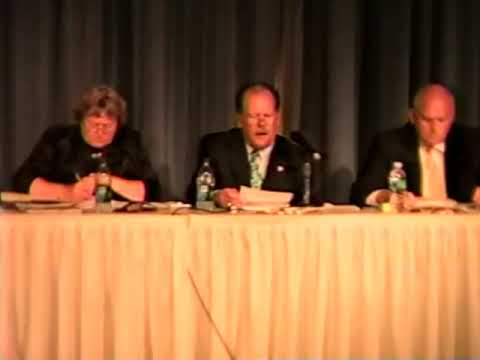
Lakeville — Voters at a June 15, 2009 Lakeville town meeting approved a package of transfers that included adding $34,342.43 in settlement proceeds to the town’s Water Infrastructure Improvement Stabilization Fund and then authorizing $100,000 from that fund to pay for design work on an elevated water storage tank and pump station.
Supporters said the design money is “seed” funding required to apply quickly for low-cost state loans and federal stimulus (ARRA) allocations that have tight deadlines. Selectman Nancy Yates said the project would address low system pressure, enable future master metering and allow Lakeville to capture water‑sales revenue now received by neighboring Taunton. “For the first time in a hundred years, Lakeville has the opportunity to realize revenue from our own water,” Yates said.
Opponents and some voters urged caution. Several speakers warned that much of the stabilization fund comes from a lawsuit settlement tied to contaminated town wells and argued those one-time dollars should be preserved for remediation or other long-term needs. A resident who identified himself as Leo DuBois questioned how buying treated water from Taunton and storing it in a town tower would produce net revenue. “If we do nothing, we have no pressure,” Yates replied, citing fire-suppression and development constraints without the tower. Finance committee members and selectmen also discussed using betterment and user fees to repay debt rather than relying on the general fund.
Finance Committee recommendation and vote counts: the finance committee recommended approval. The design-appropriation article required a two-thirds vote because it used stabilization funds; tellers counted the meeting and the moderator declared the article passed by the required margin after a hand-count that the moderator summarized as 281 in favor, 29 opposed (two-thirds threshold met).
Background and next steps: Town officials explained the design money would pay architects and engineers to prepare drawings and bid documents so Lakeville could be “shovel‑ready” for an SRF (State Revolving Fund) loan and potential ARRA (American Recovery and Reinvestment Act) stimulus funds. Officials repeatedly said receipt of grant or SRF assistance is not guaranteed — the town must meet a fast federal/state timeline to remain eligible. Town staff indicated subsequent steps and any borrowing or betterment assessments would be brought to voters in later articles (the water-tower construction and financing were on the warrant as later articles).
Other related transfers: Earlier in the evening the town voted to transfer $34,342.43 from a special-revenue reserve into the Water Infrastructure Improvement Stabilization Fund (finance committee recommended approval; the moderator declared it passed by the required two-thirds vote). Voters also approved several routine transfers to close fiscal-year 2009 accounts earlier in the special meeting.
Why it matters: Lakeville officials framed the project as infrastructure needed to support commercial development (including a planned redevelopment near the train station and Great Ponds Industrial Park), improve public-safety water pressure, and capture local water-revenue that is currently realized by another municipality. Opponents cautioned against using one-time lawsuit dollars as recurring solutions.
What to watch: Detailed design costs, whether the town wins SRF/ARRA funding, the final construction budget, and decisions about betterment or user-fee schedules that would determine who ultimately pays to extend and use the system.