Get Full Government Meeting Transcripts, Videos, & Alerts Forever!
Get email alerts on the Zoning R1a topic
No spam. Unsubscribe anytime.
Passaic residents urge council to amend R1A zoning amid proposed 194-unit development
Summary
Dozens of residents and neighborhood leaders urged the City of Passaic Council to remove high-rise conditional uses from the R1A zoning district, citing traffic, school-safety and parking concerns; city officials said the issue is legally complex and that staff are exploring alternatives.
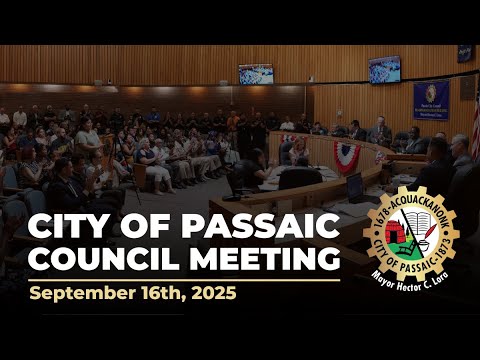
Dozens of residents told the City of Passaic Council on Sept. 16 that the R1A zoning district — created in the 1950s near the train station — should no longer permit high-rise, multifamily development as a conditional use.
“...I now return to the council to once again implore the council to pass an ordinance to amend the zoning ordinance to remove the conditional use of high rises in the R1A District,” said Joshua Goldman, a resident who opened the public-comment block and cited the city’s 2013 master plan and a 2024 reexamination that both recommended limiting high-rise multifamily uses in the area.
The request came during the council’s public-comment period and followed several speakers who said a current development proposal — described in comments as a 194-unit project sited near Westervelt and Orchard streets — would worsen parking congestion, traffic and pedestrian safety near schools and synagogues.
“Introducing additional high-rise developments here would significantly increase traffic congestion and parking pressures, which in turn will put those children at greater risk,” said Razele Asa, a resident who identified children walking to a nearby private school as particularly vulnerable. Several other speakers, including Leah Zimmerman and Frida Kogan, described narrow neighborhood streets and heavy pedestrian traffic near schools and houses of worship.
Organizers and residents said they have circulated a petition and draft ordinance language. “We've come to you with a drafted zoning amendment. The language is ready to be introduced,” said Steve Weisman, who said the group had collected nearly 400 petition signatures and that both the 2013 master plan and the 2024 reexamination recommended removing the conditional-use allowance for multifamily buildings of four stories or more in R1A.
City staff and elected officials described the legal and procedural constraints. Business Administrator Rick Fernandez summarized why the R1A district was created in the 1950s — to concentrate higher densities near mass transit — and said the provision remains a conditional use requiring specific findings and, where applicable, board review under the New Jersey Municipal Land Use Law. He noted R1A is “one of the smallest residential zones” in the city and that a conditional-use project typically requires assembling multiple parcels to be viable.
The mayor told residents the administration and council have been discussing alternatives behind the scenes and said staff have pursued incentives and negotiated approaches in other cases to redirect development in ways that could reduce local impacts, though he warned details could not be disclosed publicly because of the possibility of litigation. “I am optimistic that we may find a solution that everyone in the immediate area will be very happy with,” the mayor said.
Council members and staff repeatedly explained the steps available to the governing body: the council may propose zoning changes (which must be reviewed for consistency with the municipal master plan by the planning board), and boards considering applications must weigh technical reports such as traffic, water/sewer and fire-safety studies provided by the applicant. Fernandez emphasized that the applicant carries the burden of proof for conditional-use and variance applications and that members of the public may present their own experts at board hearings.
Residents pressed for a near-term council ordinance to eliminate the R1A conditional-use allowance; the council did not introduce or adopt such an ordinance during the meeting. The mayor said the administration will have its attorneys and staff review the petition language the residents offered and advised that the council and administration have been discussing potential nonpublic avenues to address the immediate application while also considering longer-term zoning changes.
Next steps identified at the meeting: residents said they will submit the draft ordinance and petition to the council; the administration said staff and outside counsel will review proposed language; and the council reiterated that any ordinance change must be routed through the planning board for a consistency review with the master plan before final council action.
There was no formal council vote on rezoning during the Sept. 16 meeting.