Get Full Government Meeting Transcripts, Videos, & Alerts Forever!
Get email alerts on the Emergency Response topic
No spam. Unsubscribe anytime.
High Point committee reviews July 9 flash‑flood response; staff recommend permanent signs and facility analyses
Summary
The High Point Transparency Engagement and Communication Committee on Sept. 17 reviewed the city’s emergency response and public‑notification efforts following a flash‑flood event on July 9, 2025, that generated 23 calls for service — 19 of them water rescues — and flooded portions of the Westside Wastewater Treatment Plant.
The High Point Transparency Engagement and Communication Committee on Sept. 17 reviewed the city’s emergency response and public‑notification efforts following a flash‑flood event on July 9, 2025, that generated 23 calls for service — 19 of them water rescues — and flooded portions of the Westside Wastewater Treatment Plant.
Assistant City Manager Damon Duquesne, the presenter, told the committee: “I have a presentation on emergency response and communications. This is, essentially tailored towards the 07/09/2025 flash flooding event.” He said the region had been saturated by earlier rain from Tropical Depression Chantelle, then received “6 plus inches in a very short period of time,” far more than the forecast 1½ inches, producing sudden flash flooding, blocked roads and downed trees.
Why it matters: City staff and elected members framed the session as an after‑action review aimed at identifying operational fixes before the next sudden flooding event. Duquesne said a consultant’s preliminary analysis of earthen berms and site conditions at the Westside plant indicated the July 9 event “could have been close to a thousand‑year storm,” a magnitude much larger than the typical 10‑year design standard used for most local infrastructure.
Key findings and follow‑ups
- Emergency calls and rescues: Duquesne reported 23 calls for service tied to the event, 19 of which were water rescues. He told the committee that three of the rescues involved people who drove past first responders who had stopped traffic, creating avoidable risks and diverting emergency resources.
- City facilities: Slides shown to the committee included photos of the Westside Wastewater Treatment Plant, where the rear parking area and a UV disinfection station were flooded. Duquesne said replacement parts for the UV station are listed on an upcoming finance committee agenda.
- Planned analyses and projects: Staff described several non‑voting follow ups from the after‑action review: a flood‑plain and berm analysis at the Westside wastewater treatment plant, an access analysis for the police department entrance off Westchester Street, and estimates for permanent warning signage. Duquesne said the city is investigating flashing “road flooded” signs that could be activated when a roadway is underwater rather than relying on crews to place temporary signs during a flash event.
- Notification systems and public preparedness: Duquesne outlined public alert options available to residents. He demonstrated the Guilford Emergency Alert Notification Information System (known locally as “Genie”), noting users can register up to six locations (home, work, school, etc.) and select preferred contact methods (text, call, email). He also reviewed Reverse 9‑1‑1 (operated by Guilford County Emergency Management), Wireless Emergency Alerts, local media and the city’s emergency management web page, which links to ready.gov, Ready Guilford and FEMA resources.
- Roles and coordination: Duquesne emphasized that county emergency management is the primary alerting authority for life‑safety warnings and that the city’s role is to respond, inform and coordinate. He said public services, police and fire personnel are trained in the Incident Command System (ICS) and that the city includes all relevant stakeholders in constructive after‑action reviews.
Discussion highlights
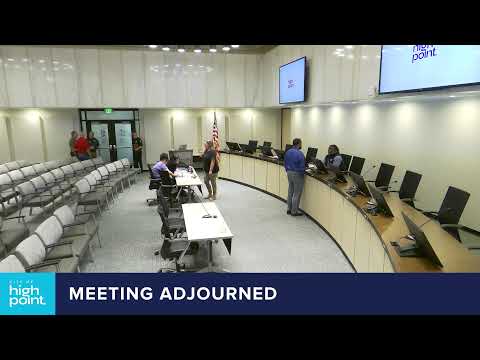
Councilman Michael Holmes, committee chair, opened the meeting and noted there was no quorum and no votes would be taken. Councilman Dr. Patrick Harmon (participating virtually) raised concerns about public trust and noted that some residents live over inherited, privately maintained drainage infrastructure in older parts of the city. Harmon said homeowners sometimes do not know whether underground pipes on their land are private or public and asked what the city could do for those residents.
Duquesne answered that the city can help residents determine their flood risk, assist with sign‑ups for alert systems, and evaluate public stormwater infrastructure on the city side to ensure it is maintained and not backing up into private systems. He recommended homeowners hire licensed professionals before altering private drainage structures and cautioned that closing a private drainage facility could create larger problems if done without engineering advice.
On design standards, Duquesne said most street infrastructure is designed to a 10‑year storm but that the city conducts case‑by‑case analyses for critical facilities (for example, wastewater treatment plants located in low areas) and can design for higher‑magnitude events where appropriate.
Other operational observations and advice from staff included planting trees and maintaining dry stream channels to reduce debris and erosion, and targeting routine cleaning and maintenance in older neighborhoods where private and public systems intermix.
No formal actions or votes
Because the committee did not have a quorum, members did not take formal votes. Duquesne and staff presented planned operational follow‑ups and analyses; committee members acknowledged and discussed those plans but did not approve or direct binding actions during the meeting.
What’s next
Duquesne said staff are gathering estimates for permanent flashing signs at known flood locations, continuing the Westside plant analyses, and completing the police department access study. The city will continue to encourage residents to check the North Carolina flood‑risk mapping tools, register for Genie and other alert services, and follow guidance from Guilford County Emergency Management for life‑safety warnings.
The committee adjourned after the presentation.