Get Full Government Meeting Transcripts, Videos, & Alerts Forever!
Get email alerts on the Immigration Response topic
No spam. Unsubscribe anytime.
County details expanded legal, outreach and rapid-response work to counter federal immigration enforcement changes
Summary
County officials told the Santa Clara County Children, Seniors and Families Committee that they have expanded litigation, legal-service contracting, a Rapid Response Network and a multilingual media campaign to protect immigrant communities amid recent federal enforcement moves.
Santa Clara County officials presented a multi-department update on the county’s response to recent federal actions affecting immigrant communities, including litigation, expedited contracting for legal aid, an expanded rapid-response network and a multilingual media campaign.
Deputy County Executive David Campos and staff from County Counsel, the Division of Equity and Social Justice, the Social Services Agency and intergovernmental relations described legal challenges, community outreach and operational preparations. Mikayla Lewis of County Counsel said the county is monitoring and litigating against federal moves to condition grants, to exclude immigrants from counts or funding, and to dismantle federal programs that support local services. She said the county has filed for declaratory relief to protect noncooperation policies.
Dr. Annelilia Garcia, director of the Division of Equity and Social Justice, described an $8.1 million investment for immigration-related legal services, outreach and expansion of the Rapid Response Network; the amount was described as the largest county investment to date. Julie Ramirez and program staff summarized the Rapid Response Network’s work: observers who document suspected enforcement activity, accompaniment for detained people and legal services for families left behind. Officials said they meet monthly with funded vendors and receive quarterly progress reports.
Communications director Maria Leticia Gomez summarized a multimedia campaign launched in May. The county has multilingual materials in English, Spanish, Vietnamese, Chinese, Tagalog and Punjabi; the campaign includes two Highway 101 billboards, radio and TV buys and ads on buses and transit kiosks. The campaign also leverages community partners and in-person outreach at clinics and schools.
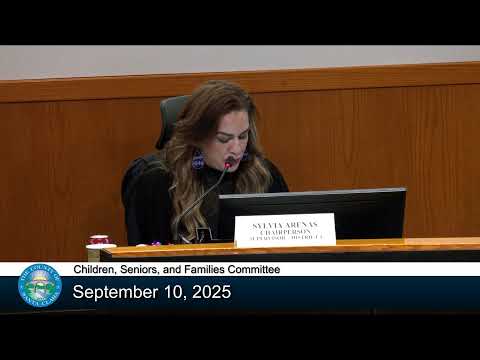
Committee members and staff discussed readiness for possible large-scale immigration enforcement actions. Supervisor Arenas and Deputy County Executive Campos asked departments to prepare tiered response plans in case ICE operations left children temporarily without parents. DFCS Director Wendy Kinnear Rausch said the department is identifying resource families, coordinating with rapid-response groups and preparing trauma-informed care and language-capable placements; officials said they were reviewing lessons from Los Angeles and exploring whether family-designation documents (caregiver packets) could be operationalized.
Supervisors asked for more detailed, actionable public guidance that residents can follow immediately ("here’s 1-2-3 steps if you worry you could be separated from your children"). The committee also requested that staff share metrics used with funded vendors, and produce a short written summary for board offices about tiered readiness and contract monitoring. The committee voted to receive the report.
The record shows the committee recognized the Supreme Court ruling referenced in testimony (Nome v. Vasquez Perdomo) and directed staff to update outreach messaging in light of changing federal rulings and to continue expedited contracting and monitoring of legal-service providers.