Get Full Government Meeting Transcripts, Videos, & Alerts Forever!
Get email alerts on the Fire Code topic
No spam. Unsubscribe anytime.
Board adopts Fire District’s updated code with two key local changes; chief pledges continued stakeholder outreach
Summary
Ventura County supervisors unanimously adopted Ordinance 34 on Sept. 16, bringing local fire rules into alignment with the 2025 California Fire Code while keeping most long‑standing local amendments and adding clarified provisions on real‑estate inspection notifications and limited access flexibility for fire apparatus roads.
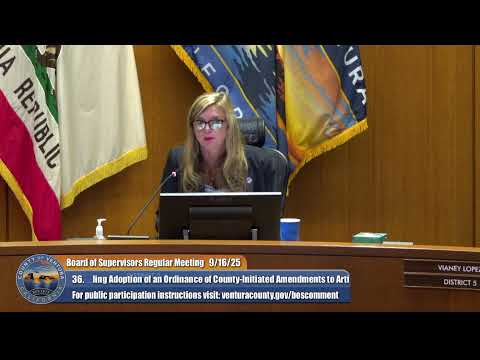
The Ventura County Board of Supervisors on Sept. 16 adopted Ventura County Fire Protection District Ordinance No. 34, updating the district’s local amendments to adopt the 2025 California Fire Code and related model codes. The ordinance passed unanimously.
Chief Dustin Gardner and Fire Marshal Joseph (Joe) [surname] told the board most of the ordinance consolidates and carries forward existing local amendments that have been in effect for decades. The adoption is part of the regular three‑year code cycle in which local fire agencies must adopt the new model code and may propose local amendments justified by climatic, geographic or topographic conditions.
Two changes drew the most attention at the hearing:
• Real‑estate transaction inspections (AB 38 implementation): State law requires fire inspection during certain real‑estate transactions in high fire hazard severity areas. The fire marshal said roughly half of transactions have come to the fire department for inspection; the other half appear to have used a disclosure option without notifying the fire department. The adopted ordinance adds language to improve notification so the department can perform the statutorily required inspection.
• Limited access flexibility for fire apparatus roads: One provision allows the fire official discretion to approve alternate approaches to secondary access requirements in some situations — a limited loosening intended to allow practical alternatives where rigid application of access standards is not feasible. The fire marshal framed this as narrowing a past problem where the strictness of a single standard could block otherwise feasible, fire‑safe solutions.
Chief Gardner emphasized the code package primarily restates longstanding local rules and that the Fire Department will continue dialog with agricultural stakeholders and landowners about implementation and exemptions (for example, sprinkler/flow requirements for agricultural buildings). The chief noted he expects some technical refinements as staff works with affected communities and local water providers.
Public comment: multiple agricultural and rural property owners, and representatives of CoLab and agricultural service organizations, urged the board to retain clear agricultural exemptions (examples cited: sprinkler and fire‑flow exemptions for barns, flexibility for off‑grid water systems, and clearer appeals options so that county property owners could take disputes to the Board of Supervisors if necessary). County staff acknowledged some agricultural exemptions are implemented through Fire Department policies, not the ordinance; the board asked staff to clarify the distinction and consider whether any policy exemptions should be codified to improve transparency.
CEQA and next steps: staff said the ordinance adoption responds to mandatory code‑cycle adoption requirements; technical ordinance refinements may follow. Chief Gardner and county counsel said an off‑cycle amendment process is available if the board or stakeholders want further codification of agricultural exceptions.
Board action: motion to introduce and adopt Ordinance No. 34 — which consolidates and updates local code amendments and inserts two clarified provisions (inspection notification and limited access flexibility) — passed unanimously.