Get Full Government Meeting Transcripts, Videos, & Alerts Forever!
Get email alerts on the Housing Zoning topic
No spam. Unsubscribe anytime.
Board advances RHD zoning edits to implement housing‑element program for lower‑income units
Summary
County staff won Planning Commission support and the board approved zoning amendments that add alternative compliance options and require affordable‑housing agreements to implement the RHD (residential high density) program of the 2021–2029 housing element.
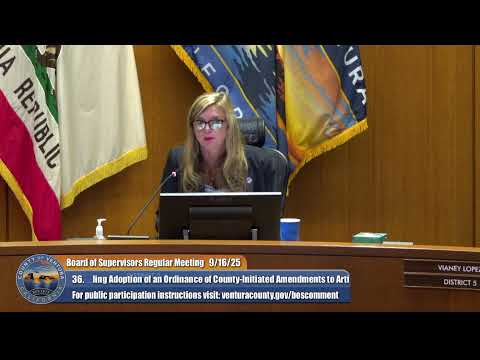
The Ventura County Board of Supervisors voted 4‑1 on Sept. 16 to adopt county‑initiated amendments to the Residential High Density (RHD) zone intended to implement Program HE‑H of the county’s certified 2021–2029 housing element.
Background: the RHD zone was created in 2011 to identify parcels appropriate for multifamily housing to meet the county’s lower‑income housing need. When originally authorized, the RHD included a minimum density floor (20–22 dwelling units per acre) and a county requirement that new multifamily projects on RHD parcels reserve 100% of units for lower‑income households. No multi‑family development has been completed on the RHD parcels; seven parcels in El Rio, Piru and Santa Susana contributed 250 units to the county’s sites inventory.
What the ordinance does: the board approved amendments that keep the RHD zoning and density but change the affordability requirements so developers have multiple, clearly defined ways to meet the inclusionary obligation. The adopted ordinance provides four compliance routes: on‑site affordability consistent with state law; priority incentives for very‑low and extremely low‑income units; higher‑percentage on‑site set‑asides (a 30% option was added by staff to encourage on‑site production); and off‑site or alternative compliance under rigorous planning‑director review — including land donation, the acquisition of existing units, or “equivalent action” proposals. Any alternative compliance proposal requires prior planning‑director approval and must meet explicit criteria tied to the housing element goals.
Implementation and enforcement: the county will require an affordable‑housing agreement recorded against the property when an RHD development proceeds. Staff proposed a list of sample agreement components (design, phasing, unit type, affordability levels, monitoring and recapture provisions) that will be finalized with county counsel after adoption. Alternative compliance and affordable‑housing agreements will also direct any collected funds into an affordable‑housing trust account.
Planning Commission input and technical constraints: the Planning Commission recommended changes to tighten timing rules and asked staff to outline affordability‑agreement components; staff updated the draft accordingly. The board heard concerns about the viability of the Santa Susana parcels (safety/traffic lines of sight on Santa Susana Pass Road), wildfire hazard overlays and habitat/wildlife corridor overlays. Public Works told staff that traffic and sight‑line requirements would be rechecked at the time a development proposal is filed; the Fire Department and water providers previously participated in an infrastructure forum to review constraints on El Rio parcels and noted potential storage and water‑supply solutions but no guaranteed path to immediate hookups.
CEQA: staff concluded the ordinance is exempt from CEQA under specified categorical and statutory exemptions cited in the staff report and the board’s resolution.
Board action: the board approved the ordinance 4‑1 (Supervisor Long opposed), reflecting both support for enabling lower‑income housing paths and continuing concerns about the viability of some RHD parcels. Several supervisors asked staff to include this topic in the county’s longer‑range work plan and to explore infrastructure solutions for El Rio (including potential water‑provider consolidation and grant funding) even as the zoning changes move forward.
Speakers who addressed the board included a local venue operator and one in‑person supporter; no development applications were before the board at the time. Staff said they will produce the final affordable‑housing agreement language and return with implementation details and monitoring procedures.
Vote: Motion to approve staff recommendation passed 4‑1.