Get Full Government Meeting Transcripts, Videos, & Alerts Forever!
Get email alerts on the Housing Element Rhna topic
No spam. Unsubscribe anytime.
Santa Clara County officials warn RHNA assignment and ABAG process leave county with few credits for housing units
Summary
Santa Clara County officials told the Hewlett Committee on Sept. 18 that the county’s sixth-cycle housing element obligations were magnified by regional methodology choices and by rules that limit how many RHNA credits the county receives when parcels in unincorporated areas are annexed by cities.
Santa Clara County officials told the Hewlett Committee on Sept. 18 that the county’s sixth-cycle housing element obligations were magnified by regional methodology choices and by rules that limit how many RHNA credits the county receives when parcels in unincorporated areas are annexed by cities.
“From the very outset…our regional housing need allocation increased by over a thousand percent,” Deputy County Executive Sylvia Gallegos said, describing the 2020 ABAG methodology and the county’s large rural land base. She said ABAG and the methodology use a population baseline that dramatically raised Santa Clara County’s assigned units compared with peer jurisdictions.
The county’s planning director, Jacqueline Anciano, and staff described efforts to seek legislative relief and to identify additional buildable sites. “We were disadvantaged,” Gallegos said. She told the committee the county is pursuing both programmatic responses — additional site inventory and consultant help on code amendments — and legislative solutions to reduce the county’s exposure.
Why it matters: Committee members were presented with a technical explanation of how ABAG allocates RHNA and transfer-credit mechanics that, county staff said, discourage cities from taking transfer credits. Anciano, Lisa Mikhail (deputy director for planning services) and Gallegos described a specific example — a proposed East San Jose project at 1125 Kirk Avenue — where county and city submissions diverged and ABAG awarded the county credit for only two units despite local analysis showing up to 12 units consistent with the county’s housing element.
“ABAG is only gonna give us credit for 2 units,” Gallegos said, summarizing the county’s view of the transfer outcome for that site and warning supervisors the transfer rules provide “pennies on the dollar.” David Campos, deputy county executive for intergovernmental relations, told the committee he and his team are vetting multiple legislative proposals and conducting outreach in Sacramento to identify viable approaches and potential authors.
Staff outlined a menu of proposed state-level changes and process options they are developing with county counsel and the intergovernmental relations team: allowing ABAG to consider alternative RHNA methodologies; directing ABAG to explicitly consider urban services availability when assigning units; clarifying the treatment of “urban islands” that sit inside city boundaries; automatic or planned RHNA transfers for annexed properties; and extending the time window for transfer agreements so cities and counties have more time to negotiate credits.
The planning director also noted an operational proposal the county is considering: allow fees associated with a builder’s-remedy application to be assessed at current rates so that processing costs are borne by the applicant rather than absorbed by county general revenue.
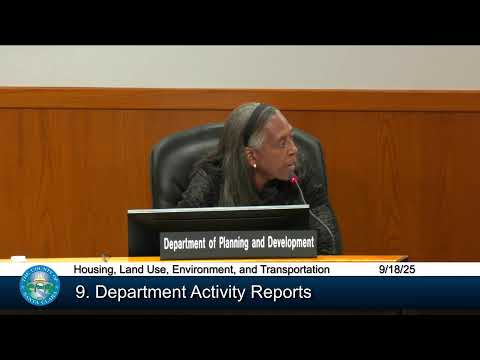
Supervisors pressed staff on process and timing. Supervisor Susan Hernandez told staff she was not satisfied with how the county developed its recommendations and said she would not approve a final package without more board-level collaboration. “I am not here to give you a rubber stamp. I’m here as a collaborator and as a partner and I am a policy maker,” Hernandez said, requesting earlier and deeper engagement by supervisors as staff refine proposals.
What the committee decided: Committee members agreed to continue discussion. Chair Margaret Abakova and staff said they would schedule follow-up briefings and one-on-one meetings before the board-level action. Gallegos said the county plans to return with a recommended bill package in November and noted legislative authoring deadlines in early February.
Officials emphasized uncertainty in Sacramento political leadership as a factor in timing: David Campos said committee members should expect shifting committee assignments and leadership that could affect sponsorship and chances for success.
Next steps: Staff will continue to refine legislative options, work with county counsel and IGR, solicit input from other Bay Area jurisdictions and the Bay Area caucus in Sacramento, and schedule briefings for individual supervisors before returning to the board in November. The committee agreed to continue the item to the next meeting and to hold staff-supervisor follow-ups.
Votes and formal actions: Committee did not adopt the staff legislative recommendations at the Sept. 18 meeting. Instead the item was continued for further discussion; staff were directed to meet individually with supervisors and return with a refined package.
Ending note: County leaders reiterated that a combination of additional site work and targeted Sacramento engagement will be required to address what their staff described as “structural” allocation disadvantages created by the current regional methodology.