Get Full Government Meeting Transcripts, Videos, & Alerts Forever!
Get email alerts on the County Budget topic
No spam. Unsubscribe anytime.
Oktibbeha County adopts balanced FY2025–26 budget, approves escrow and closing agreements tied to hospital sale
Summary
The Oktibbeha County Board of Supervisors on a 4-0 vote adopted the fiscal year 2025–26 budget and related ad valorem levies, approved escrow arrangements tied to the pending sale of Oktibbeha County Hospital and authorized two separate checking accounts for tort claims and health-insurance runout funds.
The Oktibbeha County Board of Supervisors adopted the county's fiscal year 2025–26 budget and corresponding ad valorem tax levies and approved several escrow and closing-related agreements tied to the pending sale of Oktibbeha County Hospital.
County Administrator Wayne Cox told the board the proposed fiscal year 2025–26 budget "is a balanced budget, with both revenue and cash sufficient to cover the anticipated expenditures for the coming fiscal year." Cox also said overall projected revenue falls versus the current year, a decline he attributed primarily to the conclusion of ARPA and other one-time grants used in FY2025.
The budget package the board approved includes: adoption of the FY2025–26 budget and the presented ad valorem levies; approval of a third‑party administrator agreement to manage tort-claims escrow funds; approval of an accounts‑receivable escrow agreement tied to the hospital sale; a memorandum of understanding to enable transfer of participation in a federal drug-pricing program; and authorization to open two separate checking accounts to hold the tort-claims escrow and a health-insurance runout escrow.
Why it matters: the board tied several urgent transaction approvals to the anticipated closing on Oktibbeha County Hospital. County staff said the closing could produce a significant net proceeds transfer that will require separate holding accounts and legal oversight before funds are released.
Key figures and fiscal context - County Administrator Wayne Cox said total projected revenue for FY2025 was approximately $70,500,000 and for FY2026 approximately $60,800,000; the decrease is driven by one-time grant and ARPA funding in the current year. - Core ad valorem tax revenue was presented increasing from about $26,700,000 in FY2025 to $27,700,000 projected for FY2026, a modest change Cox attributed to assessed-value growth. - Cox reported the general fund is budgeted to receive $19,091,000 and to spend $20,935,000 in FY2026, leaving a budgeted gap of about $1,843,000 that the county plans to cover with beginning cash balance. - County cash balances were described as “somewhere in the neighborhood of $20,000,000” (county staff noted some cash is restricted to other funds). - Cox identified the statutory 55‑mill cap on school operations and explained that school districts calculate requests separately for operations, notes and referendum bond debt; he gave the district’s value-per‑mill and the county’s value‑per‑mill as figures they used in calculations (transcribed as roughly $496,000 and $491,000 per mill, respectively).
Board action and votes - The board adopted the FY2025–26 budget and the corresponding ad valorem levies (motion by Supervisor Little; second by Supervisor Williams). Vote: 4–0 (one supervisor was absent). The administrator reminded the board the budget must be approved prior to statutory deadlines and that budget amendments remain possible later if circumstances change. - The board approved a third‑party administrator service agreement to manage tort-claims funds associated with the hospital closing (motion by Supervisor Williams; second by Supervisor Liddell). County staff said approximately $2,400,000 is currently allocated to the tort-claims escrow account. Vote: 4–0. - The board approved an accounts‑receivable escrow agreement with Baptist Memorial Hospital and Renaissance Bank under which $5,000,000 will be placed in escrow and used to reimburse the buyer for certain accounts-payable and other liabilities as collected (motion by Supervisor Williams; second by Supervisor Bill as recorded). Vote: 4–0. - The board approved a memorandum of understanding to allow transfer of participation in the federal drug-pricing program (identified in the transcript as the “30 b” program; county staff and counsel described it as necessary to complete closing and transfer program participation). The board recorded the motion as approved 4–0. - The board authorized opening two separate checking accounts—one to hold the tort-claims escrow (tied to the roughly $2,400,000 figure) and a second to hold funds for health-insurance claims runout during the 90‑day claim filing window after closing (motion by Supervisor Williams; second by Supervisor Mills). Vote: 4–0. County staff said the tort-claims account is subject to a 12‑month runout and the health-insurance account to a 90‑day runout period. - The board adopted the published millage rates as presented in the budget packet (as recorded in the meeting transcript). Motion recorded and approved 4–0.
Discussion items and next steps Board members and staff discussed the possibility that the hospital sale could free substantial funds and that any spending tied to net proceeds would require subsequent board action and likely a budget amendment. Cox said an endowment creation was already being explored and that the FY2025–26 budget was prepared on the assumption that the hospital had not yet sold. Multiple line items—fire trucks and sheriff’s vehicles among them—were tabled pending the hospital closing and further study of financing options; the county indicated any purchase would need a future budget amendment.
County Administrator Cox and staff repeatedly emphasized that some figures (particularly cash timing and one‑time bond proceeds) are subject to timing and execution constraints, and that not all budgeted capital projects will necessarily be executed in the first year because of contractor bandwidth and multi‑year scheduling.
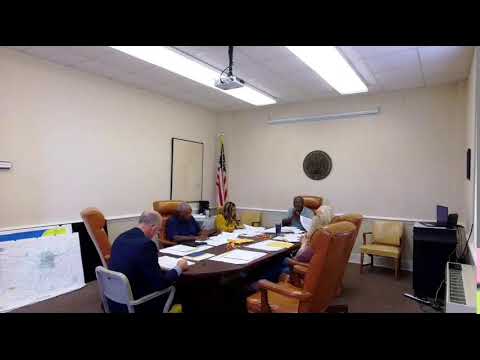
The board adjourned the budget hearing after approving the budget, levies and the transaction-related agreements. Supervisors recorded the meeting vote totals as 4–0 on the listed items; one supervisor was out of town and identified as absent during the hearing.