Get Full Government Meeting Transcripts, Videos, & Alerts Forever!
Get email alerts on the Emergency Preparedness topic
No spam. Unsubscribe anytime.
Pitkin County public‑health staff outline emergency‑management roles, plans and volunteer resources
Summary
County environmental health manager walked the board through incident command, emergency operations centers, ESF‑8 responsibilities, grant‑funded preparedness work and local volunteer resources including the Medical Reserve Corps.
Kurt Dahl, Pitkin County environmental health manager, told the Board of Health on April 17 that public health plays two primary roles in emergencies: subject‑matter expert on an incident management team at the scene and lead/support for ESF‑8 (health and medical) functions in an emergency operations center.
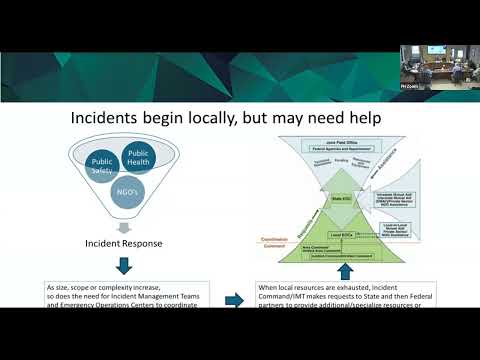
Dahl summarized how incidents begin locally and can grow to require regional, state and federal resources. "All events are local," he said, describing how initial response and resource needs escalate as an incident grows. He explained the difference between incident command (on scene) and coordination (EOC support), and said public health may be active in both places depending on the event.
Program and planning: Dahl said the department’s public health emergency preparedness (PHEP) program — a federal pass‑through grant administered through the state — requires planning, training, exercises and regional coordination. The county maintains an all‑hazards plan (updated every five years) and a suite of operational plans, including mass prophylaxis/points of distribution, quarantine and isolation guidance, and an environmental health shelter/evacuation inspection plan. Dahl noted the department has pulled together a measles response plan and runs tabletop exercises; staff recently participated in a measles tabletop.
Operational notes: Dahl described typical public‑health tasks in evacuations (shelter sanitation, sanitation inspections, animal care, mental‑health coordination) and responder safety plans for protecting staff during responses. He noted the county’s regional partners — neighboring counties, hospitals, emergency services and behavioral‑health providers — coordinate through regional healthcare coalitions and monthly meetings with the regional epidemiologist.
Volunteers and communications: The county is connected to the Rocky Mountain Medical Reserve Corps for volunteer clinical staffing and uses PickAnAlert (pickanalert.org) to communicate emergency messages to residents. Dahl urged residents to sign up and stressed individual preparedness: "If you think you need to go, go. Don't wait for somebody to tell you," he said, citing lessons from recent disasters.
Funding uncertainty: Dahl and staff acknowledged uncertainty about future federal public‑health funding and said state realignments and grant changes could affect scope of work; however, they said immediate response roles would likely remain focused on operations and coordination.
Why it matters: Dahl said preparation (planning, training and exercises) consumes far more staff time than the response itself, but is essential for effective incident response. "There's a consensus that you spend much more amount of time preparing for the response than you actually do in the response in most cases," he said.
Next steps: Dahl said the all‑hazards plan will be updated on schedule and the department will continue regional coordination, provider outreach and public communications through PickAnAlert.