Get Full Government Meeting Transcripts, Videos, & Alerts Forever!
Get email alerts on the County Budgeting topic
No spam. Unsubscribe anytime.
Clear Creek County leaders outline 2030 financial vision and budget timetable at work session
Summary
Deputy County Manager described a 2030 vision to stabilize county operations, limit unbudgeted FTE growth and use the fund balance selectively while investing in technology and strategic projects.
Deputy County Manager (title recorded in the meeting as “Deputy County Manager”) described a long-term vision to 2030 that prioritizes stabilizing day‑to‑day services while creating room for targeted change. "What we're looking to do…is a stabilization of operations while creating some capacity for change," the deputy said, outlining four pillars: budgeting that balances capacity and innovation; managing the county fund balance conservatively; ROI‑focused decisions about ongoing costs and FTEs; and technology optimization to maintain staff productivity.
Why it matters: Clear Creek County faces acute demographic and land constraints that shape long‑term revenue prospects and service demand. The deputy told commissioners that only about 11% of county land is developable, the resident population is small (roughly 9,000) while annual visitation is very large (roughly 9,000,000 visits reported in the presentation). Those realities, combined with an aging county population, rising EMS and social service demands, and heavy visitor pressure, mean the county must be deliberate about one‑time spending, ongoing staff costs and where to concentrate investment.
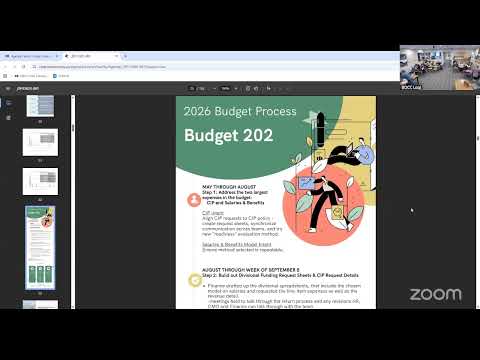
Budget calendar and process: Finance staff reviewed the schedule county leaders will follow for the 2026 budget. Key statutory dates the team emphasized: the county must deliver a preliminary budget to the board by Oct. 15, set mill levies by Dec. 15 and submit the final budget to the state by Jan. 31. Staff said October through mid‑December is the active evaluation window for commissioners to reconcile proposed salary/benefit models in advance of formal adoption. Finance staff noted they would present a “working draft” on Oct. 15 that will include the line‑by‑line detail commissioners requested.
Salary and benefit models: Finance described three candidate approaches for budgeting salaries across funds: (1) a market‑rate model (pay everyone to market — highest cost), (2) an "attrition model" (market less a turnover adjustment — intermediate cost) and (3) an actuals model that uses last year’s payroll patterns adjusted only for a small COLA — the most conservative (and most expensive) approach. The finance presentation said staff’s recommended starting point for board discussion is the attrition model but that commissioners will choose the final approach during October–December deliberations. Finance reported the county’s five‑year rolling average benefit burden is about 31% of salary and said they are hedging on 32% next year to reflect rising insurance costs.
Use of fund balance and fiscal discipline: The deputy urged the board to treat the county’s fund balance as a tactical resource — to “buy time” when trends are positive but to avoid deficit spending if trend lines show deterioration. Staff framed that approach as preserving flexibility if the county faces an economic downturn: using one‑time reserves to smooth transitions, not to indefinitely support ongoing services.
Transparency and workload: Finance and HR staff said they are improving transparency between the October preliminary document and the December adoption by preserving a line‑by‑line comparison so commissioners can see specific adjustments between the two submittals. HR and finance are also working to standardize salary/FTE reporting and clarify the difference between an FTE position count and the dollars appropriated to fund that FTE in any given year.
Commissioner guidance and next steps: Commissioners asked for clearer, repeated explanations about how benefits and vacancies affect the budget. Staff committed to provide detailed, fund‑level scenarios during the October 15 working session and again before the December adoption vote. The board will decide which salary model to adopt and whether to prioritize one‑time capacity investments (for example, ERP/technology) versus ongoing FTE additions.
Ending: Staff said they will return with detailed scenarios and supporting documentation in time for the Oct. 15 preliminary budget submission and the board’s October–December review period. The county emphasized it will preserve statutory public notice and the required public hearings during the budget cycle.