Broomfield outlines major development projects, projects about 5,000 new housing units over next five years
Loading...
Summary
City and County of Broomfield officials summarized how development is reviewed, public engagement steps and timelines, and highlighted three major project areas — Center Street District/Baseline, Broomfield Town Square and Flatiron Crossing — while projecting roughly 5,000 new housing units in the next five years.
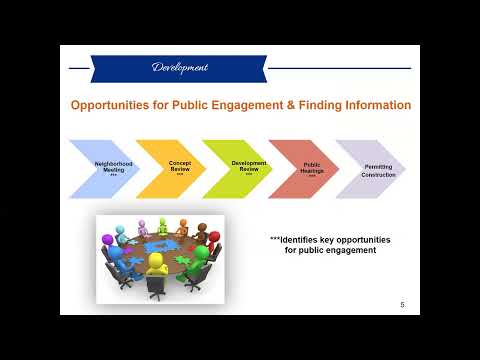
City and County of Broomfield planners told a community briefing that development in the city is reviewed through a multi-stage process that includes developer-led neighborhood meetings, staff review, public comment on the Broomfield Voice platform and, for larger cases, public hearings before quasi-judicial bodies or city council. Katie Allen, Broomfield’s director of community development, led the presentation on how development works and the timeline for several large projects.
The overview emphasized that the comprehensive plan is the city’s overarching vision, that staff enforce applicable building codes and engineering standards, and that formal public notice is posted on properties and mailed to neighbors within 1,000 feet of a proposed project (a 250-foot radius applies for neighborhood board of adjustments variance cases). Community members are directed to the Broomfield Voice project page and the active projects map for status updates.
Why it matters: The briefing combined procedural guidance with specific project timelines and capacity projections; that mix signals what residents can expect to see in their neighborhoods in coming years and where the city expects growth.
Allen and other staff described three “key developing places” that anchor near-term work. The Center Street District and the Baseline area, described as intended to provide shopping, dining and about 50 housing units in Phase 1, is planned to include roughly 3,000 square feet of retail in its first phase, plazas and roughly 100–170 acres of open lands and, over time, space or funding for library services, a police annex and a bus or bus rapid transit stop on Colorado 7. The presentation gave an anticipated construction window for initial retail and mixed-use work of 2026–2028.
Broomfield Town Square will reuse the former Safeway site to create a market hall and other commercial space. Staff gave a program estimate of as much as 63,590 square feet of commercial uses, two mixed-use buildings north of First Avenue, and about 491 housing units (rental apartments and 12 townhomes). The site is planned around a four-acre lake and public plaza; horizontal (site) work was described as targeted for mid‑2026 with vertical construction and openings for the market hall and housing targeted in late 2027 or 2028.
Flatiron Crossing’s owner is pursuing a multiyear reinvestment. The presentation named a Phase 1 neighborhood called “HiFi” between the mall and AMC theater with 340 apartments (with capacity to double in later phases), a stated target of about 20% affordable units and approximately 50,000 square feet of curated food-and-beverage space. Staff said utilities and site work were underway and new vertical construction was expected to begin imminently.
Officials presented residential pipeline projections and commercial forecasts. Staff said the residential pipeline could yield roughly 5,000 new housing units over the next five years, with apartments expected to outpace other housing types where developable land is limited and near major corridors such as U.S. 36, Colorado 7 and West 120th Avenue. Commercial projections through 2030 were estimated at about 2.8 million square feet, with stronger demand anticipated for non-retail commercial and flex/innovation space than for traditional retail.
Public engagement and permitting: Staff described that smaller permits (fences, decks) may be reviewed in hours or days, while rezonings, comprehensive plan amendments and major site plans generally take several months and include developer-hosted neighborhood meetings, public notices, Broomfield Voice comment periods and, when required, public hearings before the land use review commission or city council. The final permitting stage, when construction designs are approved, was presented as the point where active project maps reflect the approved scope.
What residents asked and what staff said: In the Q&A, staff said developers typically drive the timing of projects and private investors usually propose land uses; the city’s role is to ensure proposals comply with land-use rules and engineering standards, and to provide public notice and hearings where required. Staff also said major developers typically give council updates roughly two to three times per year.
The briefing closed by encouraging residents to monitor the Broomfield Voice page and the planning department’s active projects map and to participate in public hearings if they wish to influence project outcomes.