Get Full Government Meeting Transcripts, Videos, & Alerts Forever!
Get email alerts on the Zoning Residential Development topic
No spam. Unsubscribe anytime.
Sumter County Council adopts overhaul of residential zoning rules; clarifies accessory apartments and housing-type definitions
Summary
Council approved ordinance 25-10-33 after planning staff described a wide-ranging text amendment that defines housing types, allows staff to require plot/floor plans for 1- and 2-family lots, and limits accessory structures in higher-density products.
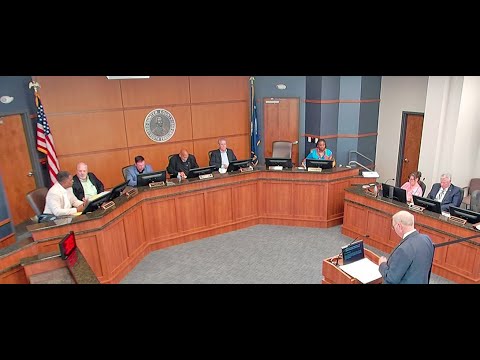
Sumter County Council on third reading approved ordinance 25-10-33, a text amendment to the county's residential development standards that adds definitions for housing types, clarifies where duplexes, townhouses and accessory apartments may be located, and authorizes planning staff to request additional site information for certain single- and two-family lots.
The amendment, presented by Helen Rudman of the county planning staff, rewrites multiple sections of the zoning ordinance to add definitions and a tabular format for residential development standards. "This text amendment is to amend our residential development standards in the county," Rudman said during the council meeting. The council approved first reading with an exception to remove a two-bedroom limit for accessory apartments, and later approved final reading.
The changes aim to reduce ambiguity in long-standing ordinance language that Rudman said dates to 1999. The amendment adds clear definitions for accessory apartment, duplex, triplex, quadriplex, townhouse and single-family attached dwellings. An accessory apartment is defined as "a second dwelling unit either in or added to an existing single family detached dwelling or in a separate structure on the same lot as the principal single family detached dwelling" with independent cooking, bathing and sleeping facilities.
The ordinance also gives the zoning administrator the authority to require a plot plan, floor plan or survey for detached one- and two-family dwelling applications when needed to verify compliance. Rudman said the change is intended to prevent situations where a building is constructed and later found not to fit the lot, which could otherwise force an appeal to the Board of Zoning Appeals.
Key numeric and procedural details added or clarified in the ordinance include: - Accessory apartments are limited to 40% of the ground area of the existing dwelling or 1,000 square feet, whichever is less, and require one off-street parking space; the earlier two-bedroom cap was removed at council request. - Accessory buildings larger than 1,200 square feet must maintain a 10-foot setback from property lines. - Accessory structures without walls (for example, carports) are measured by covered roof area for square-footage limits. - In the R15 district, only single-family detached dwellings are permitted going forward; R9 will allow duplexes and single-family attached dwellings as conditional uses, while townhouses will be limited to RMF and certain commercial districts.
The amendment replaces verbose, duplicative text with tabular use and development standards; it also relocates conditional-use review criteria for townhouses and related housing forms to Article 5 so the county can evaluate setbacks, parking and site access as part of conditional-use review. Rudman told council the Planning Commission recommended approval and said the changes will make the ordinance easier to use and reduce the need for after-the-fact appeals.
Council members debated small elements of the draft. One council member asked why accessory apartments were limited to two bedrooms; Rudman said that provision had been carried over from the prior code and agreed it could be struck because the size cap effectively limits unit size. "There's no reason that we can't strike that before second reading," Rudman said; council members voted to remove it prior to advancing the ordinance.
The ordinance also clarifies accessory-building counts on higher-density lots (noting that the standard allowances for multiple detached accessory buildings do not translate well to small townhouse or single-family-attached lots) and standardizes measurement language for yards and common walls in attached products. Rudman noted site-plan versus plot-plan distinctions and said more formal site-plan reviews remain for commercial or multi-structure projects.
The council approved first reading with the removal of the two-bedroom accessory-apartment language and later approved final reading. The ordinance text and the Planning Commission recommendation were entered into the record as part of the council packet. Rudman said a separate accessory-structure amendment will be brought forward later this year to address remaining accessory-structure issues.
Rudman and council members emphasized that the changes are procedural and clarifying in many places rather than a wholesale change to allowed uses. "We are just making it clear in the code that we can point to for a lender or an underwriter that yes, in fact, the situation that they have is legal," Rudman said.