Get Full Government Meeting Transcripts, Videos, & Alerts Forever!
Get email alerts on the Ground Mounted Solar topic
No spam. Unsubscribe anytime.
Planning board advances review of ground‑mounted solar at historic ‘‘The Grove’’; archaeology questions remain
Summary
Applicant Christopher Travers seeks a front‑yard ground‑mounted solar array at a National Register‑listed property known as The Grove. Board advanced the application for review, requested DEC jurisdictional determination and noted the need for archaeologic Phase 1B testing given the site’s historic status.
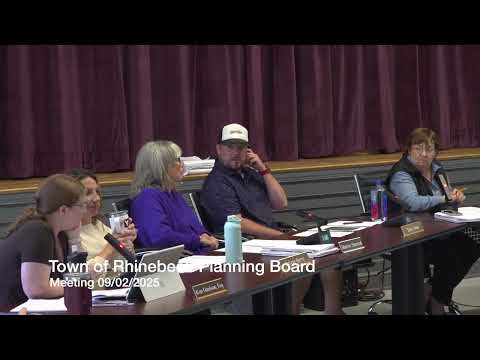
The Rhinebeck Planning Board continued preliminary review Sept. 2 of an application by Christopher Travers to install a small ground‑mounted solar array at a property known as The Grove, a National Register‑listed historic property. The board accepted the application for further review and scheduled a public hearing for Oct. 6.
Jeff Iris of Hudson Solar, the applicant’s engineer, told the board the proposed array is small, sited roughly 80 feet from Route 308 and intentionally placed behind a vegetated berm to reduce visibility from the road. Iris said the design uses screw‑pile foundations to minimize ground disturbance and would produce roughly 30% of the house’s annual electricity demand.
Board members and staff focused discussion on the property’s historic status and on archaeology. The applicant has already commissioned a recent archaeological study for nearby work that found no significant historic features associated with the previously surveyed garage area, but the board’s planning consultant noted that the previously completed Area of Potential Effect (APE) and Phase 1A study did not cover the proposed array footprint. On historic properties, testing known as Phase 1B (shovel/test pits) is commonly required to determine whether subsurface resources exist in the new disturbance area.
Planning staff recommended that the applicant submit DEC jurisdictional‑determination paperwork (to confirm wetlands/jurisdiction) and an updated archaeology scope. The board discussed the possibility of waiving repeat Phase 1A work (literature review) but said the Phase 1B (field testing) may still be necessary because the array would disturb previously unexamined ground.
The board’s draft procedural resolution accepted the application for further review, classified the action as unlisted for SEQRA purposes, set a public hearing for Oct. 6 and directed referrals to the Rhinebeck CAB, Historic Advisory/Preservation Advisory bodies (HAPAC) and Dutchess County Planning. Board members also proposed a condition that the applicant avoid further excavation beyond screw‑pile installation without prior notice to the planning board and, if deeper excavation proved necessary, to halt work and consult the board and the town’s archaeologic reviewers.
Board members asked the applicant to provide a written quote for Phase 1B testing and to clarify how the installer would respond if screw piles encountered subsurface rock or anomalies that would necessitate deeper excavation. The applicant said contractors had experience with pre‑drilling and alternative foundations but acknowledged ground conditions are an on‑site risk.
The board left the public hearing open and is awaiting DEC jurisdictional determination paperwork and detail on archaeological testing before moving toward final action.