Get Full Government Meeting Transcripts, Videos, & Alerts Forever!
Get email alerts on the Wildfire Insurance topic
No spam. Unsubscribe anytime.
County hears insurer view on wildfire insurance crisis; board resolves as Flood Control District to hold sessions on home hardening
Summary
Coconino County supervisors, sitting as the Flood Control District board, heard the insurance industry's perspective on shrinking homeowners coverage and mitigation steps industry leaders say are needed to improve insurability and affordability.
Coconino County supervisors, meeting as the Flood Control District Board of Directors, voted unanimously to resolve as the Flood Control District and heard a briefing from the insurance industry on the wildfire insurance crisis confronting many county homeowners.
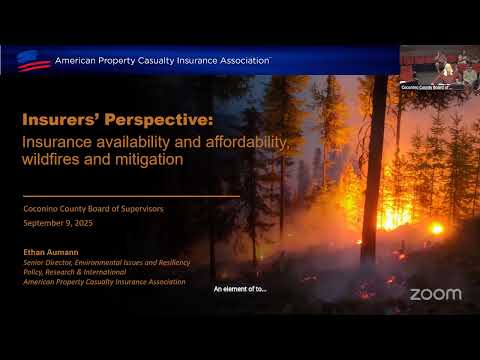
Ethan Amman, senior director for environmental issues and resiliency at the American Property Casualty Insurance Association (APCIA), told the board that insurers are seeing sustained underwriting losses nationally and that mitigation at both the parcel and community scale is the primary path to stabilizing availability and cost. "Ultimately, we think the best solution to address wildfire risk and ensure insurance availability and affordability lies in these robust science-based mitigation efforts at both the individual and community levels," Amman said.
The presentation placed the county's problem in national context by citing industry and regulator data showing multi-year underwriting losses, rising reconstruction costs since the COVID-19 pandemic, and greater numbers of homes located in high-risk areas. Amman said publicly available wildfire maps rank Coconino County in roughly the 90th percentile for county-level wildfire risk and Flagstaff higher than 99 percent of U.S. communities. He described the role catastrophe models play for insurers and said those models, combined with parcel-level mitigation certifications, are what allow carriers to offer coverage or price discounts.
Why it matters: board members said they are receiving calls and emails from residents whose policies were nonrenewed or whose premiums skyrocketed. County officials and the presenter repeatedly linked insurance outcomes to wildfire exposure, construction and maintenance costs, modeling of parcel risk, and state regulatory and legislative changes that can change carriers' ability to price or manage risk.
Key points from the presentation and Q&A
- Market conditions: Amman told supervisors that recent years have produced multi-year underwriting losses for many homeowners insurers, driven by construction inflation, demographic shifts into hazard-prone areas, and more severe, high-loss wildfire and weather events. He said ratings agency AM Best assigned a negative outlook to the U.S. homeowners market and noted a lag in regulatory reporting.
- Modeling and parcel risk: Amman described wildfire catastrophe models as complex, data-driven tools insurers use to assess individual parcel risk. He said risk scores differ among models and that insurers also consider company-specific financial strength when deciding whether to accept high-risk properties.
- Mitigation and IBHS: Amman emphasized mitigation steps promoted by the Insurance Institute for Business & Home Safety (IBHS), including a 5-foot noncombustible zone around homes, Class A fire-rated roofs, ember-resistant vents, and ongoing maintenance such as clearing gutters. He called the IBHS Wildfire Prepared Home and neighborhood programs a model that insurance companies can recognize for discounts and increased insurability. Amman said the IBHS certification has been adopted in parts of California and Oregon and that Arizona is evaluating the framework.
- Examples and scale: Amman cited the rebuilding of Paradise, California, which has incorporated IBHS standards into its ordinance and where at least one insurer planned to reenter the market after adoption. He also noted IBHS research showing mitigation done at scale can materially reduce losses.
- Funding and incentives: The presentation and supervisors discussed options to support mitigation costs, including resilience grants, low-interest loans, permit-fee waivers, sales- or property-tax credits, and possible inclusion of mitigation costs into mortgage financing. Amman referenced federal and state grant programs (including U.S. Forest Service community wildfire protection plan grants and FEMA hazard mitigation grants) as potential funding sources.
Board and public discussion
Supervisors and the presenter fielded questions about practical help for homeowners. Supervisors asked whether a clear checklist could be issued to residents so individual homeowners and neighborhoods know which actions will most improve their chances of securing coverage or discounts. Amman and county staff said IBHS guidance and existing online materials are available now, and that IBHS will present at a later county session for more detail.
Supervisors pressed on how community uptake affects results and what happens when some neighbors do not participate. Amman said neighborhood-level mitigation is important because embers and fast-moving fires can propagate from a single ignited structure; he also suggested targeted grants and outreach for lower-income homeowners who cannot afford upgrades.
County actions and next steps
- The board voted, by unanimous voice vote with no mover/second named in the record, to resolve as the Flood Control District Board of Directors for the session so the district could hear the countywide issue and continue the wildfire insurance series.
- Staff said the Flood Control District previously convened a June 3 session with Headwaters Economics and will hold additional forums focused on home hardening on Sept. 30. An IBHS representative is scheduled to present on Sept. 15. County staff said recordings and slide materials will be posted on the Flood Control District website under the wildfire insurance tile.
- County staff also said the county is pursuing Community Wildfire Protection Plan (CWPP) updates and grant applications both for the greater Flagstaff area and for 10 rural fire districts; those plans are prerequisites for some federal grant funding. The county is conducting public input sessions for rural CWPPs and expects additional grant cycles to be available if Congress and federal agencies continue funding programs.
What the meeting did not decide
The board did not adopt any new ordinance, code, or mandatory certification program during the session. Supervisors and staff discussed options for future county roles (education, coordinating assessments, potential certification or permitting approaches, and grant administration), but no formal direction or policy change was recorded at the meeting.
Ending
County staff and supervisors urged residents to attend future public sessions, sign up for county notifications, and work with local fire districts on defensible-space practices. Officials said continued engagement with insurers, mortgage lenders and state regulators will be needed to translate mitigation progress into broader insurance market improvements for Coconino County homeowners.