Get Full Government Meeting Transcripts, Videos, & Alerts Forever!
Get email alerts on the Legal Executive Session topic
No spam. Unsubscribe anytime.
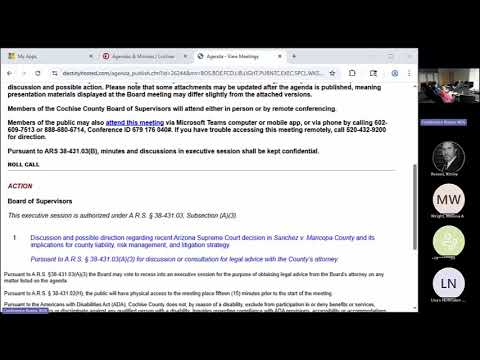
Cochise County supervisors meet in executive session to discuss Sanchez v. Maricopa County
Summary
The Cochise County Board of Supervisors convened a closed executive session Sept. 16 under Arizona law to receive legal briefing and discuss potential implications of the Arizona Supreme Court decision in Sanchez v. Maricopa County; the session was held pursuant to Arizona Revised Statutes and was confidential.
The Cochise County Board of Supervisors met in a closed executive session Sept. 16 to receive a legal briefing on the Arizona Supreme Court decision in Sanchez v. Maricopa County and to discuss possible implications for county liability, risk management and litigation strategy.
Under Arizona Revised Statutes §38-431.02(A)(3) the board convened the executive session "for discussion and possible direction" concerning the court decision; the board noted that minutes and discussion in executive session are confidential under A.R.S. §38-431.03(B). A supervisor moved to convene the executive session, another supervisor seconded the motion, and the board voted in favor by voice vote.
County Attorney Dylan Hiddell provided the briefing during the closed session, according to the board’s remarks after the meeting. After the board reconvened in public, the chair thanked Hiddell for "a very informative briefing on the Sanchez case," and the board adjourned the special session.
The meeting record available in the public portion of the transcript does not disclose the content of the executive session briefing, any formal direction given in closed session, or any votes related to litigation strategy. The board confirmed all supervisors were present for the special meeting and that standard confidentiality rules for executive sessions apply under state law.
No additional agenda items were discussed in public at the special meeting.