Get Full Government Meeting Transcripts, Videos, & Alerts Forever!
Get email alerts on the Jail Construction Sales Tax topic
No spam. Unsubscribe anytime.
Cochise County officials ask voters to approve half‑cent sales tax to fund new jail
Summary
County leaders held a town hall in Sierra Vista to explain a proposal on the Nov. 4 ballot asking voters to renew a half‑cent sales tax to fund construction of a new Cochise County jail, outlining costs, a 15‑year bond plan, design priorities and alternatives if the vote fails.
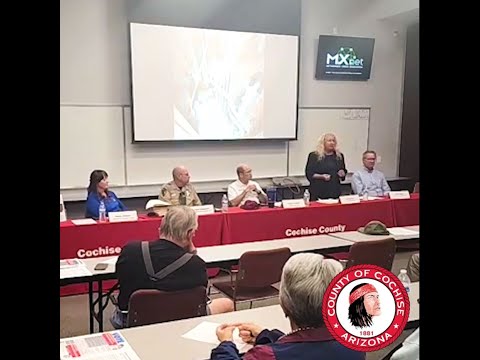
Cochise County officials and public safety leaders told residents at a town hall in Sierra Vista on Oct. 25 that they are asking voters on Nov. 4 to approve a half‑cent sales tax to fund construction of a new county jail.
County Supervisor and Board Chair Frank Cantonori said the tax would be dedicated to construction costs only and that operating and maintenance costs would continue to come from the county general fund. "As you know, on November 4, we're asking the voters of Cochise County to approve a half cent tax to use that funding to build a new jail," Cantonori said.
The county is proposing a 17‑year tax measure to meet Department of Revenue timing rules but plans to issue a 15‑year bond and accelerate principal payments so the debt could be paid off much sooner, Cantonori said. The county estimates roughly $998,000 in monthly revenue from the tax based on recent receipts, and officials said about $15.5 million from prior collections currently sits in a segregated account held by the county treasurer.
Why it matters: county officials said the existing jail — built in 1986 — is functionally obsolete, expensive to maintain and poorly suited to handle current mental‑health and substance‑use needs among detainees. Jail staff and medical leaders described small clinic space, porous fixtures and designs that force maintenance work to move detainees or disrupt operations. "Being mentally ill should not be a crime," Jail Commander Kenny Bradshaw said, urging facilities that include 24‑hour mental‑health support and spaces designed for treatment and calmer settings.
Funding and budget details: Cantonori outlined the county's planning budget and bonding approach. Officials said the construction program anticipates a roughly $100 million bond, a $20 million state contribution the sheriff secured under a statute that allows up to 20 percent state support, and roughly $10–15 million already on hand for the project. Cantonori and materials distributed at the meeting broke down the $130 million total planning figure as approximately $90 million for the physical building, $20 million for site preparation and utilities, $10 million for planning and design, and $10 million set aside as a management reserve to cover material‑price inflation or, if unused, to be applied to pay down principal on the bond when construction is complete.
Officials said the county will segregate sales‑tax receipts for construction and stop using those receipts for maintenance or operations (maintenance‑of‑effort spending). Cantonori said the board has instructed the county treasurer to hold the funds in a separate account, and that the county reimbursed and isolated prior expenditures except those already tied to planning and construction.
Capacity and design choices: consultants recommended a long‑range planning capacity of 600 detainees; the current proposal would build an initial capacity of about 400 detainees while sizing kitchen, medical and other support systems to handle up to 600. Cantonori said the design will be modular so additional "pods" for detainees can be added later if population growth requires it. Officials emphasized modern design features: dedicated utility corridors to allow maintenance without moving detainees, modular cell pods for different security classifications, and a maintenance schedule built into the facilities plan intended to extend the life of the building to 75–100 years.
Operations, programs and alternatives: County Attorney Lori Zuko and others described diversion and reentry efforts intended to reduce jail population growth. Zuko noted expanded diversion programs — including the GRACE (Giving Recovery A Chance) program — and a drug diversion coordinator funded by a state grant that screens low‑level possession cases for treatment in lieu of prosecution. Zuko said in‑county restoration‑to‑competency capacity could cut expensive out‑of‑county restoration costs; officials said sending a person to Pima County for restoration historically cost about $36,000 and to the Arizona State Hospital about $100,000 for cases the county has had to send away.
Medical leader Megan Kennedy said the jail lacks a proper clinic and that many people entering the jail now need care for withdrawal, chronic illnesses and opioid use disorder. "We have to provide constitutionally adequate health care," Kennedy said, adding the county uses grants and reentry programs to connect people to treatment after release and to reduce recidivism.
If the tax fails: officials outlined a "Plan B" that they described as less fiscally and operationally desirable. Cantonori and staff said renovating the existing jail would require gutting the facility and temporarily relocating inmates to other counties at estimated annual transportation and housing costs of $25 million or more. Without the sales‑tax revenue the county would probably have to finance construction under the general fund with a longer bond term — possibly 25 years — and offset the annual debt service with cuts to county services or property‑tax increases. Cantonori said doing the project through the general fund would also count against the statutory county spending cap and reduce flexibility for other county needs.
Election and legal background: officials said this is a reconducted vote after an earlier election was settled in litigation. Cantonori explained that a prior lawsuit alleged some inactive registered voters did not receive notice under the county's mail‑ballot approach; as part of the settlement the county stopped collecting the tax and is reconducting the election with in‑person voting available for those on the inactive list. County leaders said Department of Revenue rules require six months' notice to turn the tax on and off, which is why they requested a 17‑year period on the ballot to accommodate timing and a 15‑year bonding plan.
Public comment and local reaction: about a dozen residents spoke, with most acknowledging the facility's condition and the tradeoffs of tax choices. Resident David Walker told the meeting, "No matter how we do it, it's gonna cost somebody something. And I think this is the most equitable way to do it." Some small towns expressed concern that a county sales tax could shift shopper behavior to neighboring counties; county officials said they sought to limit the tax term and accelerate payoff to reduce long‑term burden.
No formal vote was taken at the town hall, which served as an informational session and public Q&A. Officials described upcoming outreach, tours of the jail for civic groups, and resources where voters can find more information about the measure and the ballot language.
Ending: The sales‑tax question will appear on the Nov. 4 ballot. County officials urged voters to review the county's explanatory materials and the Department of Revenue guidance on which categories are subject to the transaction privilege (sales) tax.