Get Full Government Meeting Transcripts, Videos, & Alerts Forever!
Get email alerts on the Drinking Water Fluoride topic
No spam. Unsubscribe anytime.
Gates County hears expert findings on naturally occurring fluoride; commissioners delay final target
Summary
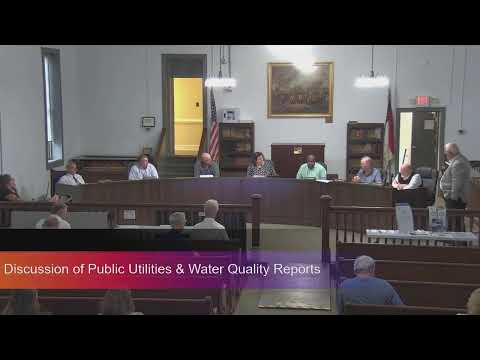
Gates County Board of Commissioners met in a Sept. 17 special session to hear technical briefings on elevated fluoride in the county’s public-water wells and to consider next steps including pilot reverse-osmosis testing, additional wells and a policy decision on an acceptable fluoride level in finished water.
Gates County Board of Commissioners met in a Sept. 17 special session to hear technical briefings on elevated fluoride in the county’s public-water wells and to consider next steps including pilot testing, additional wells and a policy target for acceptable fluoride in finished drinking water.
County Manager Rodney Sauer said the meeting was called so the public and commissioners could be briefed on “what was happening with the water system, with the fluoride issues.” He framed the immediate question for the board as “how protective of public health does this board want to be?”
Groundwater specialist Richard Spruill of GMA told commissioners the elevated fluoride in the county’s wells is naturally occurring and linked to weathering of fluoride-bearing minerals eroded from the Piedmont and redeposited in Coastal Plain sediments. “The fluorine here is naturally occurring. It’s not related to any industrial activity,” Spruill said. He walked the board through coastal-plain geology, aquifer names (Yorktown, Castle Hayne, Black Creek, Cape Fear units) and how confined aquifers and pumping change water chemistry.
Spruill and county staff reviewed recent well construction and testing results for the system’s three public wells. Well construction details cited at the presentation included screen depths reported near 146 feet, 224 feet and 300 feet in parts of Well 1A. Laboratory readings from the wells and individual screened zones showed fluoride concentrations well above public-health guidance in some zones: the water system’s blended average over recent months was reported at about 2.57 mg/L. Spruill said some upper-zone readings were initially under 0.7 mg/L but rose after pumping and development; readings in portions of the system and in deeper zones have reached about 3.2 mg/L in individual samples.
Those numbers exceed the U.S. Environmental Protection Agency’s 4.0 mg/L statutory maximum contaminant level (MCL) and are above the 0.7 mg/L concentration now recommended by public-health authorities as the optimal fluoridation level for preventing tooth decay. County staff and consultants noted North Carolina’s regional public-health office and the county’s Water System must weigh which finished-water target to design to — consultants recommended designing conservatively so treated water stays below the board’s target even when raw feed concentrations vary.
Options discussed
- Search for larger, lower-fluoride raw sources farther from the saltwater interface: Spruill recommended looking west/northwest from the existing well field and spacing production wells roughly 4,000 feet apart to limit well interference and avoid saltwater intrusion. He said test wells about 8,000–12,000 feet from the current field would be appropriate to evaluate supply. County staff noted two additional production wells are already budgeted through prior state funding.
- Advanced treatment (membrane filtration/reverse osmosis): consultants explained membrane trains and the need for pilot testing to size equipment and estimate concentrate (waste) flow. A pilot unit currently in Chowan County is scheduled to move to Halifax and then to Gates County; consultant materials named pilot timing as late summer/early winter depending on availability. Consultants said reverse osmosis (RO) systems recover a portion of feed water and produce a concentrated waste stream that requires permitted discharge.
- Disposal/permitting constraints: staff and consultants explained the concentrate (RO reject/backwash) would require an NPDES permit and a site with sufficient dilution capacity. The team recommended modeling (mixing / core‑mix modeling) and field tidal measurements on the chosen receiving water (the consultants cited the Chowan River as the likely receiving body) to demonstrate that the concentrate can be discharged without adverse environmental impact.
- Funding and schedule: staff outlined likely funding avenues — state revolving fund (SRF) loans and grants, possible federal STAG grants, and special state appropriations — and said an engineering report and pilot results would be required before construction-level design.
Board action and direction
Commissioners discussed which finished-water fluoride target the county should set and design for. One commissioner moved a target of 1.0 mg/L; that motion was later withdrawn and the board did not vote on a single numeric target at the meeting. Commissioners agreed to continue technical work and aim to make a policy decision at an October meeting after receiving pilot results and additional regulatory input. County staff were directed to proceed with pilot testing preparations, additional sampling of the well field, and continuation of the engineering work needed to scope permitting, treatment sizing and funding applications.
Ending
Consultants and staff left the board with a clear set of next steps: pilot membrane testing in Gates County when the unit becomes available; expanded lab analysis of wells and blends; engineering work to size treatment trains and to evaluate concentrate discharge options (including NPDES modeling); and detailed cost estimates tied to different finished‑water targets. The board agreed to revisit and set a final fluoride policy goal at a future meeting (commissioners said they would target October).