Get Full Government Meeting Transcripts, Videos, & Alerts Forever!
Get email alerts on the Child Nutrition topic
No spam. Unsubscribe anytime.
Senate Health Committee advances AB 1264 to define and phase out certain ultra‑processed foods in California schools
Summary
The Senate Committee on Health voted 10-0 to pass AB 1264, a bill that defines "ultra‑processed foods" (UPFs) for school meals, directs state agencies to identify UPFs of concern and phases out those items from school food service by 2032, while stakeholders raised technical and implementation concerns.
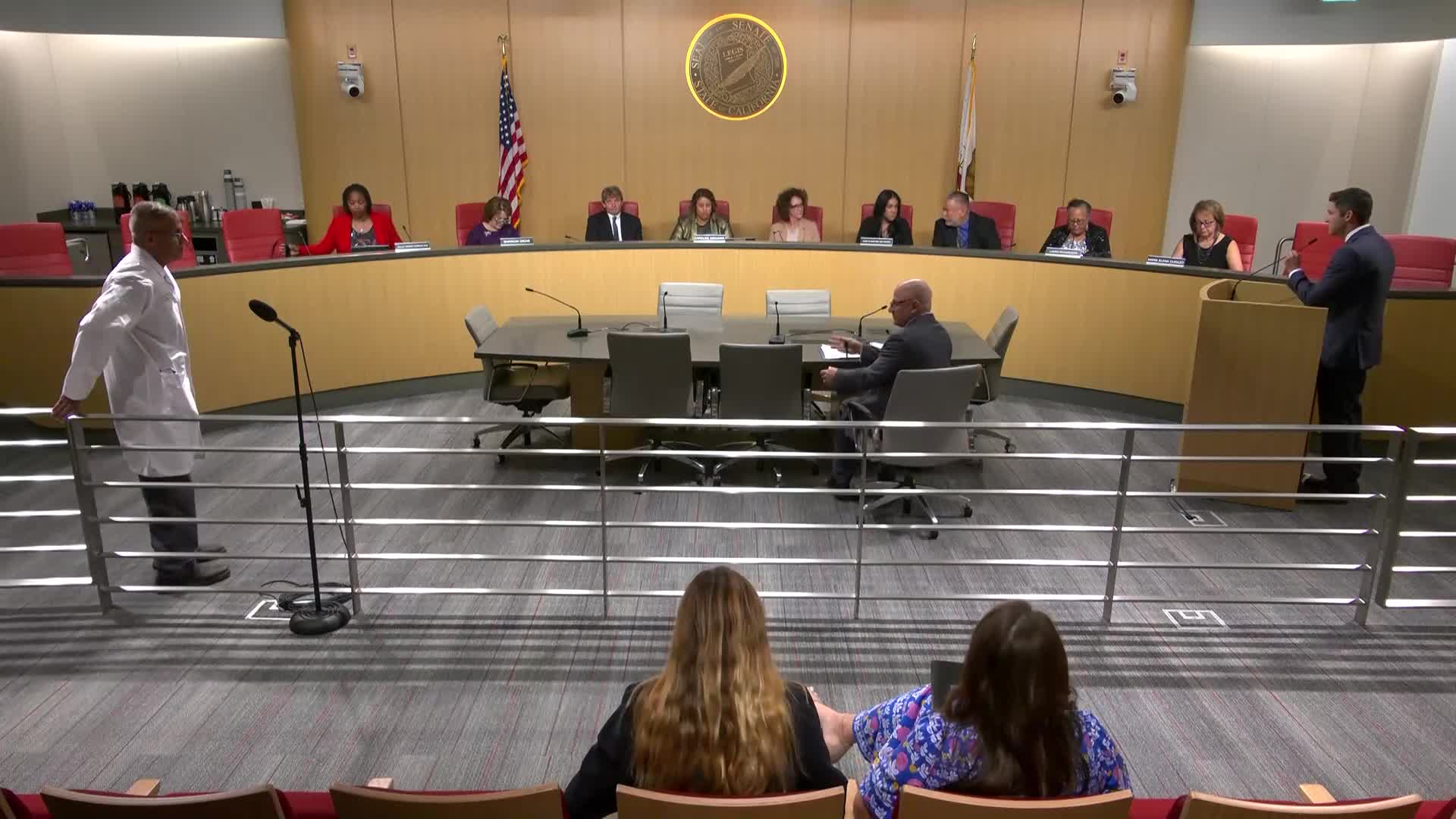
The Senate Committee on Health voted 10-0 to move AB 1264 out of committee after a hearing where the bill’s author and health and child‑nutrition advocates described the measure as a science‑based, phased approach to remove the most harmful ultra‑processed foods from school meals.
The bill’s author, Assemblymember Gabriel, told the committee the proposal has been amended more than 50 times to address stakeholder concerns and asked for the committee’s “I” vote. Supporters including the Environmental Working Group and the American Academy of Pediatrics urged approval, while food‑industry groups and agricultural representatives sought further refinements to the definition and exemptions.
AB 1264 would create a statutory definition of “ultra‑processed foods” (UPFs) in the Health and Safety Code and direct the California Department of Public Health (CDPH), working with the California Department of Education (CDE), the California Department of Food and Agriculture (CDFA) and stakeholders, to identify which UPFs are of concern for school food service. CDPH would consider whether a food is linked to serious health harms and whether it is identified as healthy by the U.S. Food and Drug Administration when compiling the list. The bill sets a compliance timeline under which vendors would be given until 2032 to phase out UPFs identified as concerning.
Supporters framed the bill as a measured, health‑focused intervention. Scott Faber of the Environmental Working Group said, “AB 1264 does not ban UPFs. AB 1264 simply defines UPFs and makes clear that foods that are raw agricultural products, unprocessed local foods, minimally processed foods like canned beans and vegetables, and pasteurized milk are not UPFs.”
Dr. Ravindra Khera, a pediatrician appearing for the American Academy of Pediatrics, testified on health impacts: “As pediatricians, we don't just see numbers, we see kids. We see how diet shapes their health, their behavior, their futures…Ultra‑processed foods are fueling a surge in chronic conditions among children.” He cited studies he said showed elevated cardiovascular risk and told the committee that UPFs appear frequently in school cafeterias.
Opponents and neutrals raised technical and implementation issues. Erin Radin of the Consumer Brands Association said the bill’s nutrient‑based elements—particularly a sodium‑to‑calorie ratio used in the UPF definition—are “problematic,” risk penalizing low‑calorie foods and do not align with U.S. Department of Agriculture school meal standards. Industry groups also flagged the bill’s treatment of non‑nutritive sweeteners, packaging gases and fortified or cultural foods as areas needing clearer treatment. A coalition representing agricultural and food producers said it had moved from opposition to neutral on some items but remained concerned about other provisions.
Committee members acknowledged the complexity. Several senators commended the author for negotiating numerous amendments and said the measure had been narrowed to focus explicitly on foods served in schools. Senator Richardson asked whether costs to schools could increase; the author and witnesses said some districts that have shifted to less processed or locally sourced options reported cost savings, and the committee noted the department’s forthcoming regulatory process and stakeholder input would shape implementation.
The motion before the committee was to do pass AB 1264. The vice chair, Senator Valadares, moved the motion. The committee roll call recorded aye votes and the bill advanced out of committee by a 10‑0 vote.
What happens next
With committee approval, AB 1264 proceeds to the Senate floor for consideration. If enacted, CDPH would develop regulations and lists of UPFs of concern through a rulemaking process that includes stakeholder input, as described in the bill text and discussed in the hearing.
Votes at a glance
• AB 1264 — Motion: do pass (moved by Vice Chair Senator Valadares). Committee outcome: passed 10‑0. (Vote recorded as 10 yes, 0 no.)
(For evidence, see the transcript excerpts below showing the bill presentation, witness testimony, and the roll call.)