Get Full Government Meeting Transcripts, Videos, & Alerts Forever!
Get email alerts on the Stormwater Management topic
No spam. Unsubscribe anytime.
Sarasota commissioners endorse Option A, direct staff to prioritize stormwater maintenance and dredging
Summary
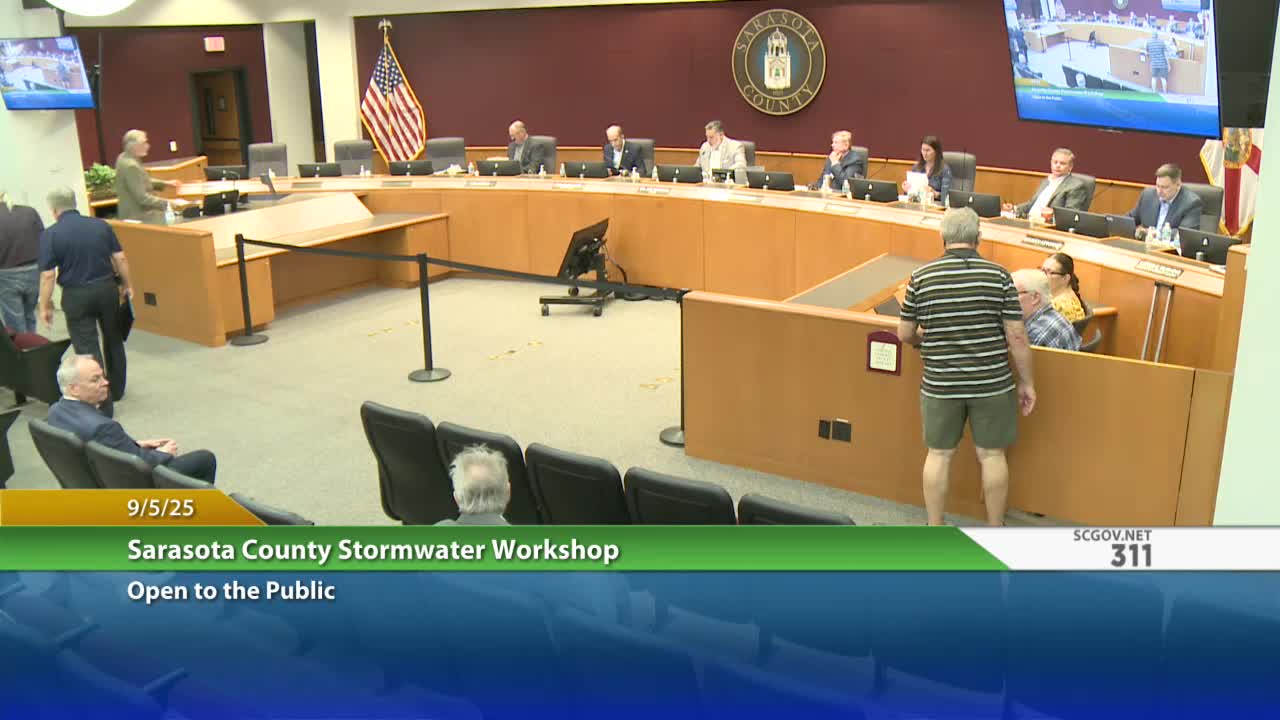
After public testimony and a consultant review, the Sarasota County Commission voted unanimously on Sept. 5 to publish and advance “Option A” for the upcoming rate hearing, and directed staff to prioritize maintenance, dredging permits and a sediment-management program while staff refines project benefits and funding options.
Sarasota County commissioners voted unanimously Sept. 5 to advance “Option A” on the county’s proposed stormwater rates and directed county staff to accelerate maintenance, finalize permitting for Phillippi Creek dredging and produce a prioritized sediment-management plan before asking residents for a rate increase.
The decision came after several hours of public comment — much of it from residents whose homes flooded in 2024 — and presentations by newly appointed stormwater director Ben Quartermaine and consultant Steve Sua. Quartermaine told the commission he will focus on transparency and data-sharing, and Sua urged clearer separation in county code between stormwater (drainage and flood conveyance) and navigational waterways (boating access).
Quartermaine, the county’s new stormwater director, said the department has created an interactive public map that will link work orders and completed maintenance so residents can see where and when work is performed. "Transparency. I believe that the more data that I can share, that we can share to the public, the better off we all are," Quartermaine said during the presentation.
Why it matters: Residents and community groups told commissioners the county’s maintenance shortfalls contributed to repeated flood damage. Multiple commenters asked the board not to raise assessments until the new department completes a prioritized list of maintenance, dredging and capital projects and until independent financial questions are answered. At the meeting’s end, the board approved moving forward with Option A — the document set staff recommended for the Oct. 10 public hearing — rather than adopting the larger rate proposal now.
What commissioners and staff said
Steve Sua, the consultant who reviewed the county’s stormwater program and projects, told the board the county’s two ordinances are distinct in purpose and funding and should remain separate. "If you read those ordinances in their entirety, it is pretty clear that they are completely separate different programs," Sua said, explaining that the stormwater utility is an enterprise funded by a non-ad valorem assessment for drainage and flood conveyance while the navigational waterways program funds boat navigation work.
Sua’s audit also found many listed capital projects lack quantifiable, project-level benefit analyses showing direct flood-reduction or water-quality gains. Commissioners and staff said the absence of consistent cost–benefit information makes it difficult to prioritize projects or justify a rate increase right now.
Public testimony and community demands
More than a dozen residents, neighborhood associations and advocacy groups urged the board to prioritize maintenance and dredging over any immediate assessment increase. John Thaxon of the Gulf Coast Community Foundation provided historical context for the two programs and emphasized the need to maintain level-of-service standards adopted in the county comprehensive plan.
Community representatives reiterated three consistent requests: - Prioritize routine maintenance (dredging, vegetation control, clearing roadside ditches) before new capital spending. - Require third-party financial review and full transparency of stormwater fund allocations (several speakers referenced an apparent $15.7 million fund balance and varying public reports about available funds). - Produce a clear, basin-by-basin plan for sediment management and maintenance scheduling rather than episodic dredging every decade.
Seth Johnson told the board the stormwater program "already collects about $30,000,000 a year," and said audit findings and federal funding should be used first rather than raising assessments now. He noted the county also has received federal and other resilience funding for projects; during public comment Johnson said the county had received about $200,000,000 in HUD funding and had dedicated roughly $75,000,000 toward Phillippi Creek projects.
Dredging and Phillippi Creek permits
Staff briefed the board on near-term dredging work in Phillippi Creek. Quartermaine said Phase 1 targets 11 high-spot locations amounting to roughly 65,000 cubic yards of material — about 6,500 standard 10-cubic-yard dump-truck loads — and that contractor bids were recently received. Quartermaine told commissioners the county filed an FDEP exemption last week to verify Phillippi Creek was man-modified and to speed the state and Corps of Engineers permitting process. He said the Corps needs an FDEP response to issue a Corps permit; staff described the permitting status as “close” but still pending.
Quartermaine described Phase 2 as a full dredge template from U.S. 41 to Beneva Road that uses a 50-foot-wide by 4-foot-deep template to test hydraulic impacts on the floodplain and to measure whether additional dredging would lower flood elevations. Funding for Phase 2 is expected from Resilient SRQ and related resilience funds, with availability estimated late this year.
Decisions, directions and next steps
The board’s formal action at the meeting was a unanimous vote to advance Option A into the published materials for the Oct. 10 public hearing on stormwater rates. Commissioner Cutsinger moved the motion; Commissioner Mass seconded it. The chair cast the final affirmative vote. The motion passed unanimously.
Commissioners also gave staff several clear directions: prioritize maintenance, finalize permitting and contracting for Phase 1 Phillippi Creek dredging, create and publish a sediment-management prioritization and a basin-level project list, link public work-order data to the interactive map, and return quarterly with updates (or sooner when key permitting milestones occur). Sua and Quartermaine both encouraged rebuilding internal engineering capacity to oversee consultants and to ensure consistent cost–benefit analysis of proposed capital projects.
Voices from the meeting
"Maintaining these level of service standards are critical in the board's ability to defend the utility legally and to provide, measurable support for your customers," said John Thaxon of the Gulf Coast Community Foundation during public comment.
"Raising assessments now without oversight and transparency and without a shift in policy will only add to the residents' burden," said Seth Johnson, a Phillippi Creek Coalition participant.
"Transparency. I believe that the more data that I can share, that we can share to the public, the better off we all are," Quartermaine said when describing the department’s new public-facing map and data tools.
What’s next
Staff will return with a sediment-management program and a prioritized project list and will provide quarterly status updates to the board; staff also expects to present a permit agreement related to dredging prior to upcoming permit issuance. The board will hold the advertised rate hearing Oct. 10; commissioners indicated they will not vote to raise rates before the department completes prioritization and benefit analyses.