Get Full Government Meeting Transcripts, Videos, & Alerts Forever!
Get email alerts on the Capital Planning Procurement topic
No spam. Unsubscribe anytime.
Charlotte County moves to standardize project delivery: procurement thresholds, governance and enterprise project software on agenda
Summary
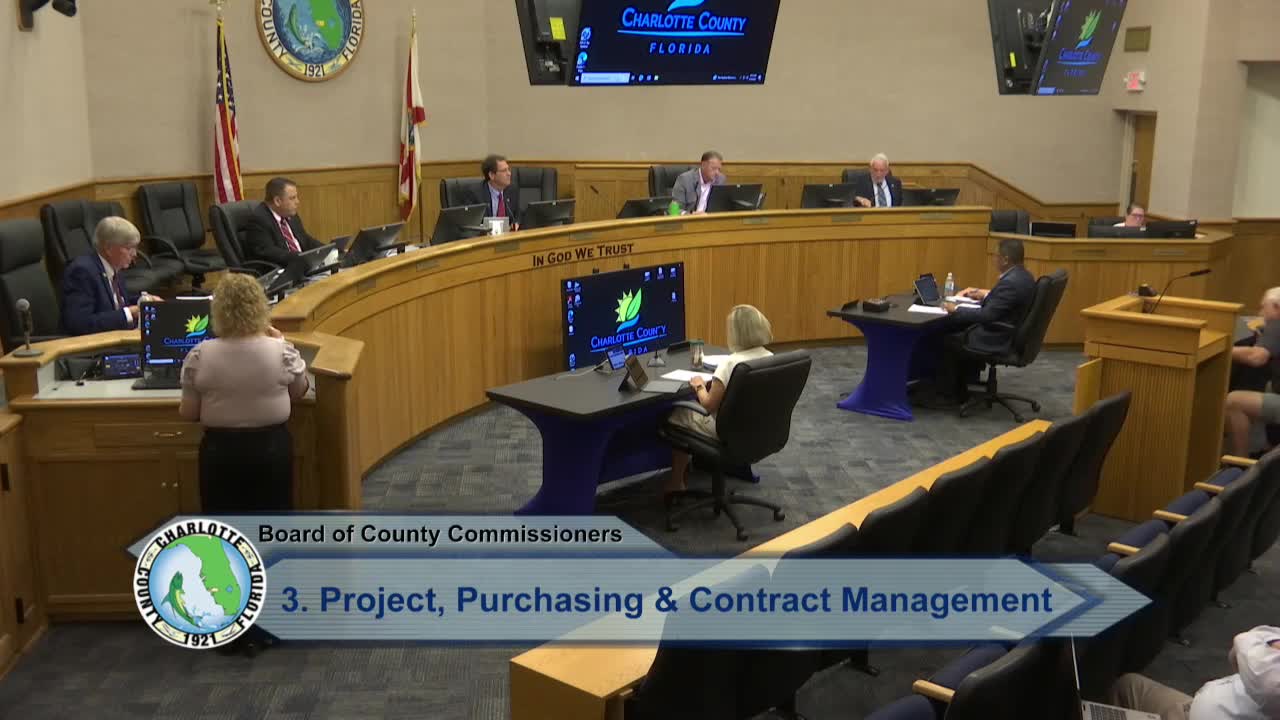
County staff told the Board of County Commissioners Sept. 16 they will standardize project delivery by strengthening governance, clarifying procurement/delivery methods on CIP materials, hiring recovery/resiliency project managers, and implementing enterprise project‑management software next year.
Charlotte County staff used the Sept. 16 workshop to present a comprehensive review of the county’s capital planning, purchasing and project‑delivery practices and to outline near‑term steps to standardize project governance, hire recovery/resiliency project managers, and implement enterprise project‑management software.
Claire Jubb, Assistant County Administrator, and Francine Lidsby, Assistant Budget Director, said the county’s 20‑year capital needs assessment shows major long‑term demand: non‑utility capital needs in the six‑year CIP window total more than $1 billion and nearly $3.75 billion over 20 years; combined county capital needs across utilities and non‑utilities exceed $6 billion over 20 years. Lidsby said the FY26 capital portfolio includes 248 active projects totaling about $889 million in the coming year.
Procurement and purchasing: Kim Corbett, Senior Division Manager for Purchasing, summarized procurement staffing and timelines and noted two new purchasing positions approved in July to keep up with workload. Corbett provided average processing times from request-to‑approval: RFPs about 130 calendar days, formal bids about 85 days and requests‑for‑quote about 40 days; she also described departmental approval limits (department discretion up to $10,000, purchasing oversight $10,000–$50,000, administration review above those thresholds). Corbett said the county’s professional services prequalification library (used for consultant selection) expires Dec. 31, 2025 and staff will reissue a newer prequalification with a shorter term (three years plus renewals).
Project governance and project managers: Jubb described a countywide project governance framework adopted in recent years that defines roles (board, administration, department project sponsor, project manager and project team), change‑management and risk‑management steps and an expectation of consistent SOPs across departments. She said there are about 43 project managers or coordinators countywide plus roughly 30 additional staff directly assigned to projects and that the county recently authorized three new project‑manager hires for hurricane recovery work. Commissioners asked for a standard that records a recommended procurement/delivery method (for example CMAR, design‑bid‑build, design‑build) on CIP sheets so the board sees the delivery approach early in the project cycle.
Recovery and resiliency roles: Patrick Fuller, Emergency Manager, described four recovery and resiliency project‑manager positions reclassified and assigned to community services, facilities, public works and utilities to serve as department points of contact for disaster recovery and resiliency projects. Fuller said those project managers will help coordinate damage‑assessment procedures, work with FEMA public‑assistance processes and tie capital projects into mitigation funding where applicable. He noted the group has produced a “damage assessment roadmap” and held an initial training session.
Enterprise project‑management software and communications: IT and communications staff said departments currently manage projects using spreadsheets, shared drives and email and lack a single enterprise project portfolio tool. Sandra Gaugh (IT) said the county plans to implement an enterprise project‑management system next year to centralize project data, standardize workflows, attach supporting documents to capital estimates and improve cross‑department visibility. Brian Gleeson (Communications Director) outlined planned improvements to the county’s project‑status pages, regular two‑week update cadence and a proposal to add on‑site signage and QR codes so passersby can quickly access status information.
Board concerns and next steps: Commissioners supported tightening early procurement and delivery‑method decisions in the CIP, asked for clearer thresholds for when procurement actions come back to the board rather than being authorized for chairman signature (staff proposed a “not‑to‑exceed advertised budget” guardrail), and urged more formal qualifications and continuing training for project managers. Staff agreed to return with proposed CIP sheet language showing recommended delivery methods, to refine the professional‑services library procurement terms, and to present options for a project‑management software procurement and a clearer approach for chairman signature authorization on negotiated contracts.