Get Full Government Meeting Transcripts, Videos, & Alerts Forever!
Get email alerts on the Infrastructure Waterways topic
No spam. Unsubscribe anytime.
Commissioners pause parallel-lock construction after manatee concerns, endorse tender‑house and lock rehabilitation work
Summary
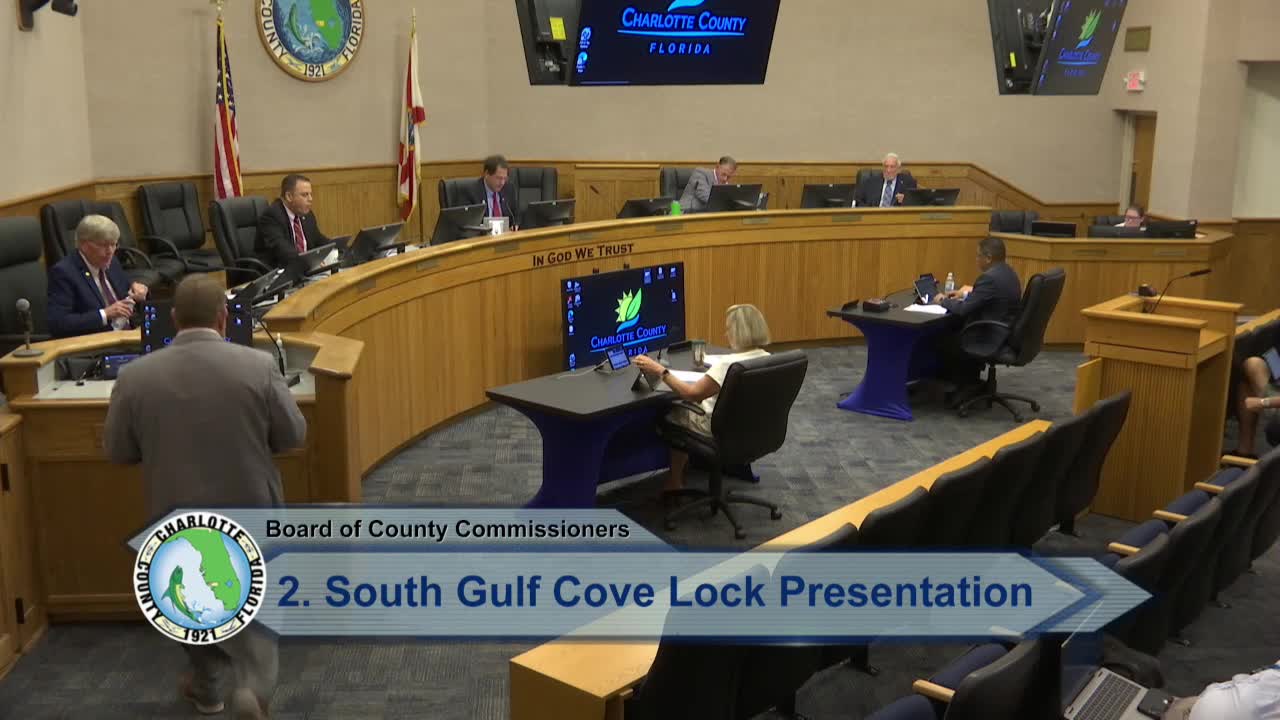
After staff outlined engineering, permitting, usage and rate impacts for the South Gulf Cove lock project, commissioners directed staff to suspend advancing the parallel‑lock through permitting and to proceed with constructing a tender house using a $6.1 million state appropriation and to modernize the existing lock to extend its useful life.
Public Works Director John Elias told the board the county faces a permitting impasse for a proposed second (parallel) lock at South Gulf Cove, and recommended the board pause the parallel-lock permitting while advancing construction of an adjacent tender house that state funds would help pay for.
Elias described the lock’s operational history and usage: “In FY '24, we had 17,429 boats traverse through the lock, and in FY '25 to date, we've had 12,681,” he said, and summarized routine operating hours and maintenance needs. He said power supply issues and aging infrastructure have driven recurring repairs and contracted service calls.
Funding and rate impacts: Elias presented a cost‑allocation model for the special‑assessment district that funds lock work. Using an equivalent residential unit (ERU) methodology, staff showed waterfront (“wet”) ERUs at about 5,319 and dry lots about 9,869; the current rate shown was $50 per wet ERU and $25 per dry ERU. Elias explained one scenario that included constructing a parallel lock and on‑site tender house with borrowing would raise the assessment to about $200 per wet lot and $100 per dry lot while borrowing is in place (tentatively FY ’28–FY ’39), with rates projected to drop after the loan payoff. The presentation also noted a $6.1 million state appropriation the county has for the tender house.
Permitting and environmental constraints: Elias warned of a key permitting obstacle. He said the U.S. Army Corps of Engineers consulted the U.S. Fish and Wildlife Service, which concluded the proposed parallel-lock expansion “may result in incidental take of manatees” and that the agency could not authorize that incidental take under current law. Elias said without the service’s support the standard permitting process is unlikely to result in an approved permit for the parallel lock.
Advisory input and board direction: Elias reported advisory‑board straw polling of South Gulf Cove stakeholders: a five‑zero preference to abandon the parallel-lock plan and a five‑zero preference to modernize and harden the existing lock; a five‑zero preference to build the tender house using state funds; and mixed views on relocating a lock to the southern lagoon entrance. After discussion, multiple commissioners including Truax, Deutsch and Doherty favored suspending the parallel-lock permitting and proceeding with the tender house design and construction while planning capital maintenance to rehabilitate the existing lock to avoid long outages. Commissioners highlighted the need to continue site‑level design, pursue the tender‑house project funded by the state appropriation, and modernize the existing lock to extend its useful life.
Operational urgency: Elias emphasized capital maintenance is imminent. He told the board the existing lock will require a rehabilitation project that could render the lock inaccessible for “6 to 8 months or possibly longer,” and that building a tender house and taking planned steps to harden the existing lock were ways to reduce operational risk.
Next steps: Staff will continue detailed design work on the tender house using the state grant, evaluate rehabilitation work for the existing lock to limit closure time, and refrain from advancing parallel‑lock permitting until environmental concerns—particularly manatee incidental‑take authorization—can be addressed. The board did not adopt a new assessment or vote on rates at the workshop; commissioners asked staff to return with more refined designs, cost estimates and permitting analyses.